Situation Summary
France remains a moderate-risk environment (global rank #36, composite threat score 37.7) with persistent terrorism and civil-unrest vectors offsetting otherwise stable governance. The security posture is actively hardening: France is expanding elite counter-terrorism and tactical-response capacity nationwide, signaling official assessment that rapid-response capability gaps exist. Concurrent geopolitical tensions (statements vs. Israel, UK, Lebanon, Russia, and Washington over the past 72 hours) and sustained overseas military commitments are shaping the threat environment and force allocation. Demonstrations and strikes continue to disrupt transport and commercial activity in major urban centers, compounding traveler and asset-security risk.
Key Developments
- Nationwide (interior security reinforcement, 2026-06-02) – France's interior ministry announced expansion of elite gendarmerie (GIGN) and national police (RAID) units with explicit goal of sub-20-minute tactical response times across metropolitan and overseas territories, indicating official prioritization of terrorism and armed-violence preparedness.
- Île-de-France (counter-terror capacity expansion, 2026-06-02) – The Paris-based BRI unit, which led the 2015 Bataclan response, will be doubled in size to handle complex armed-violence and hostage scenarios in the capital and surrounding region.
- Northern France & overseas (elite unit deployment, 2026-06-02) – RAID branches opening in Toulouse, Melun, and Noisy-le-Sec; four new GIGN branches in non-metropolitan territories (New Caledonia, Mayotte) signal concern over rapid-response gaps in dispersed regions.
- Nationwide (U.S. travel advisory reaffirmation, current) – U.S. State Department maintains France at Level 2 (Exercise Increased Caution), citing terrorism and civil-unrest risk; notes French authorities conducting regular security drills near major tourist sites and transport hubs, causing intermittent disruptions.
- Nationwide (strike and protest frequency, current) – Demonstrations and strikes occur regularly in Paris, Marseille, Lyon, and other major cities, sometimes turning violent and causing significant transport/infrastructure disruption.
- Eastern Mediterranean (force projection, 2026-06-02) – President Macron stated French forces aboard carrier *Charles de Gaulle* are on defensive mission protecting nationals and may support Strait of Hormuz escort operations, affecting domestic force availability.
- Multi-lateral tensions (2026-06-01 to 2026-06-03) – France issued threats toward Israel and UK, rejections toward Spain and international counsel, and disapprovals toward Lebanon and Washington; geopolitical friction may influence domestic security posture and civil-unrest risk.
Highest-Risk Areas
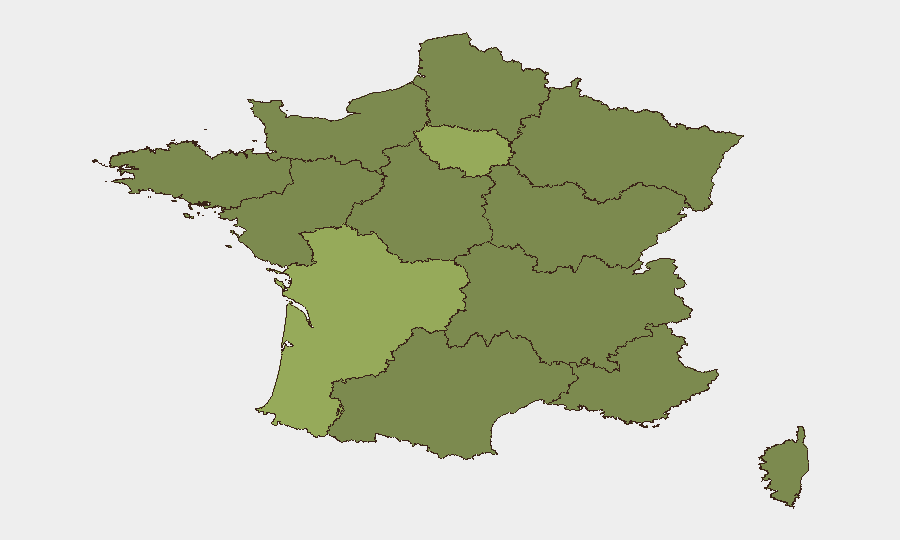
Nouvelle-Aquitaine (risk 56.4) and Île-de-France (42.8) dominate France's sub-national risk landscape. Nouvelle-Aquitaine's elevated score reflects a combination of protest activity, socioeconomic grievances, and dispersed population density; Île-de-France's risk is driven by terrorism vectors, mass-gathering venues, critical infrastructure concentration, and political activity. Normandy (35.3) ranks third, likely reflecting port and cross-Channel security concerns. The remaining nine regions cluster between 26.4 and 29.5, indicating relatively uniform baseline risk across provincial France, with pockets of specific concern (PACA for Mediterranean/migrant-related tensions, Hauts-de-France for border security).
How GeoBit Would Assist
Teams with personnel or assets in France should deploy AOI (Area-of-Interest) monitoring with alerting on Nouvelle-Aquitaine and Île-de-France to track protest escalation and terrorism indicators in real time. OSINT fusion and sentiment analysis across French media, social platforms, and Telegram channels would provide early warning of strike timing and route disruption. Network and actor analysis coupled with conflict and regime-stability search would contextualize geopolitical statement patterns and assess spillover risk to domestic civil unrest.
7-Day Outlook
Expansion of elite tactical units will reduce response times but may increase visible security presence and perceived threat salience in major cities, potentially amplifying protest-attendance risk. Demonstrated French government prioritization of counter-terrorism infrastructure suggests official assessment of non-trivial terrorism probability. No major catalytic events are imminent, but cumulative geopolitical friction and routine strike activity make transport delays and localized disruptions highly probable in urban centers through mid-June.
Highest-Risk Areas — Ranked
| # | State / Region | Risk |
|---|---|---|
| 1 | Nouvelle-Aquitaine | 56.4 |
| 2 | Ile-de-France | 42.8 |
| 3 | Normandy | 35.3 |
| 4 | Provence-Alpes-Côte d'Azur | 29.5 |
| 5 | Hauts-de-France | 26.8 |
| 6 | Brittany | 26.6 |
| 7 | Grand Est | 26.6 |
| 8 | Occitania | 26.5 |
| 9 | Centre-Val de Loire | 26.4 |
| 10 | Pays de la Loire | 26.4 |
| 11 | Bourgogne – Franche-Comté | 26.4 |
| 12 | Auvergne-Rhône-Alpes | 26.4 |