Situation Summary
Guinea remains under military rule following the 2021 coup, with governance characterized by restricted civil liberties, a de facto protest ban, and delayed democratic transition timelines. Political uncertainty is compounded by the junta's dissolution of opposition parties, documented enforced disappearances, and a pattern of lethal crowd-control responses to unauthorized gatherings. The security environment is structurally volatile, with baseline risk concentrated in the capital and eastern border regions, though the trajectory depends heavily on whether contested election timelines are met or further delayed.
Key Developments
- Conakry – Government dissolution and transition delays: Col. Mamady Doumbouya's February dissolution remains in effect; Mamadou Oury Bah continues as PM as elections are pushed to 2025, prolonging political uncertainty and institutional instability in the capital.
- Nationwide – Lethal protest suppression: At least 59 deaths nationwide since the May 2022 protest ban; eight confirmed killed in Conakry since January 2026, including three children, during crackdowns on unauthorized demonstrations—indicating elevated civil-unrest risk and forceful security posture.
- Conakry – Media environment deterioration: Security forces surrounded the independent House of the Press on January 18, detaining nine journalists ahead of a media protest, signaling hostile conditions for press freedom and elevated risk around media or opposition activity.
- Nationwide – Systematic political repression: October dissolution of 107 political parties and placement of 67 others under observation, combined with ongoing protest ban, has severely curtailed political space and increased likelihood of forceful response to any unauthorized gathering.
- Conakry and border areas – Enforced disappearances: Opposition activists Oumar Sylla and Mamadou Billo Bah forcibly disappeared in July 2024 and remain missing; arbitrary detention used routinely to silence dissent, indicating elevated personal-security risk for activists and opposition figures.
- Conakry and Nzérékoré corridor – High-profile security operations: Arrest and transfer of co-convict Claude Pivi near the Liberian border (September 2024) following landmark crimes-against-humanity convictions illustrates continued security operations and potential flashpoints among supporters in border regions.
- Structural governance constraint: Freedom House 2024 assessment rates Guinea "Not Free" under military junta rule, with significant restrictions on civil and political rights establishing a baseline of elevated instability nationwide.
Highest-Risk Areas
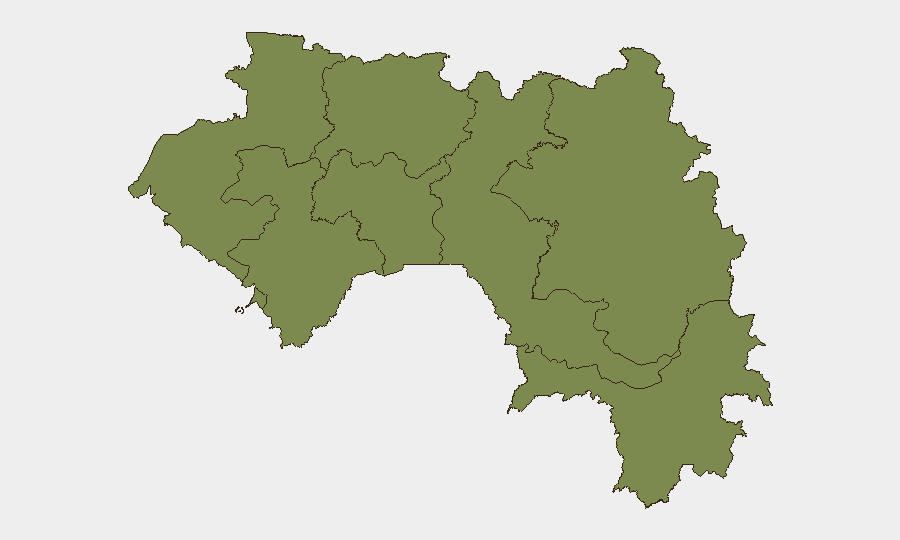
Kankan Region dominates the sub-national risk profile (35.7) and requires primary focus; its elevation likely reflects a combination of border instability, trafficking corridors, and limited state control. Conakry (7.9) remains the second-highest-risk location due to concentration of political institutions, security-force activity, protest events, and detention facilities. The remaining regions cluster at 5.7, indicating more diffuse but sustained risk; Nzérékoré's inclusion reflects its proximity to Liberia and relevance to cross-border enforcement operations documented above. Security teams should prioritize Kankan and Conakry for operational planning.
How GeoBit Would Assist
Teams with personnel or assets in Guinea should employ AOI Monitoring & Early Warning to track political gatherings, security-force movements, and protest activity in Conakry and Kankan. Multi-language OSINT feeds, X/Telegram monitoring, and sentiment analysis would provide early signals of unrest escalation or enforcement operations before they materialize. Routing & Network Analysis supports contingency planning for staff evacuation or asset repositioning should conditions deteriorate near Conakry or border regions.
7-Day Outlook
No imminent large-scale security event is signaled; however, cumulative political pressure—delayed elections, constrained civil space, and documented use of lethal force—sustains a high baseline of unpredictability. Any unauthorized opposition gathering, media activity, or border-enforcement operation carries elevated risk of violent security response. Monitoring for official election-timeline announcements and opposition activity in the next 7 days is warranted.
Highest-Risk Areas — Ranked
| # | State / Region | Risk |
|---|---|---|
| 1 | Kankan Region | 35.7 |
| 2 | Conakry | 7.9 |
| 3 | Boké Region | 5.7 |
| 4 | Labé Region | 5.7 |
| 5 | Kindia Region | 5.7 |
| 6 | Mamou Region | 5.7 |
| 7 | Faranah Region | 5.7 |
| 8 | Nzérékoré Region | 5.7 |