Situation Summary
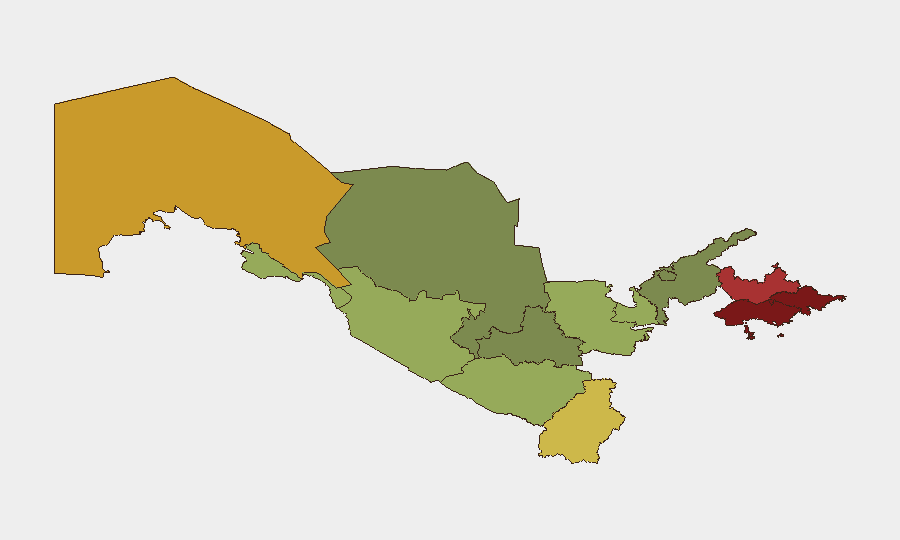
Uzbekistan remains a low-threat operating environment (global rank #162, composite score 2) with no major security incidents, mass unrest, or acute disruptions reported in the last 24 hours. The security landscape is defined by persistent structural risks—terrorism cannot be ruled out against Western interests, petty crime affects major urban centers, and political repression remains a baseline governance reality—rather than by acute events or crises. The threat trajectory is stable but uneven: risk concentrates sharply in the Fergana Valley and southern border regions, while Tashkent and western regions remain comparatively lower-risk for corporate operations.
Key Developments
- Afghanistan border corridor (Surxondaryo Region): Multiple government advisories maintain 5 km exclusion zones along the southern border due to ongoing cross-border terrorism risk and prior ISKP rocket fire into Uzbekistan (2022); no new incidents reported in past 24 hours but risk remains structurally high.
- Tashkent urban crime: Pickpocketing, bag-snatching, and residential burglaries continue at low-to-moderate frequency in bazaars, public transport, and crowded commercial areas; risk remains manageable with situational awareness but warrants baseline precautions for expatriate staff.
- Terrorism risk to foreign interests: UK and US travel advisories reiterate that indiscriminate terrorist attacks targeting Western facilities or locations frequented by foreigners cannot be ruled out across major cities; no specific credible plots reported in current window.
- Online political repression: Freedom House's 2024 assessment confirms persistent arbitrary arrests, intimidation, and surveillance of individuals critical of government on social media; poses secondary risk to journalists, activists, and politically engaged travelers.
- Infrastructure and transport safety: Poor road conditions, limited lighting, erratic driving standards, and widespread use of poorly-maintained compressed natural-gas vehicles present non-negligible travel safety risks outside major urban centers; limited banking infrastructure outside Tashkent and regional hubs.
- Rare but volatile protest dynamics: Demonstrations remain infrequent but have historically escalated rapidly with heavy police response, mass arrests, and fatalities; foreign nationals are advised to avoid any public assemblies or gatherings.
- Green-energy infrastructure development: Uzbekistan has signed agreements for major renewable-energy projects (100-MW storage system in Tashkent); reflects medium-term grid-stability efforts but does not alter acute security posture.
Highest-Risk Areas
The Fergana Valley corridor—comprising Andijan (risk 88), Fergana (82), and Namangan (78) regions—concentrates the highest sub-national threat scores and represents the primary terrorism, cross-border smuggling, and intercommunal friction risk zone in Uzbekistan. Karakalpakstan (72) and southern border regions including Surxondaryo (65) present secondary high-risk corridors driven by Afghan border proximity and historical ISKP activity. Risk degrades significantly westward and northward; Tashkent, Samarqand, and Navoiy regions fall into the 35–42 range. Corporate operations in Tashkent and major western/northern cities face manageable, baseline risk; field activities in the Fergana Valley or within 5 km of the Afghan border require enhanced vetting, liaison protocols, and contingency planning.
How GeoBit Would Assist
Security teams would leverage Intel Sweep and multi-language OSINT fusion to monitor Telegram channels, local media, and cross-border reporting for early signals of ISKP activity or border incidents in southern regions. AOI Monitoring & Early Warning with persistent watch on Fergana Valley and Afghan border zones would trigger alerts on unusual security-force movements, protests, or cross-border fire. Routing & Network Analysis would enable alternative journey planning for staff transiting high-risk regions and inform real-time exposure assessments.
7-Day Outlook
No escalation or major incidents are anticipated in the next seven days. Risk remains steady-state: structural terrorism, crime, and political-repression factors will persist, but acute security disruptions are unlikely absent external shocks (e.g., major cross-border incident from Afghanistan). Routine security postures and baseline precautions remain appropriate for Tashkent and western regions; Fergana Valley and border areas warrant elevated protocols.
Highest-Risk Areas — Ranked
| # | State / Region | Risk |
|---|---|---|
| 1 | Andijan Region | 88 |
| 2 | Fergana Region | 82 |
| 3 | Namangan Region | 78 |
| 4 | Republic of Karakalpakstan | 72 |
| 5 | Surxondaryo Region | 65 |
| 6 | Qashqadaryo Region | 58 |
| 7 | Sirdaryo Region | 55 |
| 8 | Jizzakh Region | 48 |
| 9 | Xorazm Region | 45 |
| 10 | Bukhara Region | 42 |
| 11 | Navoiy Region | 38 |
| 12 | Samarqand Region | 35 |