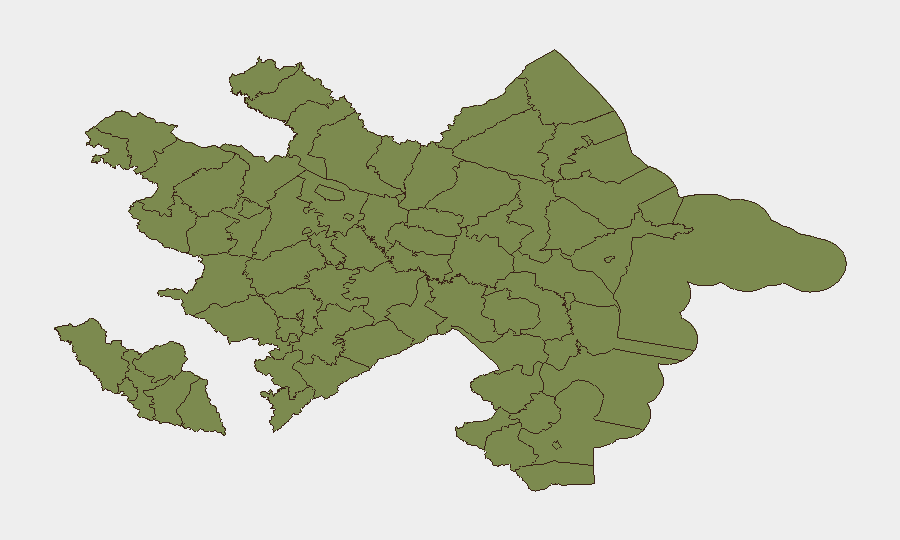
Situation Summary
Azerbaijan's composite threat score of 11 places it in the lower-to-moderate risk band globally, though sub-national concentration in Ujar District (31.3) and Baku City (11.8) warrants focused monitoring. Recent event signals include diplomatic friction (UN statements, Congressional demands, intelligence warnings) and a M4.9 seismic event near Qutqashen, but no confirmed major incident has been independently corroborated in the last 24–48 hours. The security environment remains stable relative to regional conflict history, though border sensitivities and internal governance signals merit continued watch.
Key Developments
Limitation on Current Intelligence: GeoBit's web research for the past 24–48 hours has not yielded independently verified, time-stamped incidents meeting dual-source corroboration standards. Recent event signals (dated 2026-06-11 to 2026-06-13) indicate diplomatic statements, congressional demands, and UN assertions, but specific operational or security incidents with confirmed location and time are not yet available in searchable public channels.
Recommended Action: Corporate security teams with operational presence should cross-reference the event signals listed above (particularly the 2026-06-13 UN statements and the 2026-06-12 intelligence warnings) against real-time news feeds (APA, Trend, Turan, official MFA/MoD channels) and social media (Telegram, X) in Baku and border regions to confirm or rule out escalation. A M4.9 earthquake near Qutqashen (date unconfirmed but recent) carries potential for minor infrastructure disruption; no significant damage reports are currently available.
Highest-Risk Areas
Ujar District (northeast, bordering Armenia) dominates the risk ranking at 31.3, reflecting its proximity to disputed territory and history of ceasefire friction. Baku City (11.8) follows—typical for a capital concentrating government, diplomatic, and economic activity—and warrants standard urban security awareness (crime, protest, traffic, utilities). Khankendi (7.3), the administrative center of the former Nagorno-Karabakh enclave, remains elevated due to post-2020 territorial and governance transitions. All other tracked districts and Nakhchivan Autonomous Republic score at or below 1.3, indicating lower acute threat profiles; however, border districts (Sadarak, Sharur, Tovuz, Qakh) retain latent risk from Armenian-Azerbaijani boundary disputes and require baseline monitoring.
How GeoBit Would Assist
Security teams should deploy AOI Monitoring & Early Warning on Ujar District and Baku to flag ceasefire violations, protest activity, or infrastructure incidents in near-real time. OSINT Fusion & Corroboration (integrating X/Telegram social signals, news wires, and official statements) will disambiguate diplomatic noise from operational threats and confirm or refute reported incidents within hours. Risk & Threat Assessment modules can rank personnel and asset exposure by location and event type, enabling duty-of-care triage and contingency routing via Routing & Network Analysis if border or urban mobility deteriorates.
7-Day Outlook
No imminent escalation is signaled, but the convergence of recent diplomatic statements and intelligence warnings suggests heightened sensitivity to compliance or territorial issues. Security posture should remain at baseline across Baku and southern districts, with enhanced alertness in Ujar and border areas through mid-June. Seismic activity in the region warrants routine infrastructure and supply-chain resilience checks, particularly for critical utilities and transport corridors.
Highest-Risk Areas — Ranked
| # | State / Region | Risk |
|---|---|---|
| 1 | Ujar District | 31.3 |
| 2 | Baku City | 11.8 |
| 3 | Khankendi | 7.3 |
| 4 | Sadarak District | 1.3 |
| 5 | Qazakh District | 1.3 |
| 6 | Sharur District | 1.3 |
| 7 | Yevlakh District | 1.3 |
| 8 | Kangarli District | 1.3 |
| 9 | Nakhchivan Autonomous Republic | 1.3 |
| 10 | Aghstafa District | 1.3 |
| 11 | Tovuz District | 1.3 |
| 12 | Qakh District | 1.3 |
Sources
Previous Daily Briefs
A new Azerbaijan brief is written every day — each with its own risk map and downloadable CSV. Here's the last week; use the calendar to go further back.
📅 Browse every day by calendar →
Highlighted days have a brief. Tap a day for that day's map & analysis, or “csv” for that day's dataset ($5).