Situation Summary
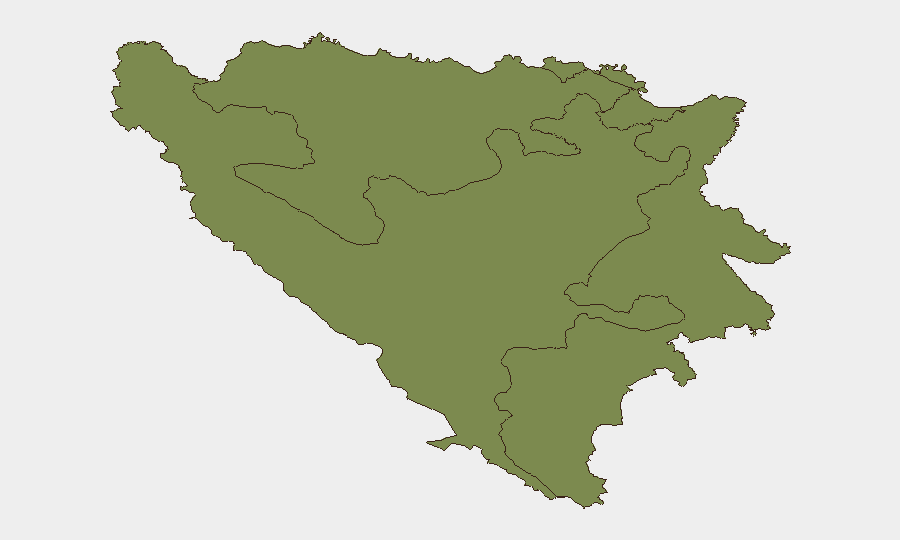
Bosnia and Herzegovina remains a low-threat environment globally (rank #185, composite score 2.0) with no credible security incidents reported in the last 24–48 hours. The Federation of Bosnia and Herzegovina carries significantly elevated risk (31.4) compared to Republika Srpska and Brčko District (both 1.4), driven by historical fragmentation and localized political tensions rather than active armed conflict or widespread civil unrest. Current trajectory is stable; no imminent escalation signals are present in open-source data.
Key Developments
No credible, time-stamped security incidents have been documented in Bosnia and Herzegovina during the last 24–48 hours. Open-source intelligence and web research confirm no civil unrest, armed clashes, critical infrastructure disruptions, major crime events, or political flashpoints with verified recent occurrence. FIFA World Cup–related activity (Bosnia and Herzegovina national team events, fan gatherings) is sports-centered and does not indicate security degradation. Absence of reported incident activity should not be interpreted as absence of risk; it reflects current open-source visibility.
Highest-Risk Areas
The Federation of Bosnia and Herzegovina drives the country's composite risk profile (31.4 vs. 1.4 for both Republika Srpska and Brčko District). This disparity reflects lingering inter-ethnic and political sensitivities from the 1992–1995 conflict, unresolved property restitution claims, and periodic tensions between Bosniak and Croat political leadership. Republika Srpska and Brčko District show near-parity low risk, suggesting relative stability in Serb-majority areas and the internationally administered district. Organizations with presence in the Federation should maintain heightened situational awareness around political narratives and electoral cycles, which can occasionally trigger localized demonstrations.
How GeoBit Would Assist
Area-of-Interest Monitoring & Early Warning would enable persistent watch over the Federation's key political and administrative nodes (Sarajevo, Mostar, Zenica) to detect emergent tensions before they escalate to unrest. Intel Sweep and multi-language OSINT (X/Twitter, local media, Telegram) would capture low-level political discourse, protest planning, and inter-entity friction early, complementing sparse English-language coverage. Network & Actor Analysis would map relationships among political parties, municipal authorities, and civil-society groups to forecast flashpoints around elections or constitutional disputes—events that historically trigger disproportionate risk in the Federation.
7-Day Outlook
No acute threats are forecast for the next seven days. Routine political activity, World Cup–related public gatherings, and standard administrative operations are expected to continue without disruption. Organizations should monitor for any uptick in rhetoric around the Federation's Bosniak-Croat power-sharing arrangements or property disputes, which remain latent flashpoints but are unlikely to trigger sudden security degradation in the near term.
Highest-Risk Areas — Ranked
| # | State / Region | Risk |
|---|---|---|
| 1 | Federation of Bosnia and Herzegovina | 31.4 |
| 2 | Republika Srpska | 1.4 |
| 3 | Brčko District | 1.4 |
Sources
Previous Daily Briefs
A new Bosnia and Herzegovina brief is written every day — each with its own risk map and downloadable CSV. Here's the last week; use the calendar to go further back.
📅 Browse every day by calendar →
Highlighted days have a brief. Tap a day for that day's map & analysis, or “csv” for that day's dataset ($5).