Situation Summary
Estonia remains a stable NATO member (global rank #158, composite threat 4/5) with well-resourced security institutions, but faces a convergence of near-term risks: Russian military posturing on the eastern border, elevated cyber and fraud activity, and infrastructure vulnerabilities documented in recent official reports. The security picture is one of heightened vigilance rather than acute crisis, though geopolitical tension and criminal activity are trending upward. Personnel and assets in eastern counties and Tallinn should expect sustained operational friction and heightened screening protocols.
Key Developments
- Lake Peipus, eastern border – Russian live-fire exercise, 14 July 2026 (reported prominently 14 July, ongoing concern). Russia conducted an unannounced live-fire exercise on Lake Peipus near Estonia's eastern frontier, marking an unusual escalation in notification protocols and triggering heightened NATO and Estonian defense-sector alerting. Border surveillance and military readiness have been elevated in response.
- Tallinn, Mustamäe district – fatal pedestrian road incident, 16–17 July 2026. A pedestrian was struck and killed by a vehicle on 16 July; police investigation is ongoing. Local traffic and personal-security risk in this residential zone warrants situational awareness for commuting personnel.
- Estonia-wide – cyber incidents surge in June, report published mid-July 2026. The Information System Authority (RIA) registered 1,232 cyber incidents in June, including DDoS attacks, service disruptions, and a customer-data breach at a southern Estonian booking system. This signals sustained cyber-threat activity and data-protection risk for corporate and travel-related systems.
- Estonia-wide – fraud losses of €13.2 million documented in first five months of 2026, figures released 16 July. Police and Border Guard Board data show 1,816 individuals and companies victimized; ongoing financial-crime risk remains elevated across the country.
- Baltic region – Lithuanian intelligence warning of possible Russian critical-infrastructure attacks, reported recently. While not Estonia-specific, regional warning of potential Russian targeting of energy and transport assets is relevant to cross-border supply chains and shared NATO infrastructure in Estonia.
- Estonia, defense policy – U.S. weapons-delivery resumption confirmed, 16 July 2026. Minister of Defense Hanno Pevkur confirmed resumption of suspended U.S. weapons deliveries in coming months, reinforcing Estonia's security posture but not indicating domestic unrest.
Highest-Risk Areas
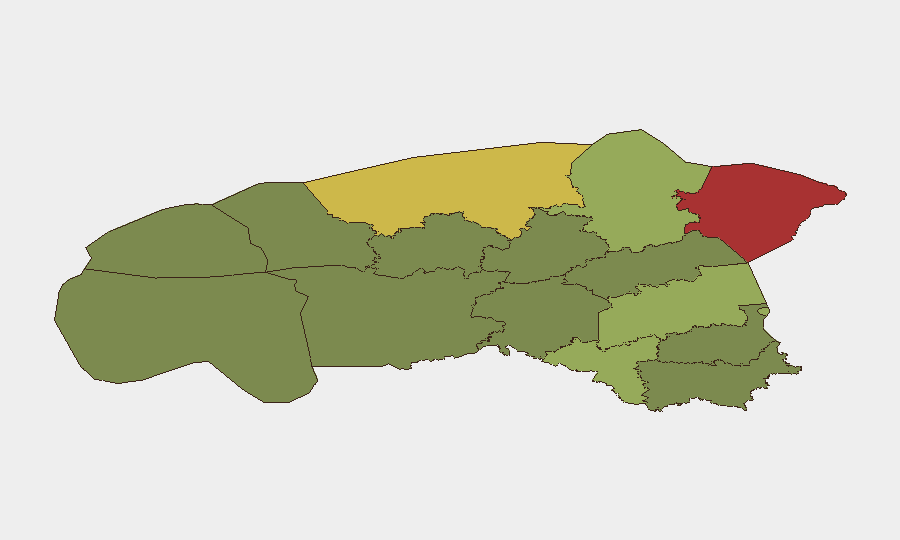
Ida-Viru County (risk 78) and Harju County (risk 68) are the primary drivers of Estonia's sub-national risk profile. Ida-Viru, which includes the northeastern industrial belt adjacent to the Russian border, faces the highest exposure to cross-border military activity, cyber spillover, and Russian economic/political leverage. Harju County, encompassing Tallinn and its metropolitan zone, concentrates cyber-infrastructure targets, financial-services hubs, and NATO facilities, making it a secondary focus for both criminal and state-level threats. Mid-tier counties (Tartu, Valga, Lääne-Viru) merit monitoring but pose substantially lower risk.
How GeoBit Would Assist
A corporate security team operating in Estonia should deploy AOI Monitoring & Early Warning on Ida-Viru and Harju counties to detect police mobilization, infrastructure anomalies, and cross-border military activity in near-real time. Cyber incident tracking and OSINT fusion (leveraging Telegram, X, and multi-language feeds) would provide early signals of new fraud campaigns, DDoS targeting, and data-breach announcements. Routing & Network Analysis capabilities enable alternative travel and supply-chain planning around high-risk zones, particularly near the Russian border and in central Tallinn during periods of elevated police activity.
7-Day Outlook
Cyber and fraud activity will likely remain at elevated levels absent significant law-enforcement intervention. Russian military posturing on the eastern border is expected to persist as part of broader NATO-Russia tension, without escalating to kinetic action in the short term. Corporate security teams should maintain heightened vigilance on data systems, border-proximate operations, and personnel movement in Tallinn and northeastern counties.
Highest-Risk Areas — Ranked
| # | State / Region | Risk |
|---|---|---|
| 1 | Ida-Viru County | 78 |
| 2 | Harju County | 68 |
| 3 | Tartu County | 58 |
| 4 | Valga County | 55 |
| 5 | Lääne-Viru County | 52 |
| 6 | Pärnu County | 35 |
| 7 | Rapla County | 32 |
| 8 | Jõgeva County | 30 |
| 9 | Järva County | 28 |
| 10 | Viljandi County | 25 |
| 11 | Põlva County | 22 |
| 12 | Võru County | 18 |
Previous Daily Briefs
A new Estonia brief is written every day — each with its own risk map and downloadable CSV. Here's the last week; use the calendar to go further back.
📅 Browse every day by calendar →
Highlighted days have a brief. Tap a day for that day's map & analysis, or “csv” for that day's dataset ($5).
Atlas — our AI intelligence desk — emails them this snapshot personally. Nothing else, no list.