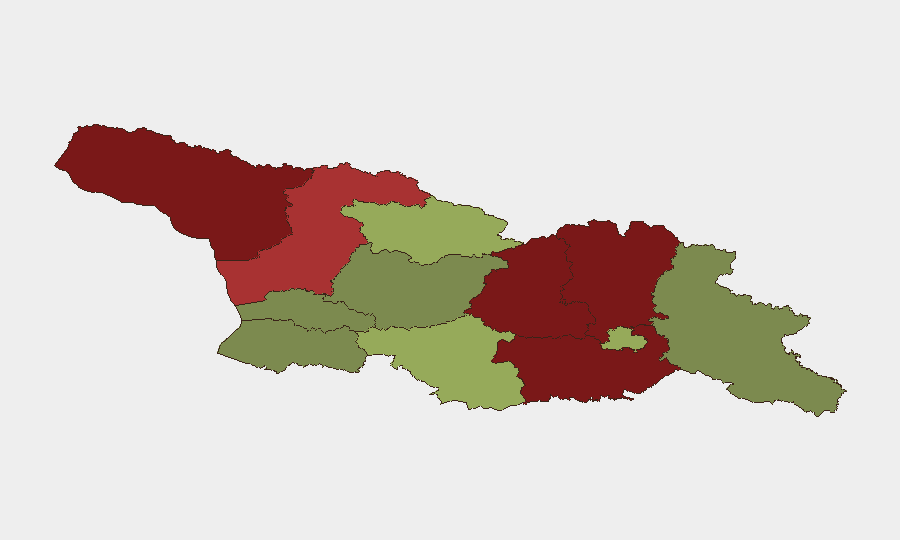
Situation Summary
Georgia ranks #124 globally with a composite threat score of 2.0, reflecting a mixed security environment dominated by regional instability in the north and west rather than nationwide systemic risk. Over the past 72 hours, corporate and government continuity has been disrupted by two major municipal cyberattacks (Fulton and Macon–Bibb counties), while routine violent crime, infrastructure incidents, and weather-related disruptions continue in urban centers. The threat landscape remains compartmentalized: separatist-controlled territories and border regions carry extreme risk (Abkhazia, Shida Kartli), while metro Atlanta and southern lowlands present conventional crime and infrastructure vulnerabilities at moderate levels.
Key Developments
- Fulton County (Atlanta) — Countywide cyberattack and IT outage (2026-06-02). Georgia's largest municipal jurisdiction experienced a significant breach over the weekend, causing widespread service disruptions across county systems. State and federal authorities are assisting in containment and recovery operations.
- Macon–Bibb County — Municipal network and telephony offline (2026-06-02). Entire government network and landline phone systems taken offline following discovery of a weekend cyberattack; ransomware status unconfirmed pending investigation.
- Atlanta, Downtown Connector — Flash flood and traffic disruption (2026-06-04). Heavy rainfall caused temporary flooding on the primary interstate corridor during peak hours, stranding multiple vehicles and disrupting regional mobility.
- Hall County near Lula — Train derailment and crossing closures (2026-06-04). Freight train derailment closed five railroad crossings along Old Cornelia Highway and Main Street; Georgia State Patrol investigating with no reported injuries.
- DeKalb County, Stone Mountain — Fatal domestic-violence shooting (2026-06-04). 44-year-old Minda Henderson killed by ex-boyfriend in drive-by shooting; prior domestic-violence reports raise concerns about threat assessment and police response protocols.
- DeKalb County, Decatur — Random stabbing and arrest (2026-06-04). 22-year-old Walter Scrutchings arrested for stabbing a woman outside a restaurant on Blackmon Drive in an apparently unprovoked attack; victim condition improving.
- Atlanta, Piedmont Park — Youth homicide (2026-06-04). 16-year-old Tiana Robinson shot during confrontation between youth groups; active homicide investigation ongoing.
- Atlanta — Shooting with critical injuries (2026-06-04). Two victims transported to Grady Memorial Hospital with graze wound and multiple gunshot wounds respectively; suspect vehicle identified but no arrests made.
Highest-Risk Areas
The Autonomous Republic of Abkhazia (risk 95) and Shida Kartli (risk 88) dominate Georgia's threat landscape due to unresolved territorial disputes, separatist control, and military volatility along the Russian border. Lower Kartli (risk 85) and Mtskheta-Mtianeti (risk 82) present similar geopolitical exposure. In contrast, Tbilisi (risk 45) and Samtskhe-Javakheti (risk 48) show moderate but measurable risk, with urban crime, infrastructure vulnerabilities, and administrative disruptions—exemplified by the current cyberattack wave—more prominent than political instability. Southern and western lowland regions (Imereti, Guria, Adjara) carry the lowest absolute risk.
How GeoBit Would Assist
Security teams protecting personnel and assets in Georgia should leverage AOI Monitoring & Early Warning to maintain persistent watch on Abkhazia, Shida Kartli, and border zones, with automated alerting on military movements or escalation signals. Cyber & OSINT capabilities, including Telegram/X monitoring and multi-language threat feeds, would enable early detection of municipal cyberattack campaigns before they impact operations—critical given current Fulton and Macon–Bibb incidents. Routing & Network Analysis provides real-time alternative journey planning around infrastructure failures (floods, derailments, road closures) affecting supply chains and personnel movement.
7-Day Outlook
Near-term threats remain localized: cyberattack recovery in metro Atlanta will likely extend 5–7 days, weather disruptions are expected to clear within 48 hours, and violent-crime incidents show no pattern suggesting coordinated escalation. Regional geopolitical risk in Abkhazia and Shida Kartli remains chronic but stable absent new trigger events. Corporate continuity teams should prioritize cyberattack resilience protocols and alternative routing contingencies for the Atlanta metro area.
Highest-Risk Areas — Ranked
| # | State / Region | Risk |
|---|---|---|
| 1 | Autonomous Republic of Abkhazia | 95 |
| 2 | Shida Kartli | 88 |
| 3 | Lower Kartli | 85 |
| 4 | Mtskheta-Mtianeti | 82 |
| 5 | Samegrelo-Upper Svaneti | 78 |
| 6 | Samtskhe-Javakheti | 48 |
| 7 | Tbilisi | 45 |
| 8 | Racha-Lechkhumi and Kvemo Svaneti | 42 |
| 9 | Kakheti | 38 |
| 10 | Autonomous Republic of Adjara | 35 |
| 11 | Imereti | 32 |
| 12 | Guria | 28 |