Situation Summary
Georgia remains at composite global threat rank #100 (score 18), with civil unrest as the primary driver. The past week saw sustained pro-European protest activity in Tbilisi, parallel demonstrations against alleged systemic prison abuse, and unrelated incidents including a uranium-trafficking detention and narcotics destruction. No kinetic escalation or infrastructure disruption has been documented, though detention and alleged abuse allegations continue to fuel street mobilization.
Key Developments
- Tbilisi, October 5: Inmate Giorgi Davitadze alleged sexual violence by prison guards in an appeals-court proceeding; the Penitentiary Service denied the charges. [Source: court/official statements]
- Tbilisi, October 6: Family and supporters of Davitadze held a rally outside the Special Penitentiary Service demanding dismissal of accused officials and staff.
- Tbilisi, October 6: Evening demonstrations outside Parliament and City Council called for release of detained protesters, repeal of repressive laws, free elections, and Euro-Atlantic integration.
- Tbilisi, October 6: Separate protest action at the Penitentiary Service focused on alleged inmate abuse and accountability for prison personnel.
- Tbilisi, October 7: Rustaveli Avenue protests addressed alleged police violence, prison abuse, and government political orientation.
- Tbilisi, October 7: Activist Sergey Kancheli alleged abduction by security personnel, transport to a cemetery, and threats including sexual violence (allegation; not independently corroborated).
- Georgia (location unspecified), October 8: State Security Service detained a male subject accused of attempting to sell uranium-238 to a foreign national for approximately $700,000.
- Georgia (location unspecified), October 6: Interior Ministry announced destruction of 553 kilograms of narcotic and psychotropic substances, estimated black-market value exceeding 34 million lari.
- Tbilisi, October 10: The 43rd consecutive pro-European "Saturday march" proceeded, emphasizing alleged systemic prison abuse, European integration, and release of political prisoners, with participants carrying Georgian and EU flags.
- Tbilisi, October 10: March reportedly held under the anti-government slogan "Georgia against Ivanishvili," with anti-Russian chants documented.
Highest-Risk Areas
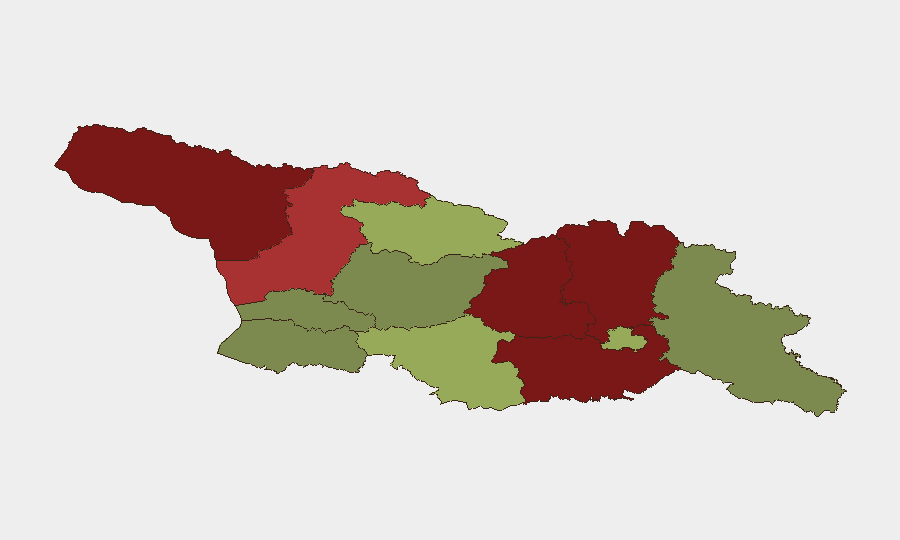
The Autonomous Republic of Abkhazia (risk 95), Shida Kartli (88), and Lower Kartli (85) dominate the sub-national ranking, reflecting ongoing territorial disputes and proximity to active conflict zones. Mtskheta-Mtianeti and Samegrelo-Upper Svaneti follow at 82 and 78 respectively, driven by border volatility and historical conflict legacies. Tbilisi, despite mass demonstrations, ranks seventh at 45—reflecting concentrated but manageable civil unrest rather than armed conflict. Organizations with operations in the northern and central regions face elevated geopolitical and access-denial risks; those in Tbilisi face protest-related disruption and alleged state security concerns.
How GeoBit Would Assist
AOI Monitoring & Early Warning enables continuous watch on Tbilisi demonstration sites and prison facilities to alert teams to sudden escalation, route closures, or violence. Intel Sweep and multi-language OSINT (X/Twitter, Telegram, local media) provide real-time event corroboration and sentiment tracking across protest movements. Routing & Network Analysis allows duty-of-care teams to model alternative transport paths if major thoroughfares (e.g., Rustaveli Avenue) are blocked. Regime-Stability Search contextualizes protest trajectory and detention practices within broader governance risk.
7-Day Outlook
The 670+ consecutive nights of pro-European demonstrations and prison-abuse allegations suggest sustained, organized opposition momentum with no immediate de-escalation drivers evident. Further marches and overnight protests are expected; the likelihood of violent clashes remains low but cannot be excluded if police enforce dispersal. Organizations should maintain flexible duty-of-care postures and monitor weekend march schedules closely.
Highest-Risk Areas — Ranked
| # | State / Region | Risk |
|---|---|---|
| 1 | Autonomous Republic of Abkhazia | 95 |
| 2 | Shida Kartli | 88 |
| 3 | Lower Kartli | 85 |
| 4 | Mtskheta-Mtianeti | 82 |
| 5 | Samegrelo-Upper Svaneti | 78 |
| 6 | Samtskhe-Javakheti | 48 |
| 7 | Tbilisi | 45 |
| 8 | Racha-Lechkhumi and Kvemo Svaneti | 42 |
| 9 | Kakheti | 38 |
| 10 | Autonomous Republic of Adjara | 35 |
| 11 | Imereti | 32 |
| 12 | Guria | 28 |
Sources
Previous Weekly Briefs
A new Georgia brief is written every Monday, covering the week — each with its own risk map and downloadable CSV. Use the calendar to go further back.
- October 5, 2026
- September 28, 2026
- September 21, 2026
- September 14, 2026
- September 7, 2026
- September 3, 2026
- September 2, 2026
📅 Browse past briefs by calendar →
Highlighted days have a brief. Tap a day for that day's map & analysis, or “csv” for that day's dataset ($5).
Atlas — our AI intelligence desk — emails them this snapshot personally. Nothing else, no list.