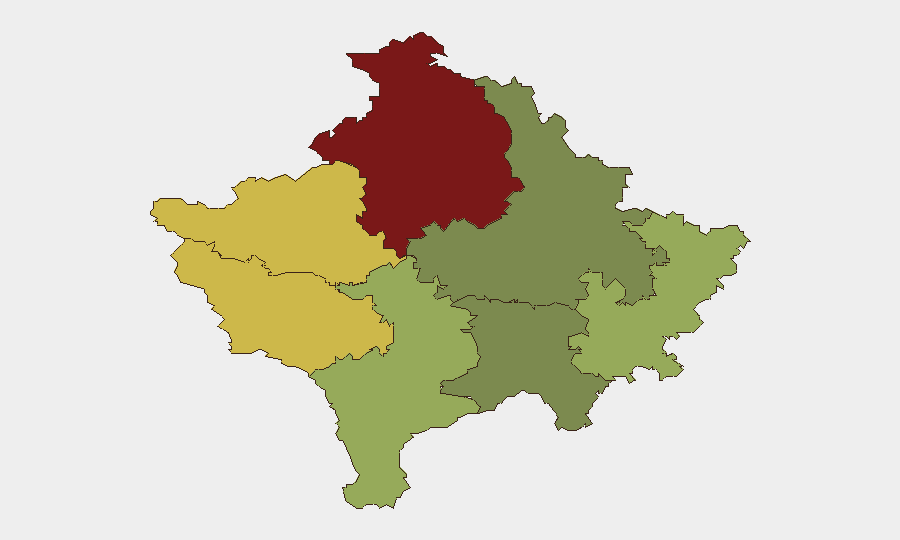
Situation Summary
Kosovo remains at elevated baseline risk (composite score 8, rank #112 globally), with no systemic security events currently tracked but a cluster of concerning incidents emerging in the past 48 hours across multiple threat vectors: ethnic-property tensions in the north, criminal violence near populated areas, journalist assault, and public-health concerns in the capital. The Mitrovica district remains the dominant driver of national risk (score 92), reflecting historical intercommunal volatility and unresolved property/governance disputes. Current trajectory shows contained but diversified incident activity rather than escalation, though journalist safety and unexplained deaths warrant continued attention.
Key Developments
- Gazivode Lake, Zubin Potok (21 July): Kosovo authorities demolished 10–11 allegedly illegal Serbian-owned weekend houses on public land, drawing EU intervention calls and strong Serbian criticism; property-rights disputes in northern enclaves remain a recurrent flashpoint.
- Laplje Selo, near Pristina (22 July, evening): Shooting incident occurred in front of a hospitality venue near a school during evening hours when children were present; multiple individuals detained by police; incident suggests return of localized criminal violence near populated civilian areas.
- Pristina (22 July, evening): Investigative journalist Parim Olluri (director, *Insajderi* outlet) physically assaulted by unknown assailants while returning home; EU missions condemned attack, raising concern over media freedom and personal security for investigative reporting figures.
- Podujeva, Mitrovica, Vushtrri (23 July, within 24h): Three unexplained deaths reported across separate municipalities—woman fallen from residential building (Podujeva), woman found lifeless in apartment (Mitrovica), man found dead (Vushtrri)—all forwarded for forensic autopsy; circumstances unclear pending investigation.
- Shushicë village, Istog (within 24h): Traffic accident resulted in two fatalities; contributes to elevated road-safety and emergency-response risk in western region.
- Pristina (ongoing, 17–22 July): Approximately 70 suspected food-poisoning cases reported at Infectious Disease Clinic, University Clinical Center; 22 hospitalized; public-health incident ongoing, suggesting potential environmental or vendor contamination.
Highest-Risk Areas
Mitrovica district (risk 92) remains the national epicenter, driven by unresolved intercommunal property disputes, Serbian enclave governance tensions, and recurring demolition/retaliation cycles—epitomized by the Gazivode Lake operation. Peja (68) and Gjakova (65) follow, reflecting volatile northwestern zones with historical intercommunal friction. Prishtina (28), despite hosting the capital, ranks seventh, suggesting that while the capital is more stable, localized criminal incidents (shooting, journalist assault, food-safety failure) persist at lower operational intensity. Northern and western districts collectively account for the majority of national risk; southern and central zones remain relatively stable but not immune to spillover effects.
How GeoBit Would Assist
Security teams operating in Kosovo should employ AOI Monitoring & Early Warning capabilities to track Mitrovica, Peja, and Gjakova districts for property-dispute escalation and intercommunal tensions; Intel Sweep and X/Twitter OSINT to surface emerging journalist-safety threats and media-freedom incidents; and Health & Environmental analysis to track food-safety and public-health clusters (as evidenced by the Pristina food-poisoning incident). Network & Actor Analysis would identify criminal cells linked to recent shooting and assault incidents.
7-Day Outlook
Short-term outlook remains measured: no systemic escalation is evident, but the concentration of incidents (violence, assault, deaths, food-safety) across multiple threat vectors over 48 hours suggests underlying fragmentation and localized instability rather than coordinated action. Northern property disputes will likely persist as a chronic irritant; journalist safety and criminal enforcement merit heightened monitoring. Public-health resolution in Pristina will be a near-term indicator of institutional capacity.
Highest-Risk Areas — Ranked
| # | State / Region | Risk |
|---|---|---|
| 1 | District of Mitrovica | 92 |
| 2 | District of Peja | 68 |
| 3 | District of Gjakova | 65 |
| 4 | District of Prizren | 55 |
| 5 | District of Gjilan | 52 |
| 6 | District of Ferizaj | 38 |
| 7 | District of Prishtina | 28 |
Sources
Previous Daily Briefs
A new Kosovo brief is written every day — each with its own risk map and downloadable CSV. Here's the last week; use the calendar to go further back.
📅 Browse every day by calendar →
Highlighted days have a brief. Tap a day for that day's map & analysis, or “csv” for that day's dataset ($5).
Atlas — our AI intelligence desk — emails them this snapshot personally. Nothing else, no list.