Situation Summary
Latvia remains a stable, NATO-member state with composite threat score of 11 (global rank #97). However, heightened precautionary security measures around critical energy infrastructure—announced 15–17 July—reflect assessed hybrid threats from Russia targeting regional sabotage and destabilization. Over the past 24–48 hours, no new incidents of armed conflict, civil unrest, major crime, or infrastructure failure have been documented; the current operational posture is defensive and preventive rather than responsive to active events.
Key Developments
- Inčukalns gas storage facility (central Latvia) — 17 July 2026
Prime Minister Andris Kulbergs confirmed increased protective measures at Latvia's strategic underground gas storage site following intelligence assessments of potential Russian sabotage threats against Baltic energy infrastructure.
- Hydroelectric power plant near Riga — 17 July 2026
Authorities reinforced security perimeters around a major hydroelectric facility upstream of Riga based on Western intelligence warnings of possible Russian-directed provocations or infrastructure attacks in the region.
- Nationwide energy sector — 17 July 2026
The Prime Minister announced sector-wide security strengthening across Latvia's energy infrastructure, including expanded protective measures and coordination with NATO partners in response to assessed sabotage and attack risks.
- NATO–Latvia sabotage threat coordination — 15 July 2026
President Edgars Rinkēvičs stated in Vilnius that NATO intelligence assessments confirm Russia has attempted sabotage operations aimed at reducing security posture in Latvia and neighboring states, triggering preventive monitoring and defensive steps.
- Unidentified drone engagement in Latvian airspace — 15 July 2026
A NATO air asset shot down an unidentified drone over Latvian territory; the incident is being assessed within the broader pattern of hybrid-threat activity, though attribution and operational details remain limited.
Note: All above events fall within the 15–17 July window; no new time-stamped incidents have been corroborated in the 24–48 hours immediately preceding this brief (17–19 July 2026).
Highest-Risk Areas
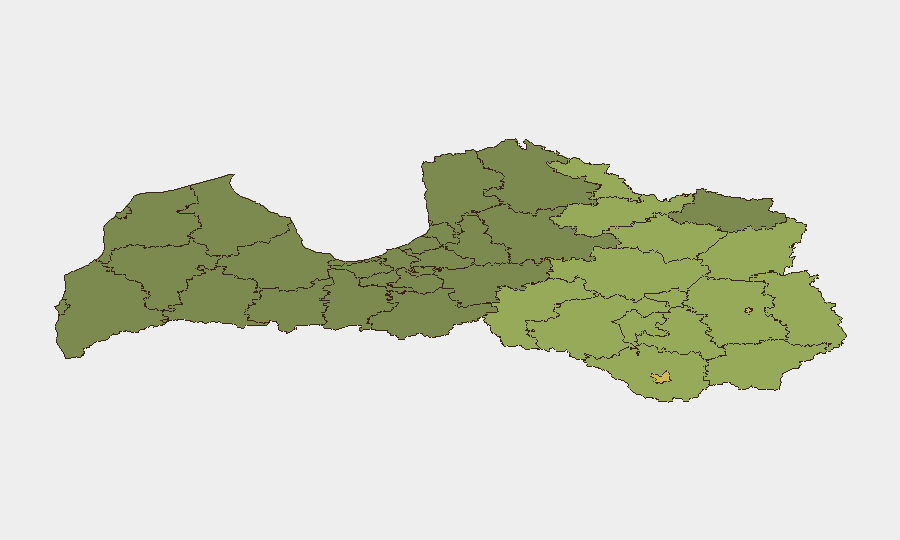
Eastern and southeastern municipalities drive the sub-national risk ranking: Rēzekne (risk 68), Daugavpils (65), and Rēzeknes novads (58) register the highest composite scores, followed by clusters in Ludzas, Balvu, Preiļu, and Krāslavas novads. These areas share proximity to the Russian and Belarus borders, limited NATO presence relative to the Riga-Daugava corridor, and historical demographics that may complicate social cohesion during hybrid-threat campaigns. Threat drivers include potential Russian-directed disinformation, cross-border criminal activity, and infrastructure vulnerabilities in peripheral energy and transport networks. Western and central municipalities, particularly around Riga and the critical energy assets, show lower sub-national rankings but remain operationally significant due to national-security criticality.
How GeoBit Would Assist
Corporate security teams should deploy AOI Monitoring & Early Warning on Inčukalns and the Riga hydroelectric facility, coupled with OSINT fusion (X, Telegram, local media, radio SIGINT) to detect early indicators of sabotage preparation or disinformation narratives. Network & Actor Analysis and entity extraction from multi-language sources will help identify Russian-linked threat groups and their operational messaging. For teams with personnel in high-risk eastern municipalities, Routing & Network Analysis can model alternative movement corridors and identify safe zones during potential escalation; GIS & Spatial Analysis combined with persistent AOI watch will enable real-time alerting if incidents emerge near critical infrastructure or population centers.
7-Day Outlook
The near-term trajectory is likely to remain defensive and precautionary rather than escalatory. NATO coordination with Latvia will sustain heightened intelligence-sharing and protective posture around energy and transport infrastructure through at least late July. Unless corroborated intelligence surfaces a specific, imminent attack vector, the current threat environment is expected to stabilize around elevated baseline vigilance rather than operational crisis.
Highest-Risk Areas — Ranked
| # | State / Region | Risk |
|---|---|---|
| 1 | Rēzekne | 68 |
| 2 | Daugavpils | 65 |
| 3 | Rēzeknes novads | 58 |
| 4 | Ludzas novads | 55 |
| 5 | Balvu novads | 52 |
| 6 | Preiļu novads | 50 |
| 7 | Krāslavas novads | 48 |
| 8 | Jēkabpils novads | 47 |
| 9 | Augšdaugavas novads | 46 |
| 10 | Aizkraukles novads | 45 |
| 11 | Varakļānu novads | 44 |
| 12 | Līvānu novads | 43 |
Previous Daily Briefs
A new Latvia brief is written every day — each with its own risk map and downloadable CSV. Here's the last week; use the calendar to go further back.
📅 Browse every day by calendar →
Highlighted days have a brief. Tap a day for that day's map & analysis, or “csv” for that day's dataset ($5).
Atlas — our AI intelligence desk — emails them this snapshot personally. Nothing else, no list.