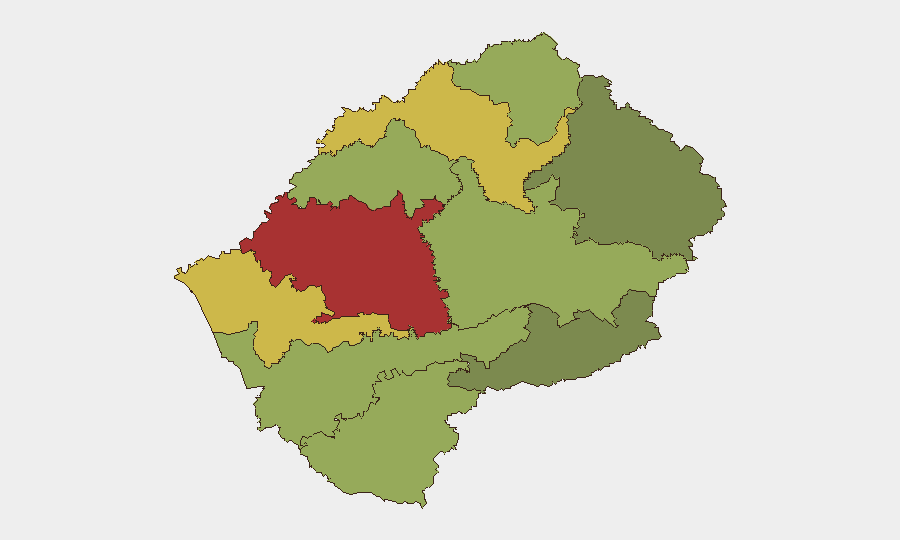
Situation Summary
Lesotho presents a moderate composite threat environment with no major security incidents reported in the past 24–48 hours. The country's risk profile remains dominated by urban crime concentration in Maseru District and secondary concerns across southern and central highland regions. Current indicators suggest stability at the national level, though localized crime and informal-sector tensions persist in high-population centers.
Key Developments
No credible, multi-source security incidents have been identified in Lesotho within the last 24–48 hours that meet threshold for inclusion in this briefing. Open-source reporting from international and regional media contains no verifiable reports of protests, civil unrest, cross-border incidents, major crimes, or infrastructure disruptions dated to 2026-06-19 or 2026-06-20. A single public statement referencing Europe (2026-06-19) exists in signal data but lacks sufficient detail or Lesotho-specific security nexus to warrant operational reporting.
Corporate security teams should note this absence of acute incident reporting does not constitute a guarantee of zero risk; rather, it reflects the current state of widely available corroborated information.
Highest-Risk Areas
Maseru District dominates the risk ranking (composite score 78) and accounts for the majority of recorded incidents, reflecting its status as the capital and primary urban center with concentrated commercial, financial, and government activity. Mafeteng and Leribe Districts follow (65 and 62 respectively), indicating secondary crime and instability clusters in the west-central and northern regions. The southern and eastern highland districts (Qacha's Nek, Mokhotlong, Quthing) show substantially lower composite scores, suggesting either lower incident density or reduced reporting coverage. Security teams with operations in Maseru should treat the capital's crime environment—petty theft, armed robbery, and informal dispute resolution—as the principal operational concern; secondary-city and rural deployments face lower acute risk but reduced emergency-response infrastructure.
How GeoBit Would Assist
GeoBit's AOI Monitoring & Early Warning capability enables persistent watch on Maseru and secondary risk zones with automated alerting for civil unrest, crime clusters, or political developments, reducing manual reporting lag. OSINT Fusion & Corroboration (X/Twitter, Telegram, local-language sources, and multi-platform temporal analysis) provides early detection of emerging incidents before they reach international wire services. Routing & Network Analysis and GIS & Spatial Analysis support duty-of-care planning by identifying secure transit corridors, safe-haven locations, and real-time alternative routing around active crime hotspots or localized unrest.
7-Day Outlook
No near-term escalation indicators are evident from available reporting. Lesotho's political environment remains stable under the incumbent government, and no major public events, elections, or planned demonstrations are flagged for the coming week. Security teams should maintain standard baseline vigilance for urban crime in Maseru and periodic informal-sector tensions, but no material increase in threat trajectory is projected for the next seven days.
Highest-Risk Areas — Ranked
| # | State / Region | Risk |
|---|---|---|
| 1 | Maseru District | 78 |
| 2 | Mafeteng District | 65 |
| 3 | Leribe District | 62 |
| 4 | Berea District | 58 |
| 5 | Mohale's Hoek District | 52 |
| 6 | Butha-Buthe District | 48 |
| 7 | Thaba-Tseka District | 45 |
| 8 | Quthing District | 42 |
| 9 | Mokhotlong District | 38 |
| 10 | Qacha's Nek District | 28 |
Previous Daily Briefs
A new Lesotho brief is written every day — each with its own risk map and downloadable CSV. Here's the last week; use the calendar to go further back.
📅 Browse every day by calendar →
Highlighted days have a brief. Tap a day for that day's map & analysis, or “csv” for that day's dataset ($5).