Situation Summary
Malta remains a low-threat jurisdiction with composite threat score 7 and no active major security incidents reported in the last 24–48 hours. However, institutional governance concerns—specifically allegations of surveillance in lawyer–client consultation rooms at the national prison—have escalated to public dispute between the legal profession and state authorities, raising rule-of-law and civil-liberties risk. Financial sector concentration in property exposure and improved educational attainment are secondary factors; the near-term security environment is stable but requires attention to institutional transparency.
Key Developments
- Corradino Correctional Facility (Paola) – 23 June 2026: Chamber of Advocates formally escalated allegations that listening devices may have been installed in high-security lawyer–client consultation rooms, demanding independent judicial inquiry and citing risks to legal privilege. State Advocate denies systemic violations; dispute remains unresolved.
- Malta (National – Justice System) – 23 June 2026: Legal profession publicly doubled down on eavesdropping claims, pressing authorities for stronger confidentiality safeguards and highlighting vulnerability of detained clients' privileged communications.
- Central Bank of Malta (National – Financial Sector) – 23 June 2026: Published Financial Stability Report (2025) flagging rising concentration risk in banking sector's property exposure; warned of potential vulnerability to sharp real-estate downturn, though sector remains robust on capital and liquidity metrics.
- Ministry for Education and Sport (National – Governance Context) – 23 June 2026: Reported 23% decline in secondary students leaving school without MQF qualification (2023–2026); 75% of Year 11 students now achieve at least one MQF level, reducing long-term social marginalisation risk.
Highest-Risk Areas
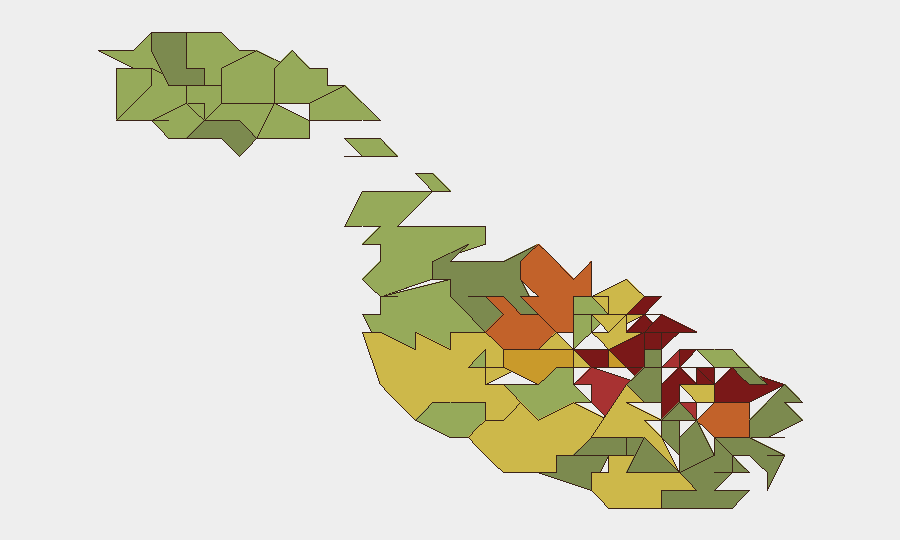
Valletta, Sliema, and Saint Julian's carry the highest sub-national risk scores (95, 92, 90 respectively), likely reflecting density of financial services, government institutions, tourism infrastructure, and international business activity—not violent crime or civil unrest. The next cluster (Gżira, Hamrun, Paola, Msida) shows elevated risk tied to administrative/institutional presence and urban density. The prison surveillance dispute centred in Paola (rank 6, risk 86) is a localized institutional concern rather than a widespread public-safety threat. Overall, top-risk zones correlate with governance, commerce, and institutional concentration rather than criminality or instability.
How GeoBit Would Assist
Security teams monitoring personnel or assets in Malta would deploy AOI Monitoring & Early Warning on Valletta and Sliema financial/government districts to detect escalation signals in institutional disputes; OSINT fusion & corroboration (X/Twitter, local news feeds, Chamber of Advocates statements) to track legal-profession disputes and rule-of-law developments before they affect operational environment; and Routing & Network Analysis to identify alternative routes and safe zones if any localized civil-liberties protests or disruptions emerge near government or judicial facilities. Entity extraction and sentiment analysis on government, judicial, and professional-body communications would flag policy shifts affecting corporate compliance, data security, or privilege risks.
7-Day Outlook
No major escalation of the prison surveillance dispute is expected in the next 7 days, though legal-profession pressure on authorities will likely continue. Financial sector concentration warnings do not signal imminent crisis but warrant ongoing monitoring of real-estate market indicators. Malta's security posture remains stable; duty-of-care focus should centre on institutional transparency developments and minor disruption risk near central Valletta administrative zones.
Highest-Risk Areas — Ranked
| # | State / Region | Risk |
|---|---|---|
| 1 | Valletta | 95 |
| 2 | Sliema | 92 |
| 3 | Saint Julian's | 90 |
| 4 | Gżira | 88 |
| 5 | Hamrun | 87 |
| 6 | Paola | 86 |
| 7 | Msida | 85 |
| 8 | Birkirkara | 84 |
| 9 | Birgu | 83 |
| 10 | Senglea | 82 |
| 11 | Cospicua | 81 |
| 12 | Żabbar | 80 |
Sources
Previous Daily Briefs
A new Malta brief is written every day — each with its own risk map and downloadable CSV. Here's the last week; use the calendar to go further back.
📅 Browse every day by calendar →
Highlighted days have a brief. Tap a day for that day's map & analysis, or “csv” for that day's dataset ($5).