Situation Summary
North Korea's security threat profile remains elevated and structurally stable, with no discrete incidents reported in the past 24 hours but sustained military modernization and constitutional repositioning continuing to drive medium- to long-term risk. The country ranks #24 globally (threat score 60.6) with 20 tracked events; the dominant drivers are accelerated long-range artillery and missile development, confirmed advances in nuclear weapons production capacity at Yongbyon, and a formal constitutional shift redefining South Korea as a separate hostile state. While the immediate kinetic environment shows no new border clashes, missile launches, or internal security crises, the trajectory reflects entrenchment of a more adversarial posture toward the peninsula and sustained weapons modernization that will shape regional volatility for months ahead.
Key Developments
- Pyongyang – Strategic weapons advancement (ongoing): North Korea has unveiled a 155 mm self-propelled artillery system with claimed range exceeding 60 km, placing much of Seoul within reach if deployed near the DMZ; no new test reported in past 24 hours but capability announcement reinforces escalation risk.
- Yongbyon Nuclear Complex (North Pyongan Province): IAEA assessment confirms "very serious" advances in nuclear weapons production capacity and likely addition of a new uranium enrichment facility; no new test event reported but complex remains under sustained development.
- East Sea / Sea of Japan – Missile test corridors: Regional militaries continue monitoring launch areas used in April and May ballistic and cruise-missile tests, including April destroyer-based anti-ship missile launch and multiple May short-range ballistic launches; no additional launches overnight but corridors remain active testing zones.
- DMZ / Inter-Korean border: North Korea's early-May constitutional removal of reunification as a state goal and formal redefinition of South Korea as a separate neighboring country continues to underpin more hostile border posture; no new skirmishes reported in past 24 hours but long-term flashpoint risk is elevated.
- Pyongyang – Succession and regime stability: Intelligence reporting indicates Kim Jong Un's teenage daughter is being positioned as a potential successor; no new moves reported but ongoing internal power-management narrative carries implications for longer-term regime stability.
- Nationwide travel environment: Arbitrary detention, opaque legal processes, and near-total state control over movement remain structural barriers for foreign nationals; no policy changes reported in past 24 hours.
Highest-Risk Areas
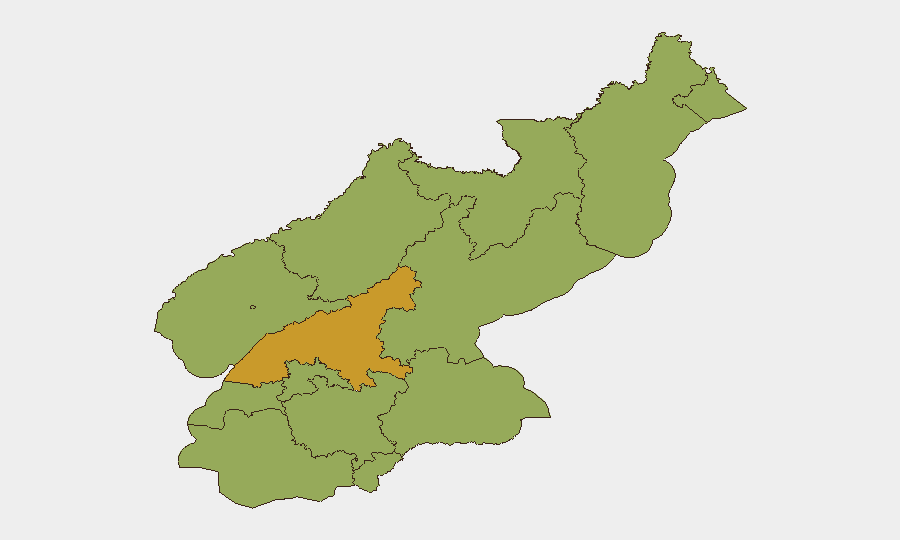
South Pyongan (risk 72.4) and Pyongyang (44.5) drive the highest sub-national scores, reflecting concentration of military infrastructure, weapons development, and regime control functions in the northwest. South Pyongan's elevated risk reflects proximity to strategic military installations and the Yongbyon nuclear complex in adjacent North Pyongan; Pyongyang's score reflects political sensitivity, internal security apparatus activity, and detention/legal-process risks. The remaining nine provinces cluster at 42.4, indicating relatively uniform baseline risk across the country driven by shared structural factors—state control, limited rule of law, and arbitrary enforcement—rather than localized instability.
How GeoBit Would Assist
Security teams with personnel or assets in North Korea should leverage GeoBit's AOI Monitoring & Early Warning capability on Yongbyon, DMZ corridors, and East Sea test zones to detect changes in nuclear or missile activity; OSINT fusion across state media, regional reporting, and imagery to track weapons-capability claims and deployments; and regime-stability search to monitor succession narratives and elite movement that could signal internal shifts affecting detention or travel policy.
7-Day Outlook
No major escalation is anticipated in the immediate week absent a provocative external event, as North Korea's focus remains on weapons testing and internal consolidation rather than new kinetic moves. Continued low-level military exercises, state media messaging on strategic capabilities, and routine border posturing are expected; any sudden shift in weapons-test frequency or border activity would warrant rapid reassessment of near-term risk trajectory.
Highest-Risk Areas — Ranked
| # | State / Region | Risk |
|---|---|---|
| 1 | South Pyongan | 72.4 |
| 2 | P'yŏngyang | 44.5 |
| 3 | Ryanggang | 42.4 |
| 4 | North Hamgyong | 42.4 |
| 5 | North Pyongan | 42.4 |
| 6 | Chagang | 42.4 |
| 7 | Nampo | 42.4 |
| 8 | South Hwanghae | 42.4 |
| 9 | North Hwanghae | 42.4 |
| 10 | South Hamgyong | 42.4 |
| 11 | Kaesong | 42.4 |
| 12 | Kangwon | 42.4 |