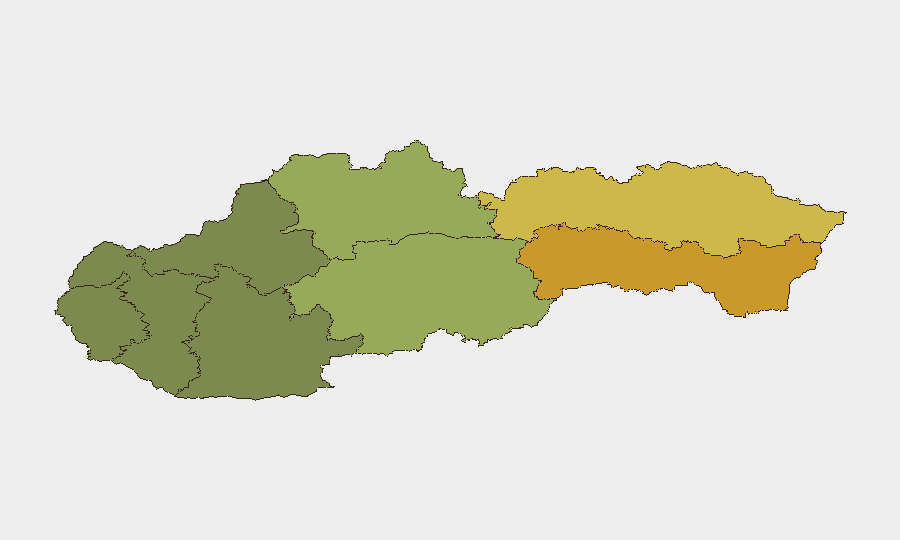
Situation Summary
Slovakia remains a low-threat environment globally (composite score 9), with no tracked security incidents in the past 24–48 hours. However, recent political strain—notably a Constitutional Court–mandated confidence vote in Prime Minister Fico's government on 18 June 2026 following a public debt breach—signals underlying fiscal and governance stress that may constrain policy stability and resource allocation in the coming weeks. Eastern regions, particularly Košice and Prešov, carry significantly elevated sub-national risk profiles and warrant focused monitoring by organizations with personnel or assets in those areas.
Key Developments
- Bratislava, National Level – 18 June 2026: Slovakia's parliament passed a confidence vote in PM Robert Fico's coalition government (78 of 150 votes), following a Constitutional Court ruling that forced the vote after the state breached its constitutional public debt ceiling. This outcome confirms short-term government continuity but underscores fiscal and political fragility.
- Hungary–Slovakia Border – 17 June 2026: Multiple diplomatic signals (disapproval exchanges and demands directed at the UN) involving Slovak and Hungarian state actors were recorded, reflecting ongoing bilateral tensions. No acute security escalation or border incidents have been reported as of this writing.
- Live incident data (18–19 June): No confirmed reports of terrorism, mass protests, critical infrastructure disruption, major crime spikes, or travel-advisory-level events in Slovakia in the last 24–48 hours have been identified in accessible sources.
Note on data limitations: Real-time feeds from Slovak Police (Polícia SR), Interior Ministry, and local city news outlets, as well as current embassy security alerts, were not available during this analysis window. Emerging incidents in Košice, Prešov, or other high-risk regions may not yet appear in indexed web sources.
Highest-Risk Areas
Košice Region (risk 72) and Prešov Region (risk 68) are substantially higher-risk than the western and central zones, likely reflecting cross-border crime, trafficking exposure, and organized-crime activity tied to proximity to Hungary, Ukraine, and Poland. Banská Bystrica (55) also warrants attention. By contrast, Bratislava (28), Trenčín (22), and Trnava (18) remain comparatively stable. Organizations with operations or staff in the eastern regions should apply heightened duty-of-care protocols, including staff briefing, incident-reporting workflows, and contingency planning.
How GeoBit Would Assist
GeoBit's AOI Monitoring & Early Warning capability would enable persistent watch on Košice and Prešov with automated alerting for emerging incidents (protests, crime, infrastructure disruption, or cross-border movement spikes). Multi-language OSINT fusion—combining Slovak police statements, local news outlets, X/Telegram signals, and cross-border regional feeds—would provide real-time situational awareness ahead of mainstream reporting. Risk & Threat Assessment and Network & Actor Analysis tools would help security teams map organized-crime and trafficking networks operating in eastern regions, informing site-security and personnel-movement decisions.
7-Day Outlook
Government continuity is assured for the near term, reducing acute political-destabilization risk. However, fiscal pressure and coalition strain may lead to policy volatility and reduced state capacity in law-enforcement and border management—factors that typically elevate localized crime and trafficking risk in eastern regions. No major escalation in Slovak–Hungarian tensions is anticipated in the next 7 days, but monitoring of diplomatic signals and border activity remains warranted.
Highest-Risk Areas — Ranked
| # | State / Region | Risk |
|---|---|---|
| 1 | Region of Košice | 72 |
| 2 | Region of Prešov | 68 |
| 3 | Region of Banská Bystrica | 55 |
| 4 | Region of Žilina | 42 |
| 5 | Region of Nitra | 35 |
| 6 | Region of Bratislava | 28 |
| 7 | Region of Trenčín | 22 |
| 8 | Region of Trnava | 18 |
Sources
Previous Daily Briefs
A new Slovakia brief is written every day — each with its own risk map and downloadable CSV. Here's the last week; use the calendar to go further back.
📅 Browse every day by calendar →
Highlighted days have a brief. Tap a day for that day's map & analysis, or “csv” for that day's dataset ($5).