Situation Summary
Turkmenistan remains a relatively stable, low-incident environment (global threat rank #160) with no confirmed major security events in the last 24 hours. However, the country is characterized by tight state control, heavily restricted information flows, and structural vulnerabilities—including food-security pressures, seismic risk, and acute sensitivity around southern land borders with Afghanistan and Iran. The absence of open-source incident reporting should not be interpreted as absence of lower-level unrest or crime; independent visibility is severely limited by authoritarian governance and media restrictions.
Key Developments
- Torghundi border crossing (Mary province, Turkmenistan–Afghanistan border): Taliban governor publicly called for 24-hour operations to expand trade after Pakistan disruptions, underscoring strategic sensitivity and potential for sudden closure or operational changes at this critical frontier.
- Southern land borders (Afghanistan and Iran frontiers): UK advisories confirm periodic unannounced closures and tight restrictions on cross-border movement, with high risk of disruption to travel and commerce without warning.
- Terrorism threat posture (nationwide): Both UK and US advisories note no recent history of terrorism in Turkmenistan but state attacks cannot be ruled out; global terrorist threat environment creates indirect risk to foreign nationals and assets.
- Document and identity controls (Ashgabat and urban centers): Police conduct periodic identity checks; foreign nationals must carry passports at all times, with risk of questioning or detention if documents absent—reflecting securitized internal environment.
- Road safety and enforcement (Ashgabat and intercity routes): Poor driving standards, dangerous night-driving conditions outside cities, and strict speed-limit enforcement (60 km/h in Ashgabat, enforced by cameras without warning) pose accident and law-enforcement risk.
- Petty crime and fraud (Ashgabat): Low overall crime baseline, but unlicensed taxis present recurrent fraud risk; some drivers illegally demand USD payment and overcharge foreigners.
- Food security and socioeconomic strain (nationwide): Government modernizing agriculture after years of reported shortages, import dependence, and high prices; previous reports of food problems in military indicate underlying structural pressure.
- Seismic vulnerability (countrywide): Turkmenistan lies in active seismic zone with regular tremors and history of strong earthquakes; risk to infrastructure, transport, and housing largely under-reported.
Highest-Risk Areas
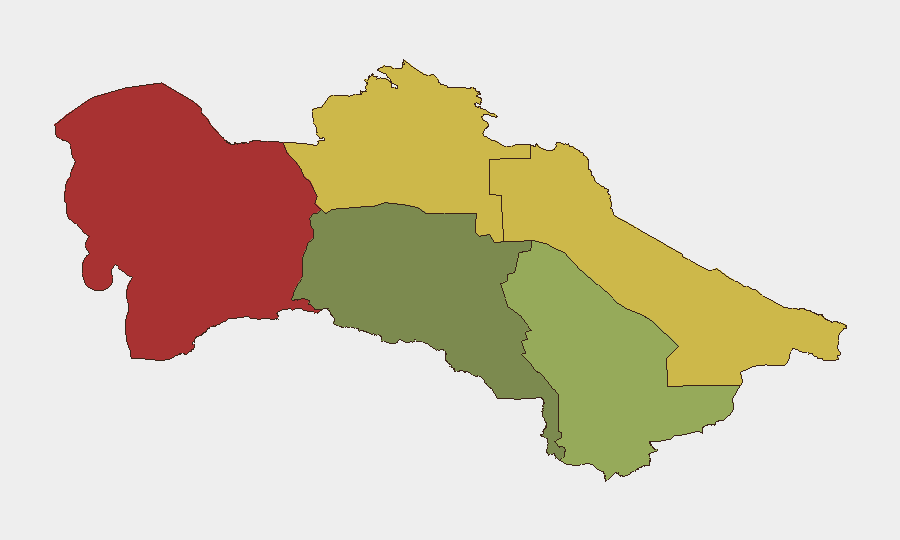
Balkan Region (#1, risk 78) and Lebap Region (#2, risk 68) dominate the sub-national risk profile, driven by proximity to Afghan and Iranian borders, porous frontier controls, and limited state presence. Dashoguz Region (#3, risk 62) presents similar border-related vulnerabilities. Ashgabat City (#6, risk 18) remains the lowest-risk jurisdiction, reflecting capital concentration of security apparatus and international presence, though petty crime and enforcement intensity remain material. Risk in southern and western regions correlates directly with border proximity and Taliban-controlled territory across the frontier.
How GeoBit Would Assist
A security team monitoring Turkmenistan would deploy AOI Monitoring & Early Warning to track Torghundi and southern border crossing status for sudden closures or operational changes. OSINT Fusion & Corroboration (X/Telegram, multi-language search, sentiment analysis) would compensate for restricted media by surfacing trader complaints, visa delays, or localized incidents in open channels. Intel Sweep and Routing & Network Analysis would enable alternative journey planning and asset-movement coordination around documented road hazards, speed enforcement, and document checkpoints.
7-Day Outlook
No acute crisis indicators signal imminent escalation. However, continued sensitivity around Taliban-controlled borders, ongoing agricultural modernization efforts, and structural under-reporting of lower-level incidents mean that localized disruptions—border closures, localized protest, or enforcement sweeps—could emerge with limited advance warning. Teams should maintain passive monitoring posture and assume heightened verification burden due to information opacity.
Highest-Risk Areas — Ranked
| # | State / Region | Risk |
|---|---|---|
| 1 | Balkan Region | 78 |
| 2 | Lebap Region | 68 |
| 3 | Dashoguz Region | 62 |
| 4 | Mary Region | 42 |
| 5 | Ahal Region | 35 |
| 6 | Ashgabat City | 18 |