Situation Summary
Venezuela faces an acute political and security crisis following the U.S. capture and extradition of President Nicolás Maduro on 2026-06-01, creating a command-and-control vacuum and triggering competing claims to state authority. U.S. military forces remain deployed at strategic sites throughout the country, with ongoing airspace and infrastructure volatility. The absence of centralized leadership has enabled entrenched criminal networks—particularly Tren de Aragua—to expand territorial control and violent operations in urban centers, while factional competition within security forces and political elites risks armed confrontation. Risk trajectory is upward over the near term.
Key Developments
- 2026-06-01, National: U.S. military raid captures Nicolás Maduro and his wife; both transferred to federal custody in Brooklyn. Maduro faces narco-terrorism and corruption charges. Remaining U.S. forces occupy key military and strategic infrastructure.
- 2026-06-01–06-02, Caracas Region: Satellite-confirmed "surgical" U.S. airstrikes target regime-linked military and security facilities in and around the capital; infrastructure damage and unexploded ordnance (UXO) hazards reported in strike zones.
- 2026-06-02, National: Caribbean airspace restrictions imposed during the U.S. operation are lifted as Maduro is secured in U.S. custody; commercial aviation resumption expected but remains operationally uncertain.
- 2026-06-03, International: International Criminal Court initiates investigation into Venezuela; prison oversight body and hospital administration formally disapprove of regime actions; multiple international actors issue public statements on the political situation.
- 2026-06-01–06-03, Caracas and Major Cities: Criminal gang activity (particularly Tren de Aragua) escalates as central authority weakens; kidnapping, extortion, and territorial violence increase in urban neighborhoods and transport corridors.
- 2026-06-01–06-03, National Oil Belt and Export Terminals: U.S. political statements referencing control of Venezuelan oil reserves raise uncertainty over PDVSA facility security, potential labor unrest, and export infrastructure integrity; sabotage and factional seizure risks elevated.
- 2026-06-01–06-03, National: Competing political and media narratives circulate regarding U.S. intentions ("law enforcement" vs. "takeover"); information operations and disinformation risks fuel spontaneous protests, roadblocks, and community-level unrest.
Highest-Risk Areas
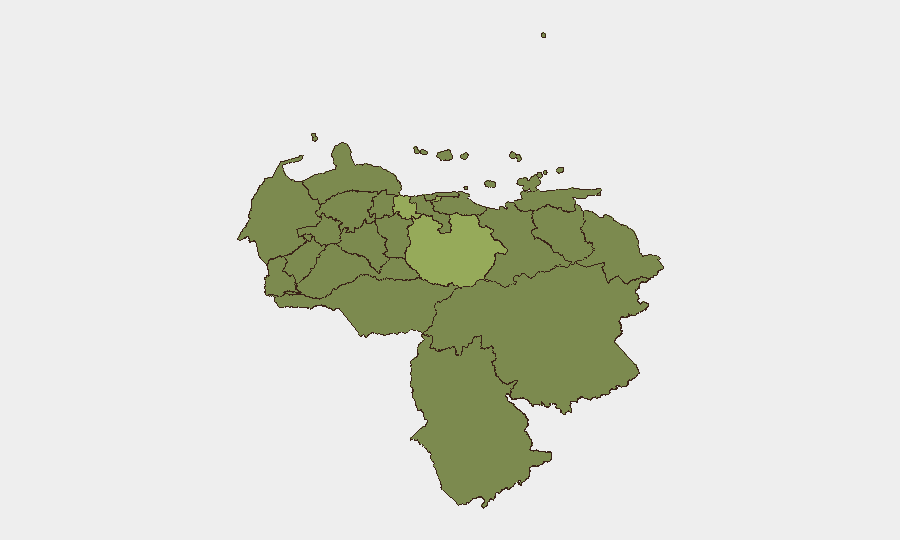
Guarico State (54.6), Federal District/Caracas (44.1), and Carabobo State (42.9) register the highest composite threat scores and drive national-level risk. Caracas remains the epicenter of political instability, command-and-control fragmentation, and criminal-gang competition for territorial control; the Federal District encompasses the capital's administrative, security, and symbolic infrastructure. Guarico State's elevated score reflects its strategic geography, proximity to military installations, and gang-trafficking networks. These three regions should receive priority monitoring for factional clashes, criminal violence, infrastructure disruption, and spontaneous civil unrest.
How GeoBit Would Assist
Security teams should deploy AOI (Area-of-Interest) Monitoring & Early Warning with persistent alerting on Caracas, Guarico, and Carabobo to detect signs of factional mobilization, criminal activity escalation, or protest activity in real time. Conflict & Military capabilities—including force-structure analysis and battle mapping—enable tracking of competing security-force positions and potential armed clashes. OSINT Fusion (X/Twitter, Telegram, YouTube, multi-language search, sentiment analysis) provides early detection of disinformation narratives, localized unrest calls, and criminal-network coordination before physical incidents occur.
7-Day Outlook
The near-term period (7 days) will likely see continued factional jockeying for control of Caracas and key military/resource sites, with criminal networks exploiting the authority vacuum through heightened kidnappings and territorial violence. U.S. military presence and follow-on strike risk remain elevated if pro-Maduro resistance hardens or perceived U.S. interests are threatened. International pressure and ICC investigation will intensify political polarization and risk of nationalist, anti-U.S. mobilization and localized unrest in opposition strongholds.
Highest-Risk Areas — Ranked
| # | State / Region | Risk |
|---|---|---|
| 1 | Guarico State | 54.6 |
| 2 | Federal District | 44.1 |
| 3 | Carabobo State | 42.9 |
| 4 | Anzoategui State | 29.6 |
| 5 | Amazonas State | 29.6 |
| 6 | Sucre State | 29.4 |
| 7 | Zulia State | 29.2 |
| 8 | Tachira State | 27.3 |
| 9 | Monagas State | 25.7 |
| 10 | Falcon State | 24.6 |
| 11 | Federal Dependencies | 24.6 |
| 12 | Nueva Esparta State | 24.6 |
Previous Daily Briefs
A new Venezuela brief is written every day — each with its own risk map and downloadable CSV. Here's the last week; use the calendar to go further back.
📅 Browse every day by calendar →
Highlighted days have a brief. Tap a day for that day's map & analysis, or “csv” for that day's dataset ($5).