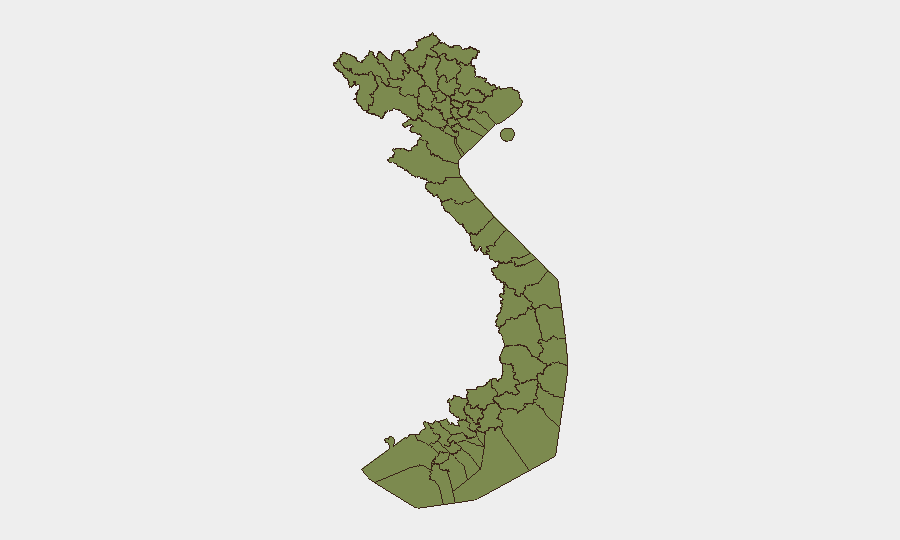
Situation Summary
Vietnam remains a mid-tier global security risk (rank #50, score 5.6) with acute exposure to sophisticated cyber threats and state-directed digital surveillance. Recent days have brought disclosure of two ministry-level data breaches, exfiltration of 160+ million national credit records by ShinyHunters, and confirmation of ongoing APT32 espionage operations—signaling a systemic shift toward higher-impact, targeted attacks against critical infrastructure and sensitive populations. Geographic risk remains heavily concentrated in Huế (risk 33.9), which dominates national threat reporting, while broader cyber and state-surveillance threats affect all major urban and administrative centers.
Key Developments
- National cyber incident surge (2026-06-02/03): Vietnam's National Cybersecurity Center disclosed two active, high-severity breaches of ministry-level information systems affecting millions of user records; existing security operations centers (SOCs) failed to detect intrusions that blended into normal traffic, indicating advanced evasion capability.
- National Credit Information Center (CIC) mass-breach (2026-06-03): ShinyHunters hacker group confirmed to have compromised CIC database, exfiltrating 160+ million credit records (possibly billions of rows) containing personally identifiable and financial data; records offered for sale on underground forums.
- Ho Chi Minh City financial-sector alert (2026-06-03): VNCERT and Ho Chi Minh City police issued heightened fraud and identity-theft warnings to banks and financial institutions following CIC breach disclosure, reflecting downstream operational and credit-risk exposure across the financial system.
- Systemic ransomware escalation (trend through 2026-Q2): Vietnam's Ministry of Information and Communications reported that ransomware and sophisticated attacks against telecoms, energy, securities, and logistics sectors have increased in *severity* (operational disruption, financial and reputational damage) despite lower recorded incident counts, indicating attacker professionalism is rising.
- State-linked APT32 espionage persistence (chronic): Ocean Lotus (APT32) continues conducting spyware campaigns against Vietnamese activists, dissidents, foreign governments, and companies, reportedly coordinated with state authorities; estimated 10,000-strong "cyber-troops" sustain information-control operations nationwide.
- Vietnam Post ransomware precedent (recent): State-owned Vietnam Post suffered ransomware attack forcing IT disconnection and nationwide postal/delivery disruption for several days, illustrating systemic vulnerability in logistics and public-service infrastructure.
- Australian–Vietnam tension escalation (2026-06-02): Multiple threat signals logged on 2026-06-02 between Australian and Vietnamese actors, suggesting elevated diplomatic or cyber-political tension; context and scope require monitoring.
Highest-Risk Areas
Huế's exceptional risk score (33.9) stands isolated and requires urgent clarification of underlying drivers; without sector-specific or incident detail, the spike warrants immediate investigation to determine whether it reflects political instability, organized crime, or concentrated cyber/infrastructure targeting. The second tier—Thái Nguyên and Hải Dương provinces (both 8.5)—suggests manufacturing and logistics-sector exposure. Hà Nội (7.0) reflects capital-city exposure to financial, government, and multinational targeting. Northern border provinces (Lai Châu, Lào Cai, Hà Giang, and others, all 3.9) show baseline cross-border risks typical of frontier regions.
How GeoBit Would Assist
A security team protecting personnel and assets in Vietnam should employ Network & Actor Analysis to map APT32 and ShinyHunters infrastructure and targeting patterns; Intel Sweep and multi-language OSINT (X/Twitter, Telegram, underground forums) to monitor hacker chatter, data-sale announcements, and state-linked disinformation campaigns; and AOI Monitoring & Early Warning pinned to Huế, Ho Chi Minh City, and Hà Nội to detect emerging incidents in real time. Risk & Threat Assessment workflows would synthesize ministry breach indicators and financial-sector breach cascades to anticipate credit-fraud and identity-theft waves affecting employees and supply chains.
7-Day Outlook
Financial and critical-infrastructure sectors will likely experience elevated credential-compromise and fraud attempts as CIC data circulates and downstream exploitation accelerates; organizations should assume SOC evasion techniques demonstrated in recent ministry breaches remain active. APT32 activity and state cyber-troop coordination will persist, sustaining risk to foreign entities' communications, employee devices, and political-risk exposure. Clarification of Huế risk drivers and Australian–Vietnamese tension context is expected within 48–72 hours.
Highest-Risk Areas — Ranked
| # | State / Region | Risk |
|---|---|---|
| 1 | Huế | 33.9 |
| 2 | Thái Nguyên Province | 8.5 |
| 3 | Hải Dương Province | 8.5 |
| 4 | Hà Nội | 7 |
| 5 | Ninh Thuận Province | 6.2 |
| 6 | Lai Châu Province | 3.9 |
| 7 | Lào Cai Province | 3.9 |
| 8 | Hà Giang Province | 3.9 |
| 9 | Tuyên Quang Province | 3.9 |
| 10 | Cao Bằng Province | 3.9 |
| 11 | Bắc Kạn Province | 3.9 |
| 12 | Điện Biên Province | 3.9 |
Sources
Previous Daily Briefs
A new Vietnam brief is written every day — each with its own risk map and downloadable CSV. Here's the last week; use the calendar to go further back.
📅 Browse every day by calendar →
Highlighted days have a brief. Tap a day for that day's map & analysis, or “csv” for that day's dataset ($5).