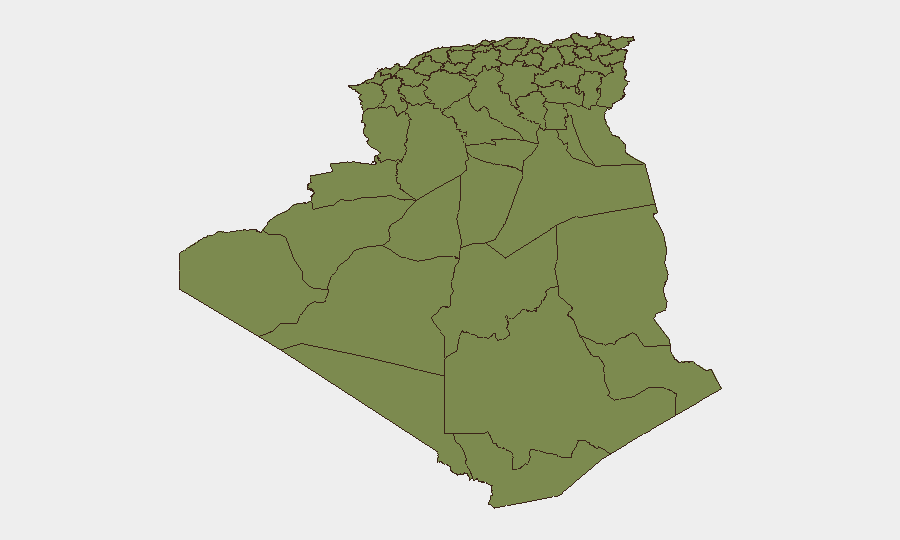
Situation Summary
Algeria remains a mid-tier composite security risk (rank #73 globally, score 16) with no reliably documented security incidents, attacks, or major civil unrest in the last 24–48 hours. The country continues to face chronic terrorism and militant activity concentrated in the southern Saharan regions, particularly In Salah, alongside historical grievances and political constraints that create structural fragility. Current trajectory suggests stability in urban centres and the north, offset by persistent low-intensity insurgent activity in energy-producing zones and remote border areas.
Key Developments
No discrete security, conflict, crime, or infrastructure incidents were reliably documented in Algeria during the 24–48 hour window (2026-06-23 to 2026-06-25).
Available web research and open-source feeds contain no time-stamped reports of attacks, riots, kidnappings, sabotage, or service disruptions meeting verification standards for this briefing. Structural issues (e.g., humanitarian gaps, diplomatic posture) and incidents outside Algeria (e.g., supporter clashes in Qatar and New York) do not constitute current threat developments for on-the-ground operations.
A 7-day research window is recommended to establish actionable incident reporting.
Highest-Risk Areas
In Salah dominates the sub-national risk ranking (31.9), reflecting its status as Algeria's primary oil and gas production zone and a persistent focus for militants exploiting remote terrain, porous borders, and logistical vulnerabilities. Tipaza (16.9) ranks second, likely reflecting proximity to Algiers and a history of militant recruitment and low-level activity, though current intensity remains modest. The remaining ten tracked regions cluster at 1.9, indicating either controlled risk or limited incident density in the current reporting window. Organizations with personnel or assets in In Salah should maintain heightened situational awareness and supply-chain resilience; those in Tipaza and greater Algiers should monitor political gatherings and border-region reporting.
How GeoBit Would Assist
Security teams should deploy AOI Monitoring & Early Warning on In Salah's energy infrastructure and key transport corridors to detect militant movement or disruption signals before escalation. Intel Sweep combined with multi-language OSINT fusion (X, Telegram, local news feeds) provides continuous, low-latency awareness of protest activity, militant claims, and security-force operations across Tipaza and Algiers. For duty-of-care planning, Routing & Network Analysis identifies alternative supply and evacuation routes that bypass high-risk southern zones, while Risk & Threat Assessment models personnel exposure in real time as conditions change.
7-Day Outlook
Barring a discrete incident or sudden policy shift, Algeria is expected to remain operationally stable in the short term, with routine militant activity confined to the deep south and energy sector. Monitoring should intensify if there are signs of coordination between groups, escalation in targeting of foreign nationals, or disruption to hydrocarbon supply chains. A 7-day research refresh is recommended to capture any emerging developments.
Highest-Risk Areas — Ranked
| # | State / Region | Risk |
|---|---|---|
| 1 | In Salah | 31.9 |
| 2 | Tipaza | 16.9 |
| 3 | Bechar | 1.9 |
| 4 | Beni Abbes | 1.9 |
| 5 | Adrar | 1.9 |
| 6 | Bordj Badji Mokhtar | 1.9 |
| 7 | El Bayadh | 1.9 |
| 8 | Ghardaia | 1.9 |
| 9 | Saïda | 1.9 |
| 10 | Algiers | 1.9 |
| 11 | Boumerdes | 1.9 |
| 12 | Tizi Ouzou | 1.9 |
Sources
Previous Daily Briefs
A new Algeria brief is written every day — each with its own risk map and downloadable CSV. Here's the last week; use the calendar to go further back.
📅 Browse every day by calendar →
Highlighted days have a brief. Tap a day for that day's map & analysis, or “csv” for that day's dataset ($5).