Situation Summary
Armenia remains a stable country globally (#65 composite threat score, 2.2) but faces elevated political risk in the immediate aftermath of 7 June 2026 parliamentary elections. Post-election tension centers on opposition claims of irregularities and external pressure documented by OSCE/ODIHR observers, creating conditions for localized protest mobilization rather than kinetic conflict. The security environment is primarily political and information-based rather than terrorist or military in nature, though sub-national concentration of risk in Yerevan (31.5) and Ararat Province (21.4) reflects capital-centric governance and political volatility.
Key Developments
- Yerevan, 8 June 2026 – OSCE/ODIHR preliminary statement on the 7 June elections documented "direct pressure from abroad" in the form of trade restrictions and security threats aimed at influencing voters, signaling a heightened strategic-risk environment tied to Armenia's EU orientation and Russian geopolitical pressure.
- Yerevan, evening 7 June 2026 – Large crowds of ruling Civil Contract supporters held celebrations in central Yerevan following election night, with smaller opposition groups disputing results; police presence was visible but restrained, with no major clashes reported.
- Yerevan, 7–8 June 2026 – Opposition figures and Armenia Alliance backers alleged electoral unfairness via social media, explicitly rejecting results and signaling non-negligible risk of protest rallies or sit-ins in the capital and other urban centers in coming days.
- Nationwide, 7–8 June 2026 – Regional media and analysts framed the election explicitly as a referendum on Armenia's EU tilt versus Russian influence; heightened information-operations pressure from Moscow contributed to perception of strategic uncertainty.
- Nationwide, 7 June 2026 – Election day security posture included increased police deployment nationwide; voting proceeded calmly overall with no confirmed outbreaks of systematic violence or polling-station intimidation, though procedural irregularities were noted.
Highest-Risk Areas
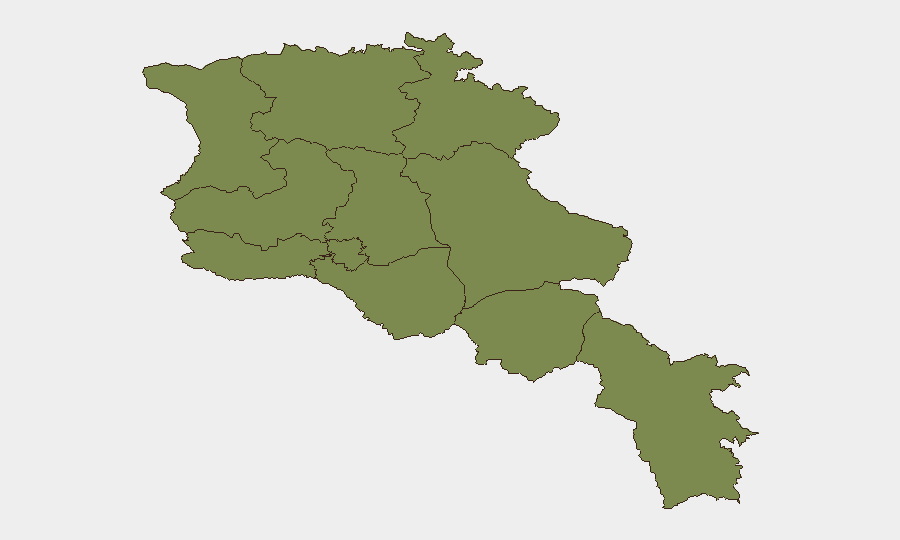
Yerevan dominates the risk profile (31.5), reflecting concentration of political authority, media, opposition organizing capacity, and security force deployments. Post-election protests, sit-ins, and political confrontations will almost certainly center there. Ararat Province (21.4) ranks second, likely tied to demographic and socioeconomic factors relevant to political mobilization but not to immediate kinetic threat. The remaining nine provinces each score 3.3 or below, indicating that security risk is capital-centric and primarily political rather than distributed across borderlands or minority areas. Travel and asset exposure in Yerevan should assume elevated protest activity and potential localized road closures; provincial operations face minimal election-related disruption.
How GeoBit Would Assist
Security and duty-of-care teams should deploy Election Monitoring (OSCE-aligned oversight and real-time polling/protest tracking), AOI Monitoring & Early Warning (persistent watch on central Yerevan and key opposition organizing sites with alert protocols for rally formation), and OSINT Fusion (multi-language social-media and news aggregation to detect protest calls and political statements before mobilization). Routing & Network Analysis enables contingency-path planning around likely protest sites and police cordons, while Sentiment & Temporal Analysis on Armenian and diaspora social platforms can provide 12–24-hour early warning of escalation in rhetoric that typically precedes street action.
7-Day Outlook
Opposition protest activity in Yerevan is probable within 7–10 days as legal challenges and public mobilization intensify; magnitude and duration will depend on government response and perceived legitimacy of official results. No kinetic escalation with security forces or cross-border incidents are forecast. International mediation (OSCE, EU) and media coverage will likely remain high, sustaining political tension but not acute operational risk for most organizations. Asset-level contingency planning should prioritize mobility protocols and secure facilities in or near the capital.
Highest-Risk Areas — Ranked
| # | State / Region | Risk |
|---|---|---|
| 1 | Yerevan | 31.5 |
| 2 | Ararat Province | 21.4 |
| 3 | Shirak Province | 3.3 |
| 4 | Armavir Province | 2.1 |
| 5 | Vayots Dzor Province | 2 |
| 6 | Lori Province | 1.5 |
| 7 | Tavush Province | 1.5 |
| 8 | Kotayk Province | 1.5 |
| 9 | Gegharkunik Province | 1.5 |
| 10 | Syunik Province | 1.5 |
| 11 | Aragatsotn Province | 1.5 |
Sources
Previous Daily Briefs
A new Armenia brief is written every day — each with its own risk map and downloadable CSV. Here's the last week; use the calendar to go further back.
📅 Browse every day by calendar →
Highlighted days have a brief. Tap a day for that day's map & analysis, or “csv” for that day's dataset ($5).