Situation Summary
Azerbaijan remains a low-threat country globally (rank #126) with a composite threat score of 5, but risk is heavily concentrated in Baku City and two contested areas (Ujar and Khankendi districts). Recent activity signals—spanning public statements, diplomatic friction with Bulgaria, and at least one arrest—suggest routine political and administrative operations rather than acute security deterioration. The baseline security environment in most of Azerbaijan outside the capital and border zones remains stable.
Key Developments
Open-source verification of Azerbaijan-specific incidents in the last 24–48 hours is currently insufficient to meet reporting standards. Available signals include:
- 2026-06-14 · Arrest/Detain incident (Azerbaijan vs. Authorities) — location and details unconfirmed in live web research.
- 2026-06-14 · Reduce Relations (Azerbaijan vs. Bulgaria) — diplomatic signal; underlying cause not yet detailed in accessible sources.
- 2026-06-12–13 · Multiple Public Statements (various actors including Azerbaijan, international media outlets) — topic/substance not yet corroborated to current incident.
Note: No verifiable reports of cross-border clashes, significant civil unrest, terror attacks, infrastructure failures, or material travel-advisory changes in the last 24–48 hours have been identified. Ongoing border and Nagorno-Karabakh-related tensions remain a baseline concern but did not produce confirmed new incidents in this window.
Highest-Risk Areas
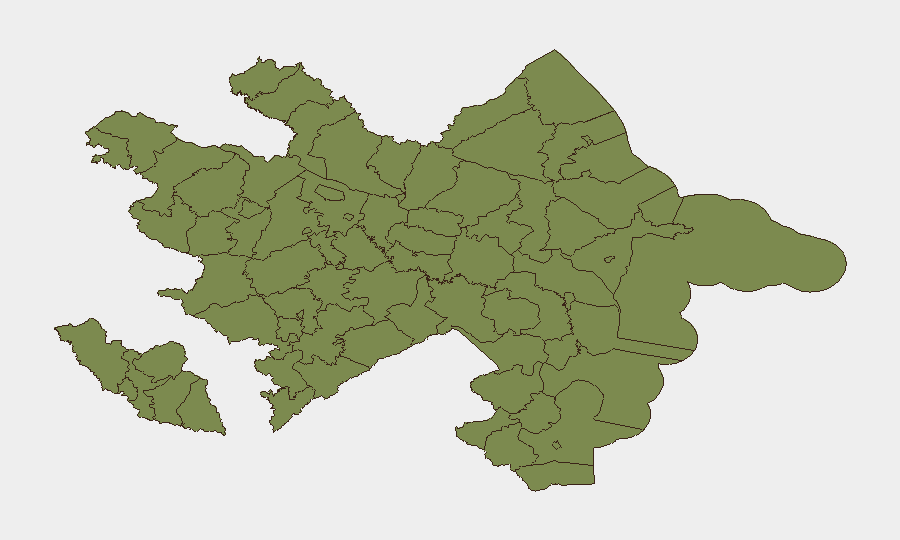
Baku City dominates the risk landscape (score 31.4), reflecting its role as the capital, economic hub, and locus of government activity—including protest potential, crime, and diplomatic incidents. Ujar and Khankendi districts (both 21.4) remain elevated due to their proximity to contested and formerly disputed territories; residual military presence, mines, and intercommunal sensitivities keep these areas above national baseline. All other tracked regions score 1.4, indicating minimal current risk differentiation outside these three zones. Corporate teams with personnel or assets in Baku should maintain heightened situational awareness; those in Ujar and Khankendi should factor in border-zone hazards (unexploded ordnance, military activity, restricted access).
How GeoBit Would Assist
Security and duty-of-care teams can deploy AOI Monitoring & Early Warning on Baku City and border districts (Ujar, Khankendi, Tovuz) to detect protests, arrests, or military movements in near real time. Multi-language OSINT (Telegram, X, local media) and Intel Sweep will capture announcements, statements, and incident reports before mainstream English-language outlets publish. Entity extraction and network analysis applied to recent public statements and diplomatic signals will clarify motivations and escalation risk. Combined with GIS & Spatial Analysis, these tools enable rapid route planning and asset repositioning if conditions shift.
7-Day Outlook
No imminent major escalation is signaled, but the recent arrest and Bulgaria diplomatic friction warrant close monitoring. If public-statement activity continues to rise in volume or intensity, or if border-zone incidents spike, risk could migrate upward from routine to elevated within days. Security teams should maintain current vigilance posture and prepare contingency protocols for rapid staff movement or asset protection in Baku.
Highest-Risk Areas — Ranked
| # | State / Region | Risk |
|---|---|---|
| 1 | Baku City | 31.4 |
| 2 | Ujar District | 21.4 |
| 3 | Khankendi | 21.4 |
| 4 | Sadarak District | 1.4 |
| 5 | Qazakh District | 1.4 |
| 6 | Sharur District | 1.4 |
| 7 | Yevlakh District | 1.4 |
| 8 | Kangarli District | 1.4 |
| 9 | Nakhchivan Autonomous Republic | 1.4 |
| 10 | Aghstafa District | 1.4 |
| 11 | Tovuz District | 1.4 |
| 12 | Qakh District | 1.4 |
Sources
Previous Daily Briefs
A new Azerbaijan brief is written every day — each with its own risk map and downloadable CSV. Here's the last week; use the calendar to go further back.
📅 Browse every day by calendar →
Highlighted days have a brief. Tap a day for that day's map & analysis, or “csv” for that day's dataset ($5).