Situation Summary
Bangladesh remains at moderate-to-elevated threat (rank #29 globally, composite score 68.5) with volatile dynamics across Dhaka and Chittagong divisions. The past 48 hours have seen a spike in targeted political violence, intensified India–Bangladesh border friction over illegal migration and alleged push-back operations, and increased detention activity. The convergence of these signals—political instability, border tension, and law-enforcement intensity—reflects a period of heightened operational risk, particularly in urban centers and frontier zones.
Key Developments
- Dhaka city – fatal stabbing of opposition-linked figure (8 June, ~20:00 local time). Billal Hossain Talukdar, a former Swecchasebak Dal leader, was stabbed fatally in the chest near Anarkali Market, New Market area. Two suspects were arrested by 9 June. This signals renewed political-faction violence in Dhaka's densest commercial zone.
- Jhenaidah District – border confrontation: BGB thwarted 10 attempted push-ins (past 24 hours, 9 June). Border Guard Bangladesh reported foiling 10 separate incursions by Indian Border Security Force personnel attempting to force individuals illegally into Bangladesh across multiple frontier points, including a four-to-five-person group at Jadabpur border. Reflects heightened cross-border enforcement and potential for localized standoffs.
- Netrakona District – intelligence on imminent cross-border push (past 24 hours, 9 June). BGB detected 15–20 individuals assembled at Balishi Gitaram Government Primary School (Assam, India) opposite Kochugora border, positioned for alleged illegal entry into Bangladesh. BGB increased patrols and surveillance in response. Indicates pre-positioning of migrants and escalating border-security alertness.
- India–Bangladesh frontier – reported refusal to accept pushed-back group (past 48 hours). Social reports indicate Bangladeshi authorities rejected acceptance of approximately 30 individuals pushed back from India at an unspecified border sector, resulting in a brief frontier standoff. Signals deepening diplomatic friction and potential for confrontation over repatriation practices.
- Countrywide detention activity and public disapproval statements (8 June). Multiple arrests and detention reports, alongside public statements of disapproval directed at both detainees and government officials, suggest an intensified law-enforcement campaign concurrent with political tensions. Pattern consistent with a crackdown phase.
- BSF deportation surge: 386 Bangladeshi nationals repatriated (past 48 hours). Indian Border Security Force operations ejected 386 irregular Bangladeshi migrants within 48 hours, indicating heightened Indian border enforcement and likelihood of corresponding backlogs and friction points on the Bangladeshi side.
Highest-Risk Areas
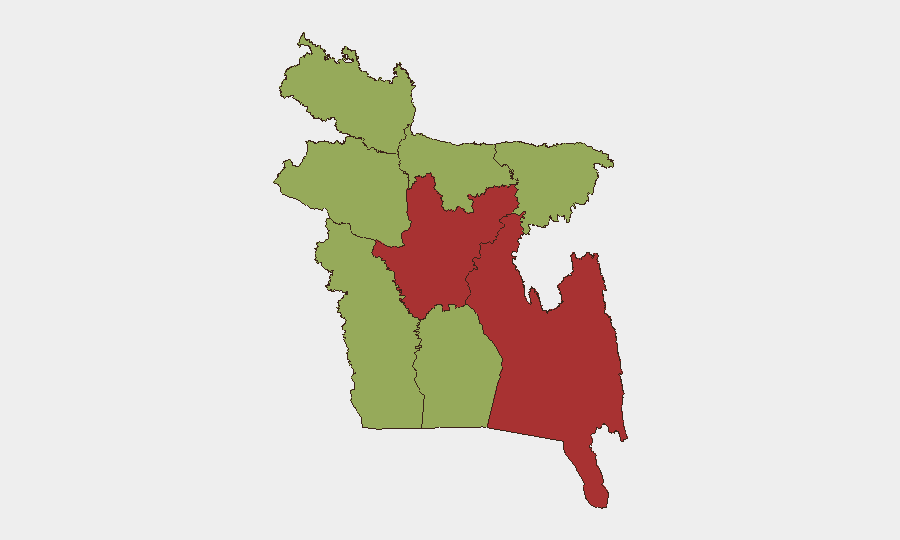
Dhaka Division (77.9) and Chittagong Division (76.4) dominate the threat landscape. Dhaka's risk is driven by urban political violence, dense commercial infrastructure, and law-enforcement activity targeting opposition figures and networks. Chittagong, Bangladesh's second-largest city and major port, faces compounded risks from organized crime, trafficking networks, and periodic militant activity. Barishal (55.1) and Rangpur (54.6) divisions show elevated but secondary risk, with Barishal linked to maritime smuggling and Rangpur to border instability. Remaining divisions (Khulna, Rajshahi, Mymensingh, Sylhet) cluster below 50, reflecting lower but persistent localized tensions.
How GeoBit Would Assist
Security teams would deploy AOI Monitoring & Early Warning on Dhaka's opposition strongholds and major markets, coupled with Intel Sweep and X/Telegram OSINT to detect faction messaging and mobilization signals ahead of violence. Border & Disputed-Territory Search and GIS & Spatial Analysis enable real-time tracking of cross-border push-in incidents, illegal migration flows, and patrol positioning along India–Bangladesh frontier sectors. Network & Actor Analysis maps political factions and criminal networks driving Dhaka instability.
7-Day Outlook
Political violence in Dhaka is likely to persist as opposition-linked figures remain targeted. India–Bangladesh border friction will sustain at elevated levels given ongoing migration pressure and disagreement over repatriation protocols; localized standoffs are possible but unlikely to escalate into major military confrontation. Law-enforcement activity will remain intensive; travel in Dhaka and near border zones (Jhenaidah, Netrakona) should be avoided or carefully coordinated with local security advisors.
Highest-Risk Areas — Ranked
| # | State / Region | Risk |
|---|---|---|
| 1 | Dhaka Division | 77.9 |
| 2 | Chittagong Division | 76.4 |
| 3 | Barishal Division | 55.1 |
| 4 | Rangpur Division | 54.6 |
| 5 | Khulna Division | 49 |
| 6 | Rajshahi Division | 48.5 |
| 7 | Mymensingh Division | 47.9 |
| 8 | Sylhet Division | 47.9 |
Sources
Previous Daily Briefs
A new Bangladesh brief is written every day — each with its own risk map and downloadable CSV. Here's the last week; use the calendar to go further back.
📅 Browse every day by calendar →
Highlighted days have a brief. Tap a day for that day's map & analysis, or “csv” for that day's dataset ($5).