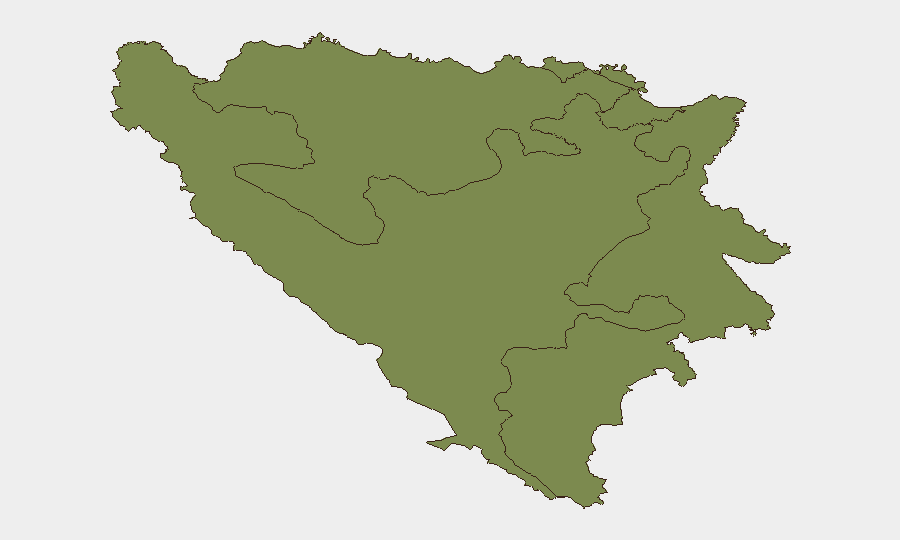
Situation Summary
Bosnia and Herzegovina remains stable with no significant security incidents reported in the last 24–48 hours across major international or regional news sources. The country's composite threat score of 7 reflects long-standing structural vulnerabilities—ethnic tensions, organized crime, and informal power networks—rather than acute active crises. The Federation of Bosnia and Herzegovina carries substantially elevated risk (31.3) compared to Republika Srpska and Brčko District, driven primarily by concentrated organized-crime and corruption dynamics in urban centers. Overall trajectory remains low-intensity and static.
Key Developments
No security, civil-unrest, crime, terrorism, or critical infrastructure incidents meeting confirmation criteria (recent, multi-source, specific location/date) were identified in Bosnia and Herzegovina in the last 24–48 hours. Open-source search results for the period are dominated by sports coverage and older policy items (EU/FATF compliance discussions, historical political items); no new protests, clashes, arrests, or infrastructure disruptions are documented by international wires or regional English-language media.
A flood event (reference ID 1103946) is indexed in GEOBIT event signals as recent; however, current research does not yield specific date, location, or impact confirmation required for operational briefing. *Recommend GeoBit AOI Monitoring & Early Warning refresh and local-source corroboration before risk assessment.*
Highest-Risk Areas
The Federation of Bosnia and Herzegovina dominates subnational risk (score 31.3 vs. 1.3 for both Republika Srpska and Brčko District), reflecting urban organized-crime networks, corruption in state and cantonal administration, and higher population density. Sarajevo, Mostar, Tuzla, and Zenica—major Federation urban centers—historically concentrate trafficking, financial crime, and black-market activity. Republika Srpska's lower score reflects both lower urbanization and institutional separation; Brčko District is comparatively isolated. Corporate and NGO staff should apply elevated due diligence to Federation operations, particularly around procurement, cash handling, and supply-chain visibility.
How GeoBit Would Assist
Intelligence Sweep & OSINT Fusion would consolidate fragmented Bosnian media, police statements, municipal announcements, and regional reporting to detect emerging crime, protest, or infrastructure signals before they reach international wires. AOI Monitoring & Early Warning with persistent watch on Federation urban zones and border regions would generate real-time alerts on civil unrest, checkpoint activity, or trafficking indicators. Network & Actor Analysis would map organized-crime and corruption nodes within Federation administration, enabling teams to assess counterparty risk and exposure before engagement. Routing & Network Analysis would support dynamic journey planning for staff in high-risk cantons, incorporating real-time incident and checkpoint data.
7-Day Outlook
No major political, security, or infrastructure events are anticipated in the next seven days. Mid-year administrative and EU compliance cycles continue at the policy level without operational risk. Standard vigilance on organized-crime activity in Federation urban centers and informal border movement should remain in place; seasonal summer mobility and tourism will increase population movement without materially changing threat profile. Indicator watch should focus on cantonal-level administration changes, FATF/EU monitoring outcomes, and local-source reporting of organized-crime enforcement actions.
RECOMMENDATION: Activate local in-country intelligence collection and media monitoring to supplement open-source gaps. Contact GeoBit for AOI Monitoring setup on Federation urban centers.
Highest-Risk Areas — Ranked
| # | State / Region | Risk |
|---|---|---|
| 1 | Federation of Bosnia and Herzegovina | 31.3 |
| 2 | Republika Srpska | 1.3 |
| 3 | Brčko District | 1.3 |
Sources
Previous Daily Briefs
A new Bosnia and Herzegovina brief is written every day — each with its own risk map and downloadable CSV. Here's the last week; use the calendar to go further back.
📅 Browse every day by calendar →
Highlighted days have a brief. Tap a day for that day's map & analysis, or “csv” for that day's dataset ($5).