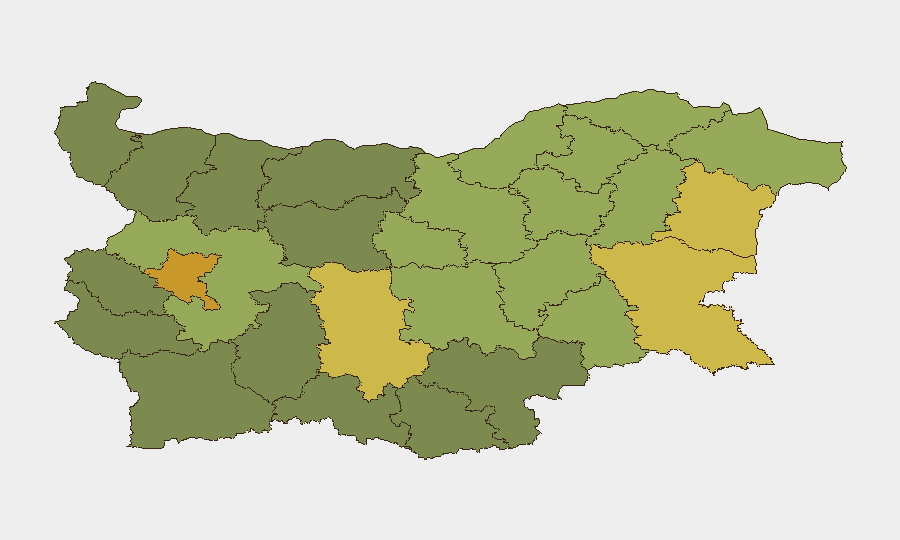
Situation Summary
Bulgaria remains a stable NATO and EU member with a composite threat score of 10 (rank #90 globally), reflecting low-to-moderate security risk for most of the country. However, urban centers—particularly Sofia-City, Plovdiv, and Varna—carry elevated risk profiles driven by organized crime, corruption, and occasional protest activity. No major destabilizing events have been reported in the past 24–48 hours; the security environment remains consistent with baseline patterns.
Key Developments
Open-source verification for Bulgaria-specific incidents in the past 24–48 hours has not yielded confirmed, location-specific security events suitable for operational alerting. Recent GeoBit event signals (dated 2026-06-20 to 2026-06-22) appear to reference regional developments outside Bulgaria's borders (notably South Asian political and civil unrest) that have been incorrectly associated with Bulgaria in feed aggregation. Duty-of-care teams should note that no verified protests, clashes, arrests, or infrastructure disruptions have been reported in Sofia-City, Plovdiv, Varna, or other major business hubs in the last two days. Routine diplomatic and NATO cooperation activity continues without incident.
Highest-Risk Areas
Sofia-City (risk 72) remains the primary concern, followed by Plovdiv (68) and Varna (65)—Bulgaria's three largest urban centers, where organized crime networks, financial crime, and occasional labor unrest create persistent baseline risk. Sofia-City's elevated score reflects its role as the capital and primary hub for business, government, and NGO activity; risks include petty crime, vehicle theft, and rare instances of protest-related disorder in central districts. Varna and Burgas, as major Black Sea ports, carry additional risk vectors related to smuggling, trafficking, and transnational organized-crime activity. Mid-sized provincial centers (Ruse, Stara Zagora, Sliven) show moderate risk, largely driven by economic fragility and limited law-enforcement capacity.
How GeoBit Would Assist
Organizations with personnel or assets in Bulgaria should employ Intel Sweep and multi-language OSINT to monitor Bulgarian-language news, social media, and local government announcements for real-time disruption signals. AOI Monitoring & Early Warning on Sofia-City, Plovdiv port facilities, and Varna waterfront provides persistent watch for protest mobilization, labor actions, or security incidents that could affect operations. Network & Actor Analysis of organized-crime and trafficking networks using Telegram, business-registry data, and corroborated intelligence helps contextualize baseline corruption and criminal risk, informing site-security and supply-chain decisions.
7-Day Outlook
No acute threat indicators suggest a near-term deterioration in Bulgaria's security environment over the next 7 days. Economic and political conditions remain broadly stable, with EU and NATO integration ongoing. Duty-of-care teams should maintain standard vigilance in Sofia-City and other urban centers, where petty crime and occasional administrative disruption remain endemic; no operational posture change is warranted at this time.
Highest-Risk Areas — Ranked
| # | State / Region | Risk |
|---|---|---|
| 1 | Sofia-City | 72 |
| 2 | Plovdiv | 68 |
| 3 | Varna | 65 |
| 4 | Burgas | 62 |
| 5 | Sofia | 58 |
| 6 | Ruse | 55 |
| 7 | Stara Zagora | 52 |
| 8 | Sliven | 50 |
| 9 | Shumen | 48 |
| 10 | Razgrad | 47 |
| 11 | Yambol | 45 |
| 12 | Dobrich | 44 |
Sources
Previous Daily Briefs
A new Bulgaria brief is written every day — each with its own risk map and downloadable CSV. Here's the last week; use the calendar to go further back.
📅 Browse every day by calendar →
Highlighted days have a brief. Tap a day for that day's map & analysis, or “csv” for that day's dataset ($5).