Situation Summary
China remains at global threat rank #18 with a composite score of 76.6, reflecting elevated diplomatic tension, state-sponsored cyber activity, and internal political friction. Recent signals (1–3 June) show deteriorating relations with Japan, the United States, and defense partners, coupled with documented arrests and internal disapproval statements. Cyber operations attributed to China-nexus threat actors have intensified significantly year-over-year, with particular focus on financial services and critical infrastructure in target countries. The overall trajectory suggests heightened operational tempo across diplomatic, cyber, and security domains through mid-June.
Key Developments
- China–Japan diplomatic escalation (2 June, nationwide): Public statement exchange signals near-term bilateral friction; maritime and economic sectors may experience secondary effects.
- US–China defense relations (1 June, Beijing/Washington): Reduction in relations announced alongside presidential disapproval; consular access and visa processing may be affected.
- International expulsion/deportation actions (1 June, multi-location): Companies reportedly expelled or deported from China; operational continuity and staff safety for foreign-invested entities should be reviewed.
- Tibet-related disapproval statement (3 June, Lhasa/Beijing): Internal and international disapproval of China's Tibet policy indicates potential intensified oversight and restricted access in the region.
- Arrest/detention event (3 June, location unspecified): Unconfirmed but signaled in event data; may involve foreign nationals or sensitive personnel—consular notification procedures recommended.
- China-linked cyber campaign activity (strategic, 2024–2025): Seven new APT groups identified; financial services and manufacturing sectors experiencing 150–300% surge in targeted intrusions and reconnaissance.
- Harbin allegation (2025, Heilongjiang): Police publicly named three alleged US NSA operatives for cyberattacks on critical infrastructure; sets precedent for foreign cyber-actor accusations and potential counterintelligence operations.
Highest-Risk Areas
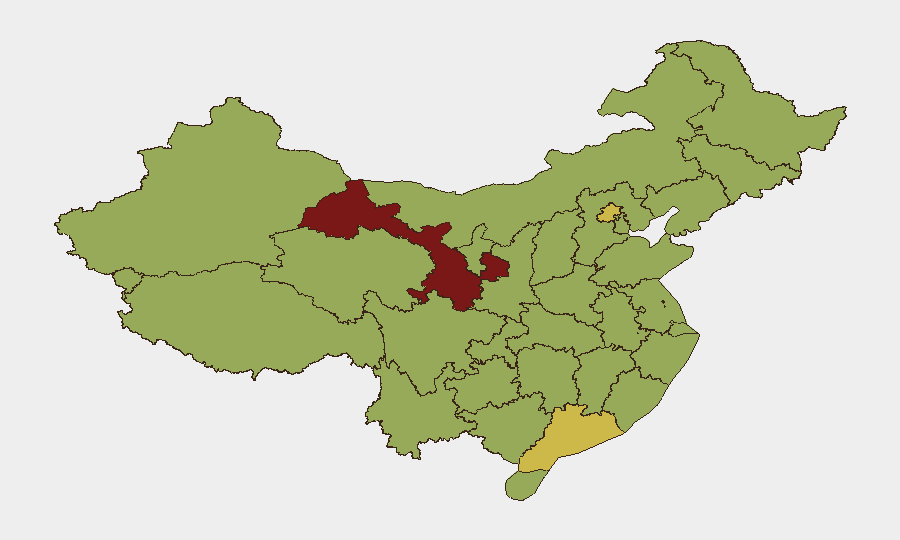
Gansu (83.6) and Beijing (67.4) lead the sub-national risk index, with Gansu's elevated score likely driven by remote geographic exposure, limited consular presence, and border-adjacent instability factors. Beijing's rank reflects concentration of government, diplomatic, and multinational corporate activity—making it a focal point for both state monitoring and cyber targeting. Guangdong, Shanghai, and Jiangsu (61.7–57.5) experience risk from major port operations, foreign investment density, and regulatory scrutiny. Xinjiang and Tibet (both 54.2 and 54.1) remain elevated due to persistent political sensitivity, restricted access, and security-force presence; operations in these regions should assume enhanced monitoring and compliance burden.
How GeoBit Would Assist
Security teams with operations in China should use Intel Sweep and multi-language OSINT to monitor emerging diplomatic and enforcement signals in real time, coupled with entity extraction and network analysis to map connections between government agencies, law enforcement, and listed sanctions actors. AOI Monitoring & Early Warning on high-risk sub-national zones—particularly Beijing, Gansu, and Tibet—enables persistent watch on arrest/detention activity, protest activity, and infrastructure disruption. Cyber threat intelligence and regime-stability tracking provide early signals of policy shifts that trigger visa denials, asset freezes, or forced exits.
7-Day Outlook
Expect continued diplomatic messaging and potential secondary sanctions or restrictions on foreign commercial activity through 10 June. Cyber targeting of foreign financial and logistics operations is likely to sustain or increase. Personnel in Beijing, Guangdong, and Shanghai should monitor consular alerts and review contingency evacuation and asset-protection procedures.
Highest-Risk Areas — Ranked
| # | State / Region | Risk |
|---|---|---|
| 1 | Gansu | 83.6 |
| 2 | Beijing | 67.4 |
| 3 | Guangdong Province | 61.7 |
| 4 | Shanghai | 58.2 |
| 5 | Jiangsu | 57.5 |
| 6 | Jiangxi | 54.8 |
| 7 | Anhui | 54.4 |
| 8 | Chongqing | 54.3 |
| 9 | Fujian | 54.3 |
| 10 | Xinjiang | 54.2 |
| 11 | Sichuan | 54.2 |
| 12 | Tibet | 54.1 |
Previous Daily Briefs
A new China brief is written every day — each with its own risk map and downloadable CSV. Here's the last week; use the calendar to go further back.
📅 Browse every day by calendar →
Highlighted days have a brief. Tap a day for that day's map & analysis, or “csv” for that day's dataset ($5).