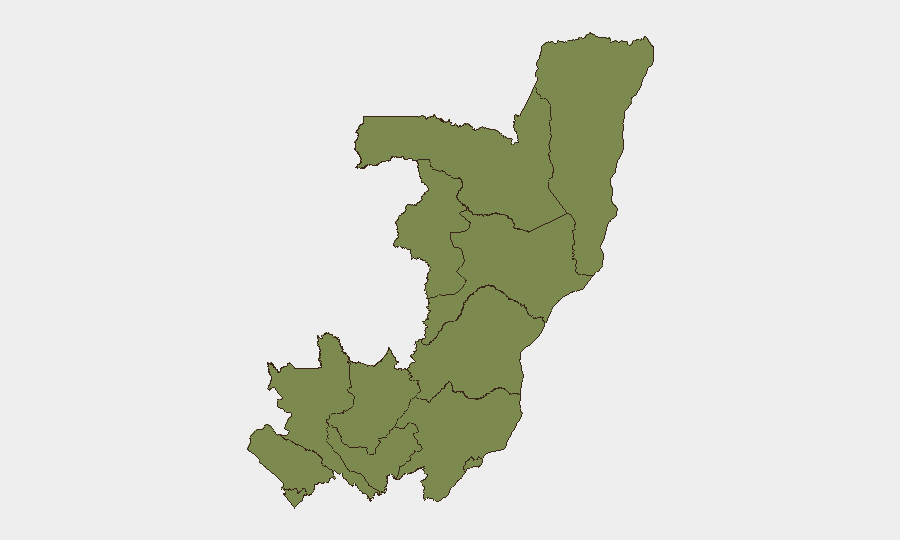
Situation Summary
Congo (Republic of) remains a lower-tier global security concern with a composite threat score of 35 and only three tracked events in the current reporting cycle. The security environment is dominated by concentrated risk in Cuvette-Ouest Department (score 31.3), while the remainder of the country shows uniformly low threat indices (1.3 each). Recent event signals include military-civilian clashes, government statements, and scientific commentary as of 19–21 July, but verified discrete security incidents meeting corroboration standards have not materialized in the preceding 24–48 hours.
Key Developments
- No verified new security incidents were documented in Congo over the last 24–48 hours that met independent corroboration and time-stamping standards, per live web research as of 20 July 2026.
- Cuvette-Ouest Department remains the focal point of measurable risk, with a composite score of 31.3—more than 24 times higher than any other region in the country—suggesting sustained instability or armed activity in that locality.
- Military and civilian event signals dated 19–21 July indicate ongoing conventional military operations and government communications, but granular incident details and casualty figures are not yet available from primary sources.
- Regional wildfire activity in Congo and neighboring DRC has been logged in recent weeks (seven separate wildfire events tracked), which may affect humanitarian access, air quality, and population displacement in peripheral areas.
- Cross-border dynamics with DRC remain relevant to Congo's security posture; ongoing ADF and M23 activity in eastern DRC (12–20 July) could indirectly influence refugee flows and regional stability, though no direct spill-in events have been confirmed for Congo proper in the past 48 hours.
Highest-Risk Areas
Cuvette-Ouest Department is the clear outlier, with a risk score nearly two orders of magnitude above all other departments. This concentration suggests either active armed group presence, localized conflict, or significant instability in forestry, mining, or border zones. All other measured regions—including the capital district (Brazzaville) and major urban centers—score identically at 1.3, indicating either residual baseline risk or data-collection gaps. Security teams should treat Cuvette-Ouest as the primary area of concern for Congo operations, while remaining alert to rapid escalation elsewhere if event signals intensify.
How GeoBit Would Assist
Intel Sweep, global event feeds, and OSINT fusion provide continuous corroboration of discrete incidents and trend analysis across government, military, and civil-society sources—critical for distinguishing noise from actionable developments in a lower-profile country. AOI Monitoring & Early Warning on Cuvette-Ouest and other high-risk departments enables persistent watch for escalation signals, allowing security teams to activate contingency plans before crises fully materialize. Conflict & Military mapping and force-structure analysis would clarify the identity, strength, and intent of armed actors driving Cuvette-Ouest's elevated risk, informing duty-of-care decisions for personnel and asset placement.
7-Day Outlook
No imminent escalation is forecast for Congo over the next seven days, given the absence of new discrete incidents and the country's low global threat ranking. Cuvette-Ouest will remain a zone requiring elevated monitoring and contingency readiness. Any spike in military or civilian event signals should prompt immediate re-assessment of regional travel, supply-chain routing, and personnel safety postures.
Highest-Risk Areas — Ranked
| # | State / Region | Risk |
|---|---|---|
| 1 | Cuvette-Ouest Department | 31.3 |
| 2 | Sangha | 1.3 |
| 3 | Likouala | 1.3 |
| 4 | Cuvette Department | 1.3 |
| 5 | Kouilou Department | 1.3 |
| 6 | Niari Department | 1.3 |
| 7 | Pointe-Noire (département) | 1.3 |
| 8 | Lékoumou Department | 1.3 |
| 9 | Bouenza Department | 1.3 |
| 10 | Plateaux Department | 1.3 |
| 11 | Pool Department | 1.3 |
| 12 | Brazzaville (department) | 1.3 |
Sources
Previous Daily Briefs
A new Congo brief is written every day — each with its own risk map and downloadable CSV. Here's the last week; use the calendar to go further back.
📅 Browse every day by calendar →
Highlighted days have a brief. Tap a day for that day's map & analysis, or “csv” for that day's dataset ($5).
Atlas — our AI intelligence desk — emails them this snapshot personally. Nothing else, no list.