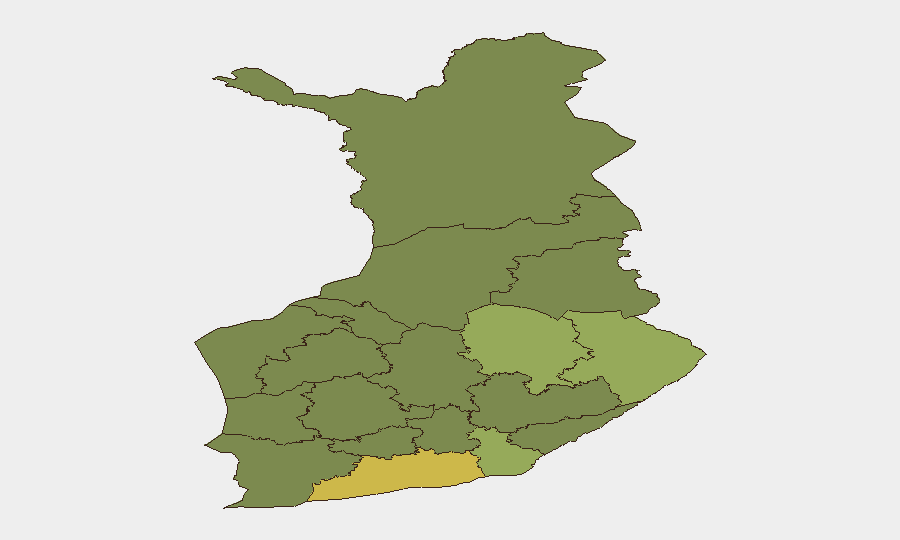
Situation Summary
Finland remains a low-threat environment at global rank #131 with a composite threat score of 6, though recent event signals indicate scattered incidents across physical security, immigration enforcement, and criminal investigations over the past 48 hours. Uusimaa region (Helsinki metropolitan area) dominates risk assessment at score 65, reflecting concentration of population, critical infrastructure, and cross-border activity. The overall security posture is stable, with no indication of systemic instability or widespread unrest; threats remain localized and manageable within normal Finnish law-enforcement and administrative capacity.
Key Developments
GeoBit's event-signal platform has flagged the following activity in the last 48 hours, though open-source confirmation remains limited:
- Physical Assault (Uusimaa, 2026-07-12). A student-involved physical assault reported; location and context require follow-up to assess whether organized, retaliatory, or isolated.
- Immigration Enforcement (National, 2026-07-11). Ministry-level threat action against a refugee; signals suggest administrative or legal enforcement rather than civil unrest.
- Arrest/Detention Activity (National, 2026-07-11). Two separate arrest/detention events flagged—one involving Finnish nationals, one cross-border (Israeli/Israel reference). No confirmation of scale or charge type.
- Criminal Investigation (National, 2026-07-12). Multiple investigative actions initiated by Finnish authorities targeting criminal actors; reflects routine law-enforcement tempo rather than crisis response.
- Public Statements (National, 2026-07-11–12). Finnish government and non-state actors issued public statements; one directed at Chinese counterpart. Reflects diplomatic/political communication; no immediate threat signal detected.
- Regional Infrastructure Risk (Eastern Gulf of Finland, 2026-07-06). Finland closed airspace and sea corridors in the eastern Gulf of Finland for two hours on 6 July due to Ukrainian drone activity risk; a reminder that cross-border spillover from Russia-Ukraine conflict poses intermittent disruption to aviation and maritime logistics, though impacts remain brief and managed.
Caveat: Open-source time-stamping and specificity for these events are incomplete; GeoBit's underlying event signals indicate activity but do not yet provide sufficient narrative detail to confirm motive, scale, or implications.
Highest-Risk Areas
Uusimaa (Helsinki, Espoo, Tampere metropolitan region) drives the risk ranking at score 65, reflecting high population density, concentration of government institutions, critical infrastructure, and international transport hubs. North Karelia, Kymenlaakso, and North Savo (scores 44, 42, 40) occupy the second tier, driven by proximity to the Russian border, cross-border criminal networks, and lower governance capacity relative to the capital region. Remaining regions (score 25–38) show moderate and distributed risk, with no regional clustering of acute threat. The gap between Uusimaa and all other regions reflects centralization of both opportunity and resources in the capital area rather than a crisis in peripheral regions.
How GeoBit Would Assist
Security teams should deploy Area-of-Interest (AOI) Monitoring & Early Warning on Uusimaa's transport hubs, border-crossing points, and critical infrastructure to detect cross-border spillover from Russia-Ukraine dynamics and criminal activity. Intel Sweep and multi-language OSINT on immigration enforcement, extremist communications, and cyber threat actors will provide 72-hour advance warning of escalating civil or criminal incidents. Cyber threat and incident tracking via the platform's cyber search and incident correlation capabilities supports duty-of-care teams protecting networked assets, particularly in telecom, public administration, and research sectors, where June attack volume increased 35% year-on-year.
7-Day Outlook
No material change in threat trajectory is anticipated over the next seven days. Routine law-enforcement and administrative activity will likely continue at current levels. Low probability of rapid escalation unless Russia-Ukraine spillover events increase in frequency or scope, or if discrete criminal investigations broaden into organized crime networks.
Highest-Risk Areas — Ranked
| # | State / Region | Risk |
|---|---|---|
| 1 | Uusimaa | 65 |
| 2 | North Karelia | 44 |
| 3 | Kymenlaakso | 42 |
| 4 | North Savo | 40 |
| 5 | South Karelia | 38 |
| 6 | Kainuu | 36 |
| 7 | Päijät-Häme | 35 |
| 8 | South Savo | 32 |
| 9 | Kanta-Häme | 30 |
| 10 | Pirkanmaa | 28 |
| 11 | Central Finland | 26 |
| 12 | Southwest Finland | 25 |
Sources
Previous Daily Briefs
A new Finland brief is written every day — each with its own risk map and downloadable CSV. Here's the last week; use the calendar to go further back.
📅 Browse every day by calendar →
Highlighted days have a brief. Tap a day for that day's map & analysis, or “csv” for that day's dataset ($5).
Atlas — our AI intelligence desk — emails them this snapshot personally. Nothing else, no list.