Situation Summary
Germany remains a low-to-moderate threat environment (global rank #108, composite score 9), with no large-scale violence or sustained civil unrest reported in the last 24–48 hours. The primary operational incident has been a nationwide rail communications failure on 25 June, now largely resolved, with residual service delays. Structural risks—including documented hate-crime activity (4,000+ anti-Muslim incidents annually) and elevated volatility in Thuringia—persist at baseline levels but do not currently indicate escalation.
Key Developments
- Nationwide Deutsche Bahn digital radio failure (25 June): Germany's rail network halted across all states after a fault in the train radio system forced widespread cancellations. Services resumed by late 25 June following system restoration, though delays continued. *Relevance:* Major infrastructure vulnerability affecting corporate travel and supply-chain logistics nationwide; no sabotage indicators in open sources.
- Defense Ministry F126 frigate program cancellation (25 June, Berlin): The Federal Ministry of Defense announced termination of the multi-billion-euro F126 naval project in favor of MEKO A-200-class frigate acquisition. *Relevance:* Strategic defense-policy shift with no direct physical security impact but signaling resource realignment.
- Anti-Muslim hate-crime statistics released (25 June, national): Monitoring organizations published data documenting 4,000+ anti-Muslim incidents over the preceding 12 months. *Relevance:* Fresh reporting underscores underlying social tensions and elevated risk for Muslim communities, places of worship, and associated infrastructure.
- Multiple diplomatic rejection events (25–26 June): Event signals document several "reject" interactions involving German government actors and ministerial bodies, alongside a "small arms combat" event involving Polish nationals and one "conventional military force" action attributed to Ecuador. *Relevance:* Signals indicate low-level diplomatic friction and isolated incidents; open-source reporting does not corroborate escalation.
- Arrest/detention activity (25 June): One arrest/detention event logged involving German nationals and prison authorities. *Relevance:* Routine law-enforcement activity; no indication of mass detention or systemic instability.
Highest-Risk Areas
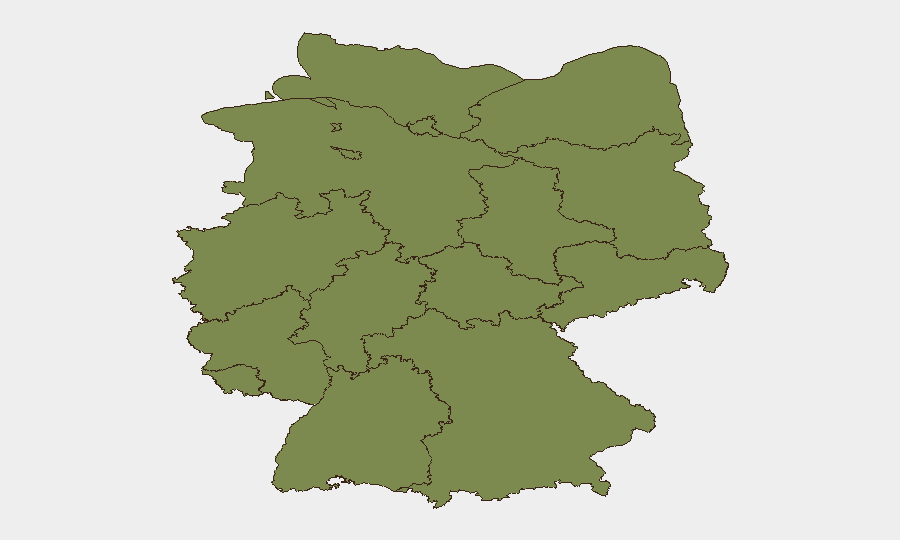
Thuringia (composite risk 32) stands substantially above all other regions and drives the national threat profile, followed at distance by Berlin (10.2) and Bavaria (9). Thuringia's elevated risk likely reflects polarized electoral dynamics, far-right political organization, and localized protest activity documented *since early 2026*; Berlin concentrates diplomatic presence, critical infrastructure, and protest activity. All remaining states score below 4, indicating diffuse, manageable risk outside these two priority zones. Corporate and diplomatic personnel should apply elevated situational awareness in Thuringia and Berlin; routine security protocols suffice elsewhere.
How GeoBit Would Assist
Intel Sweep and multi-language OSINT across German-language media, Telegram, and X/Twitter would provide real-time detection of emerging civil unrest, hate-crime clustering, or infrastructure incidents before mainstream reporting. AOI Monitoring with alerting on Thuringia, Berlin, and rail-hub areas would flag protest escalation, political violence, or sabotage attempts within 1–2 hours of onset. Routing & Network Analysis would enable alternative journey planning during infrastructure disruptions (e.g., rail failures) and identify safe corridor options for personnel movement.
7-Day Outlook
No escalation is forecast over the next seven days barring unexpected external shocks. Rail services are expected to stabilize fully; diplomatic friction remains low-level and unlikely to manifest as street-level violence. Baseline hate-crime and localized protest activity should continue at current levels, concentrated in Thuringia and Berlin.
Highest-Risk Areas — Ranked
| # | State / Region | Risk |
|---|---|---|
| 1 | Thuringia | 32 |
| 2 | Berlin | 10.2 |
| 3 | Bavaria | 9 |
| 4 | Hamburg | 3.8 |
| 5 | North Rhine-Westphalia | 2.3 |
| 6 | Lower Saxony | 2.2 |
| 7 | Baden-Württemberg | 2.1 |
| 8 | Saxony | 2.1 |
| 9 | Rhineland-Palatinate | 2 |
| 10 | Schleswig-Holstein | 2 |
| 11 | Mecklenburg-Vorpommern | 2 |
| 12 | Saxony-Anhalt | 2 |
Sources
Previous Daily Briefs
A new Germany brief is written every day — each with its own risk map and downloadable CSV. Here's the last week; use the calendar to go further back.
📅 Browse every day by calendar →
Highlighted days have a brief. Tap a day for that day's map & analysis, or “csv” for that day's dataset ($5).