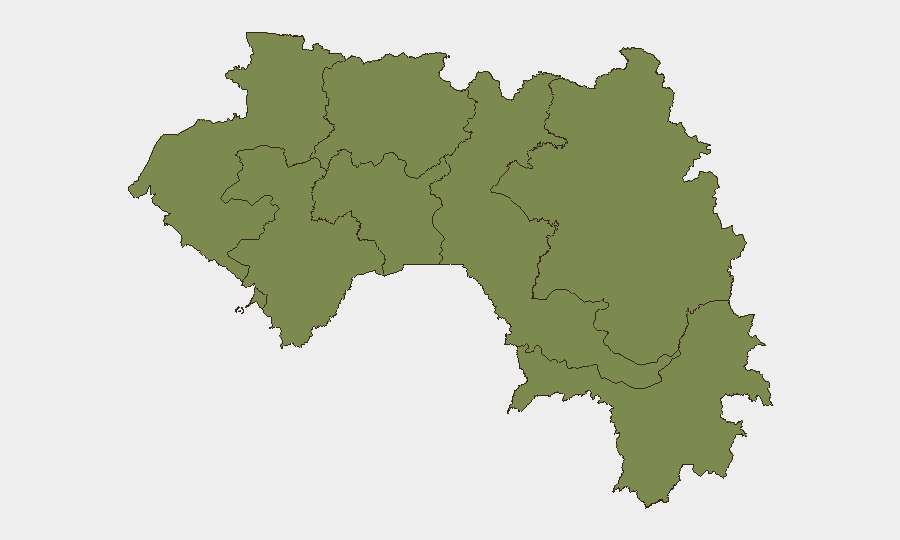
Situation Summary
Guinea remains under military rule following the 2021 coup by Colonel Mamady Doumbouya, with the junta maintaining tight political control and a demonstrated willingness to use lethal force against dissent. The security environment is characterized by chronic structural risks—including arbitrary detention, enforced disappearances, and suppression of protests and media—rather than acute conflict or widespread violence at present. No major new security incidents were reported in the last 24 hours, but the underlying risk posture remains elevated, particularly in Conakry and eastern regions. The delayed electoral transition (now pushed to 2025) and dissolution of 107 political parties reflect a hardening political environment with limited legal avenues for opposition activity.
Key Developments
- Military junta political control – nationwide (ongoing)
Colonel Mamady Doumbouya's regime continues to consolidate power through constitutional suspension, political-party dissolution (107 parties dissolved on 29 October 2024), and observation of 67 others, severely constraining legal political space.
- Protest ban and lethal-force history – Conakry (chronic risk)
Security forces have shot and killed at least 59 people since 2022 during demonstrations. Protests have been formally prohibited since May 2022, creating a high-risk environment for any public gatherings or opposition activity.
- Media worker detention – Conakry (January 2024)
Security forces besieged the House of the Press on 18 January 2024, trapping approximately 30 journalists and arresting nine, signaling ongoing risks to media personnel and press-freedom organizing.
- Enforced disappearances of opposition activists – Conakry (July 2024)
Three FNDC opposition members were forcibly disappeared on 9 July 2024; two remain unaccounted for and have not been officially acknowledged as detained, highlighting arrest and disappearance risk for civil-society actors.
- Electoral transition delay – national (political uncertainty)
Elections originally promised for December 2024 have been postponed to 2025, extending the period of military rule and unresolved governance transition.
- Shigellosis outbreak reported – Guinea (public health)
Recent surveillance data indicate circulating shigellosis; this and concurrent polio vaccine-derived virus activity in Papua New Guinea reflect ongoing regional and global health-security monitoring needs.
Highest-Risk Areas
Kankan Region in eastern Guinea carries substantially elevated risk (composite score 35.8) compared to all other zones, which cluster at 5.8. The disparity suggests localized instability—whether conflict-related, criminal, or political—concentrated in the eastern borderlands. Conakry, the capital and administrative center, ranks equally with other regions at 5.8 but warrants separate attention due to the documented pattern of security-force demonstrations against protesters, media workers, and opposition figures. All other regions (Boké, Labé, Kindia, Mamou, Faranah, Nzérékoré) show equivalent moderate risk. Organizations with personnel or assets in Kankan should prioritize enhanced situational awareness and contingency planning; those in Conakry should monitor political developments and protest calendars closely.
How GeoBit Would Assist
Security and risk teams should deploy AOI (Area-of-Interest) Monitoring & Early Warning on Conakry and Kankan to detect emerging protests, security-force movements, or civil unrest with persistent alerts. Intel Sweep and multi-language OSINT (X/Twitter, Telegram, YouTube) combined with sentiment and temporal analysis would track shifting political narratives, junta messaging, and opposition coordination signals that may precede incidents. Regime-stability and conflict search tools enable horizon-scanning on detention patterns, enforced disappearances, and security-actor behavior to inform duty-of-care risk assessments for staff in high-exposure roles.
7-Day Outlook
No imminent acute crisis is signaled by available open-source reporting. The junta's consolidation trajectory and delayed elections suggest a period of low-intensity political repression and administrative control rather than large-scale violence. Organizations should anticipate that any unscheduled political gathering, press activity, or opposition organizing in Conakry or eastern regions carries elevated risk of security-force response.
Highest-Risk Areas — Ranked
| # | State / Region | Risk |
|---|---|---|
| 1 | Kankan Region | 35.8 |
| 2 | Boké Region | 5.8 |
| 3 | Labé Region | 5.8 |
| 4 | Kindia Region | 5.8 |
| 5 | Conakry | 5.8 |
| 6 | Mamou Region | 5.8 |
| 7 | Faranah Region | 5.8 |
| 8 | Nzérékoré Region | 5.8 |
Previous Daily Briefs
A new Guinea brief is written every day — each with its own risk map and downloadable CSV. Here's the last week; use the calendar to go further back.
📅 Browse every day by calendar →
Highlighted days have a brief. Tap a day for that day's map & analysis, or “csv” for that day's dataset ($5).