Situation Summary
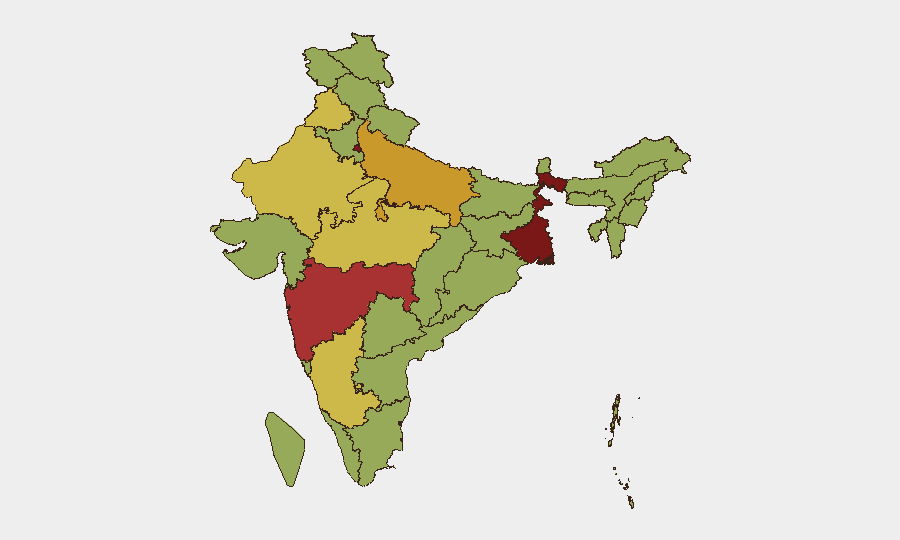
India remains a composite-threat environment (rank #15 globally, score 77.4) driven by persistent cyber threats, localized violence, and emerging health/natural hazards. The threat landscape is asymmetrically distributed across states, with Delhi and West Bengal presenting the highest risks (84.2 and 82.6 respectively), while critical infrastructure and digital-payments systems face sustained pressure from state-sponsored and criminal actors. Over 2 million cyber incidents were recorded in 2024, with 60% traced to China and Pakistan, establishing cyber as the primary systemic risk vector. The short-term trajectory suggests continued operational tempo across cyber, organized crime, and localized violence domains.
Key Developments
- Patna, Bihar – Armed attack on coaching centre (2026-06-02): Unidentified assailants fired on Khan Sir's coaching centre in Musallahpur Haat; police assessment indicates institutional rivalry rather than terrorism or communal motive, but incident underscores violence risk in educational clusters and student concentrations.
- Delhi – NIA extradition arrest (2026-06-02): National Investigation Agency arrested a narco-terror suspect extradited from Portugal linked to Pakistan-based cross-border drug smuggling and terror-financing networks; case illustrates transnational financing mechanisms targeting Indian security apparatus.
- National – Cyber targeting of critical sectors (ongoing): Phishing, malware, spyware, and data-theft operations directed at defence, telecom, and security-force networks; Chinese operations characterized as sophisticated, long-term, and focused on persistent access rather than disruption.
- National – Regulatory cyber-risk reassessment (2026-06-02): Indian insurance regulators have mandated cyber-risk exposure review focusing on AI-driven attack scenarios, indicating systemic concern over emerging attack vectors and financial-sector vulnerability.
- National – Digital-payments fraud decline (FY26 data): Card and internet-payment fraud cases fell sharply (13,332 to 293 cases; ₹517 crore to ₹29 crore), though regulators maintain elevated monitoring due to sector centrality to mobility and hospitality operations.
- Nicobar Islands – Seismic event (recent): M 4.6 earthquake recorded; context for infrastructure and maritime-asset exposure in India's eastern maritime zone.
- National – Infectious-disease signals (ongoing): Nipah virus and H9N2 avian influenza cases reported; health-security risk to personnel, supply chains, and workforce continuity.
Highest-Risk Areas
Delhi and West Bengal dominate the risk profile, driven by high population density, political volatility, criminal networks, and institutional fragmentation. Maharashtra follows as a secondary-tier hub, with Mumbai's role as financial and logistics centre amplifying exposure to organized crime, fraud, and cyber targeting. Uttar Pradesh and Madhya Pradesh rank fourth and fifth respectively, reflecting extremist recruitment activity, communal friction points, and weak law-enforcement capacity in peripheral districts. Organizations with operations, offices, or personnel in the National Capital Region (Delhi), eastern metros (Kolkata), and western financial hubs (Mumbai) face compounded risk across physical security, cyber, and personnel duty-of-care domains.
How GeoBit Would Assist
Intel Sweep and OSINT fusion across X, Telegram, and local-language sources would enable continuous monitoring of recruitment, financing, and attack-planning signals across high-risk states. AOI Monitoring and Early Warning with persistent watch over Delhi, West Bengal, and Maharashtra would surface emerging violence, protest, or operational escalation 24–48 hours ahead of tactical incident. Cyber-threat and network analysis paired with conflict/crime search would track narco-terror financing flows, dark-web procurement, and actor communications supporting cross-border operations and critical-infrastructure targeting.
7-Day Outlook
Cyber-targeting activity is expected to remain elevated, with focus on financial services and telecom given regulatory vulnerability. Localized violence in educational and commercial clusters will likely continue at low intensity, with minimal escalation unless communal or political triggers emerge. Health alerts (Nipah, H9N2) warrant personnel-screening and supply-chain contingency, particularly in Bihar and Kerala.
Highest-Risk Areas — Ranked
| # | State / Region | Risk |
|---|---|---|
| 1 | Delhi | 84.2 |
| 2 | West Bengal | 82.6 |
| 3 | Maharashtra | 79.9 |
| 4 | Uttar Pradesh | 71 |
| 5 | Madhya Pradesh | 66.4 |
| 6 | Karnataka | 63.7 |
| 7 | Punjab | 62.3 |
| 8 | Rajasthan | 60.8 |
| 9 | Gujarat | 59.1 |
| 10 | Jammu and Kashmir | 57.7 |
| 11 | Bihar | 56.8 |
| 12 | Telangana | 56.6 |