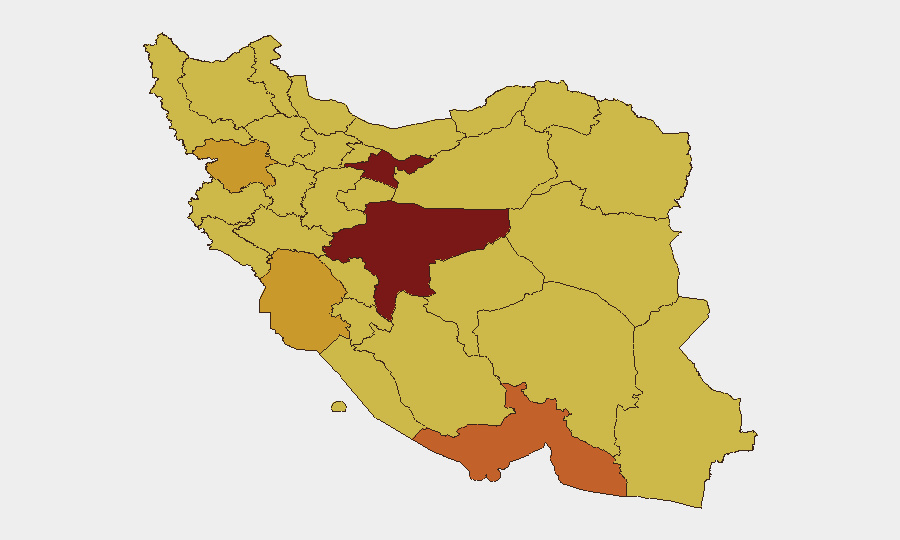
Situation Summary
Iran faces sustained multi-domain pressure from external military posturing, internal civil unrest, and contested nuclear diplomacy as of early June 2026. At least six categories of destabilizing events—military demands, arrests, violent repression, and small-arms combat—have been recorded in the past 72 hours. The threat environment is acute but not yet characterized by large-scale kinetic escalation; however, the proximity of both U.S. military consideration and ongoing talks creates unpredictable trajectory risk for organizations with personnel or assets in-country.
Key Developments
- Qeshm Island, Hormozgan Province (2026-06-01) — Multiple explosions reported at midday; Iranian state media and provincial security officials attributed blasts to disposal of unexploded ordnance rather than external strike. Social-media speculation about U.S. or Israeli involvement preceded official denial, indicating active rumor environment in sensitive coastal zone.
- National Security / Military Posture (2026-05-31) — Military demand issued against Iran; conventional military force and artillery/tank activity recorded by Iran against Israel, signaling active operational posture in regional conflict context.
- Domestic Political Unrest (2026-06-02) — Arrest/detention of Iranian citizens and disapproval statements directed at president recorded; violent repression of citizens also documented, indicating internal security response to dissent.
- U.S. Military Posture (2026-06-01) — U.S. official public statement and reported military consideration of options against Iran, followed by pause in planned operations; heightens uncertainty around near-term escalation risk.
- Diplomatic Channel (concurrent) — U.S.-Iran nuclear talks remain active; Reuters reporting cited a "very good chance" of deal limiting Iran's nuclear program, offsetting some military-escalation risk.
- Information Control (2026-06-01) — Iranian officials explicitly instructed public to disregard social-media rumors regarding security incidents, indicating authorities are managing civilian perception of threat and attempting to suppress panic.
Highest-Risk Areas
Tehran Province (risk 100) and Isfahan Province (risk 90) dominate the landscape, reflecting both capital-region political instability and central-hub strategic importance. Hormozgan Province (74.1)—home to critical Strait of Hormuz maritime infrastructure and Qeshm Island—is third-ranked, driven by proximity to external military actors and current kinetic signaling. Kurdistan, Khuzestan, and East/West border regions all exceed 70-point composite risk, reflecting historical unrest, ethnic tensions, and cross-border military activity. Risk concentration in Tehran and Isfahan indicates that governance challenges, arrest activity, and internal repression are significant drivers; Hormozgan's elevation reflects external military threat and economic chokepoint sensitivity.
How GeoBit Would Assist
Security teams should deploy AOI Monitoring & Early Warning on Tehran, Isfahan, and Hormozgan to detect arrest sweeps, protest activity, and military repositioning in near-real time. OSINT fusion (X/Telegram monitoring, YouTube/podcast intelligence, multi-language search) would track regime narratives, public-sector misinformation, and civil unrest signaling to anticipate lockdowns or travel restrictions. Conflict & Military mapping and entity/network analysis would clarify U.S. and Iranian force postures, reducing uncertainty around kinetic risk windows for travel and operations planning.
7-Day Outlook
The next week will likely remain characterized by elevated rhetoric, military signaling, and domestic arrests without immediate large-scale kinetic escalation, though the pause in U.S. military planning could reverse quickly if diplomatic talks stall. Personnel in Tehran, Isfahan, and Hormozgan should expect heightened security screening, possible localized curfews, and restricted movement. Continued monitoring of U.S. official statements and Iranian IRGC communications is critical to detect inflection points toward broader conflict.
Highest-Risk Areas — Ranked
| # | State / Region | Risk |
|---|---|---|
| 1 | Tehran Province | 100 |
| 2 | Isfahan Province | 90 |
| 3 | Hormozgan Province | 74.1 |
| 4 | Kurdistan Province | 72.8 |
| 5 | Khuzestan Province | 71 |
| 6 | Ardabil Province | 70.7 |
| 7 | Fars Province | 70.6 |
| 8 | Kerman Province | 70.6 |
| 9 | Yazd Province | 70.5 |
| 10 | East Azerbaijan Province | 70.1 |
| 11 | Semnan Province | 70.1 |
| 12 | Alborz Province | 70.1 |
Sources
Previous Daily Briefs
A new Iran brief is written every day — each with its own risk map and downloadable CSV. Here's the last week; use the calendar to go further back.
📅 Browse every day by calendar →
Highlighted days have a brief. Tap a day for that day's map & analysis, or “csv” for that day's dataset ($5).