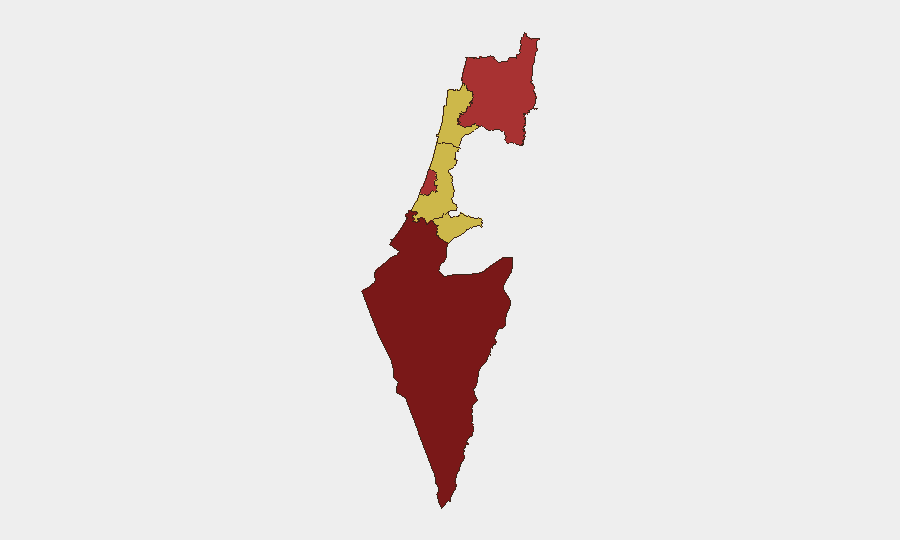
Situation Summary
Israel remains in active kinetic conflict across two primary theaters—southern Gaza and the northern Lebanese border—with a composite threat ranking of 98.6 (#11 globally). The past 48 hours have seen sustained Hezbollah cross-border attacks into northern Israel, a fatal IDF casualty from a drone strike, continued ceasefire violations in Gaza, and a parliamentary move toward early elections. Political instability is compounding military pressure as internal debate over US-influenced operational constraints intensifies.
Key Developments
- Northern Israel / Lebanon border (Haifa District, 160+ communities): Hezbollah conducted multiple rocket and explosive-drone attacks across the border; the IDF responded with airstrikes on at least eight southern Lebanese towns. An IDF captain was killed and six soldiers wounded by a drone strike on a northern position. Warning-time for rocket alerts has been extended from 60 to 90 seconds, indicating both persistent threat and calibrated civilian-defense adjustment.
- Rafah / Southern Gaza (South District): Armed militants emerged from tunnels in IDF-controlled areas and were engaged by Israeli forces and airstrikes; these incidents have been characterized by the IDF as ceasefire violations posing direct threat to troops along the frontier, despite an ostensibly fragile ceasefire framework.
- Jerusalem (Knesset / Center District): A bill to dissolve the Knesset passed its first reading, signaling concrete steps toward early elections and introducing political instability amid ongoing military crises.
- Diplomatic / Escalation signals: Lebanese sources report Hezbollah acceptance of a US-backed mutual ceasefire proposal; simultaneously, Israeli leadership has issued explicit warnings that if Hezbollah fire does not cease, IDF strikes will target Beirut's southern suburbs, reflecting both de-escalation effort and clear escalation threshold.
- US posture: The U.S. Department of State maintains "Reconsider Travel" advisories for Israel and the West Bank, and "Do Not Travel" for Gaza, a 11.3 km buffer zone around Gaza, northern Israel within 4 km of Lebanon/Syria borders, and the Egyptian border area. Non-emergency U.S. government personnel remain authorized for departure from Mission Israel.
- Domestic political tension: Opposition Leader Yair Lapid accused Prime Minister Netanyahu of converting Israel into a "full-fledged protectorate state," citing reported U.S. pressure on IDF operational plans in Lebanon, amplifying internal fracture over strategic autonomy.
Highest-Risk Areas
The South District (risk 99) remains the highest-risk region, driven by ongoing Gaza operations, tunnel-based militant activity, and ceasefire fragility. Tel-Aviv (78.9) and North Districts (78.5) follow, with the North bearing direct exposure to Hezbollah rocket and drone fire, IDF escalation responses, and potential strikes on Beirut. Haifa District (70.1) faces particular proximity risk due to rocket alert zones and expanding cross-border strike operations. The concentration of risk in South and North reflects the dual-theater nature of current conflict; Center and Jerusalem Districts (69.7 and 69.3) carry secondary but elevated risk from political instability and potential follow-on escalation.
How GeoBit Would Assist
Security teams should deploy AOI Monitoring & Early Warning on the South and North Districts to track escalation triggers (tunnel activity, rocket launches, IDF posture changes) with live alerting. Conflict & Military capabilities—including battle mapping and force-structure tracking—provide real-time understanding of IDF operations and Hezbollah positioning to inform travel/operations decisions. OSINT fusion (X/Telegram, Hebrew-language media, entity extraction) combined with Routing & Network Analysis enable rapid identification of safe corridors and alternative logistics paths as threat geography shifts daily.
7-Day Outlook
Hezbollah-IDF cross-border violence is likely to remain at current elevated levels through early week, with escalation risk contingent on ceasefire-negotiation outcomes expected mid-week. Parliamentary dissolution proceedings may accelerate, compounding policy uncertainty. Gaza ceasefire violations and tunnel incidents will continue to drive South District risk; personnel and asset positioning in northern Israel should anticipate 72–96 hour operational disruption windows if IDF escalation into Lebanon suburbs occurs.
Highest-Risk Areas — Ranked
| # | State / Region | Risk |
|---|---|---|
| 1 | South District | 99 |
| 2 | Tel-Aviv District | 78.9 |
| 3 | North District | 78.5 |
| 4 | Haifa District | 70.1 |
| 5 | Center District | 69.7 |
| 6 | Jerusalem District | 69.3 |
Previous Daily Briefs
A new Israel brief is written every day — each with its own risk map and downloadable CSV. Here's the last week; use the calendar to go further back.
📅 Browse every day by calendar →
Highlighted days have a brief. Tap a day for that day's map & analysis, or “csv” for that day's dataset ($5).