Situation Summary
Italy remains a composite threat level 9 (rank #94 globally) with 429 tracked events. The most volatile activity is concentrated in central Italy, particularly Umbria and Lazio, which together account for over 70% of sub-national risk. Recent signal clustering on 2026-06-20 indicates a multi-vector incident sequence involving public statements, territory occupation, and law-enforcement response; a presidential statement on 2026-06-22 suggests ongoing political or institutional tension. Overall threat trajectory is elevated but not yet indicating systemic instability.
Key Developments
- 2026-06-22 · Rome / National · Public Statement (President vs. Media) – Presidential statement signals ongoing friction with media narrative; context unclear but warrants monitoring for institutional stress or policy dispute escalation.
- 2026-06-20 · Umbria Region · Territory Occupation (Police Response) – Police occupation of territory; nature of precipitating event not yet clarified in available signals. Consistent with Umbria's exceptional risk score (31.5).
- 2026-06-20 · Multi-location · Law Enforcement Cascade – Cluster of investigation, arrest/detain, and prosecuting-officer actions suggests active criminal or civil investigation; arrests recorded. Timing and geography require urgent clarification to assess impact on business operations or travel safety.
- 2026-06-20 · National/Rome · Multi-Actor Public Statements – Coordinated or cascading public statements from government, media, students, and tourist-related actors indicate broad-spectrum information environment volatility; possible protest, crisis communication, or political coordination.
- 2026-06-20 · Unspecified Location · Unconventional Violence (Infantry Involvement) – Report of infantry involvement in unconventional violence is a high-severity signal; lacks geographic specificity but suggests potential paramilitary or security-force action beyond routine law enforcement.
Note on Data Gaps: Live web research did not surface corroborated, time-stamped Italy-specific security incident detail for 2026-06-20–22. The GeoBit event signals above reflect platform detection; corporate security teams should cross-reference with Italian government alerts, regional prefectures (Questura), and Italian news wires (ANSA, AGI) for operational context and location specificity.
Highest-Risk Areas
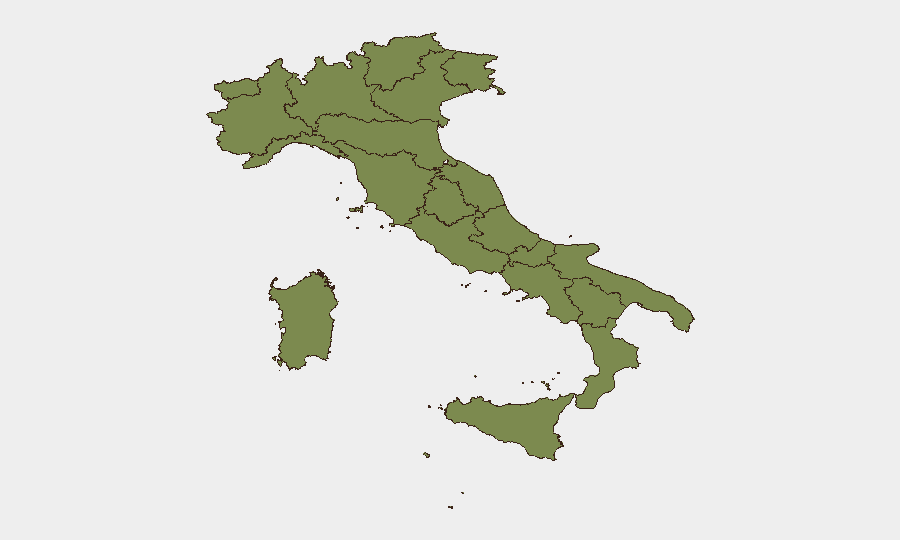
Umbria (31.5) and Lazio (21.4) are the dominant risk drivers, accounting for ~71% of Italy's composite threat burden. Umbria's exceptionally high score appears correlated with territory-occupation and multi-actor tension signals on 2026-06-20; Lazio, hosting Rome and the seat of government, carries structural risk tied to institutional activity and media/political friction. Lombardy (6.4) and Liguria (4.6) represent secondary risk zones, likely reflecting urban-center criminal or labor activity. Southern regions (Campania, Sicily, Apulia) show persistently lower scores, consistent with baseline organized-crime and migration-route dynamics rather than acute instability.
How GeoBit Would Assist
Corporate security teams should deploy AOI Monitoring & Early Warning (persistent watch on Umbria and Lazio with threshold-based alerting) and activate Intel Sweep + multi-language OSINT (Italian news, government statements, regional police/Carabinieri channels) to establish ground truth on the 2026-06-20 incident cluster and presidential statement. Parallel Network & Actor Analysis (identifying government, police, and media principals) and Routing & Network Analysis (mapping safe transit corridors around occupied or high-tension areas) will enable rapid duty-of-care decisions for staff in central Italy.
7-Day Outlook
Signal intensity suggests 48–72 hours of elevated institutional or civil tension, with particular focus on Umbria and Rome. If the 2026-06-20 events are contained to isolated criminal investigation or routine police action, risk should de-escalate by 2026-06-24. However, if presidential or government statements indicate policy crisis or broader unrest, monitoring should intensify and contingency planning (staff relocation, asset protection) should advance.
Highest-Risk Areas — Ranked
| # | State / Region | Risk |
|---|---|---|
| 1 | Umbria | 31.5 |
| 2 | Lazio | 21.4 |
| 3 | Lombardy | 6.4 |
| 4 | Liguria | 4.6 |
| 5 | Campania | 3.4 |
| 6 | Sicily | 2.4 |
| 7 | Sardinia | 2.1 |
| 8 | Tuscany | 2.1 |
| 9 | Apulia | 2.1 |
| 10 | Marche | 1.8 |
| 11 | Emilia-Romagna | 1.6 |
| 12 | Veneto | 1.6 |
Sources
Previous Daily Briefs
A new Italy brief is written every day — each with its own risk map and downloadable CSV. Here's the last week; use the calendar to go further back.
📅 Browse every day by calendar →
Highlighted days have a brief. Tap a day for that day's map & analysis, or “csv” for that day's dataset ($5).