Situation Summary
Kazakhstan's overall security posture remains stable with no confirmed acute incidents—conflict, civil unrest, crime, or infrastructure disruption—reported in the last 24–48 hours. The country is tracking at composite threat score 14 globally, reflecting baseline conditions. Recent activity consists primarily of routine diplomatic engagement, including President Tokayev's Brussels visit on 22–23 June 2026, rather than security-relevant developments. Risk remains geographically concentrated in West Kazakhstan Region and the capital, Astana.
Key Developments
- Diplomatic Activity — Astana / Brussels — 22–23 June 2026 — President Tokayev conducted an official visit to Brussels with EU counterparts; messaging involved policy dialogue and bilateral relations. No security incidents or unrest associated with this engagement.
- No Confirmed Security Incidents — Countrywide — As of 22 June 2026 — Open-source monitoring (news, OSINT feeds, social media) detected no discrete reports of terrorism, armed conflict, civil disorder, crime spikes, or infrastructure failures in the 24–48 hour window.
- Baseline Stability — Countrywide — 22 June 2026 — GeoBit platform sensors and event aggregation confirm no elevation in threat signals across tracked categories (conflict, unrest, organized crime, cyber incidents, or cross-border activity).
Highest-Risk Areas
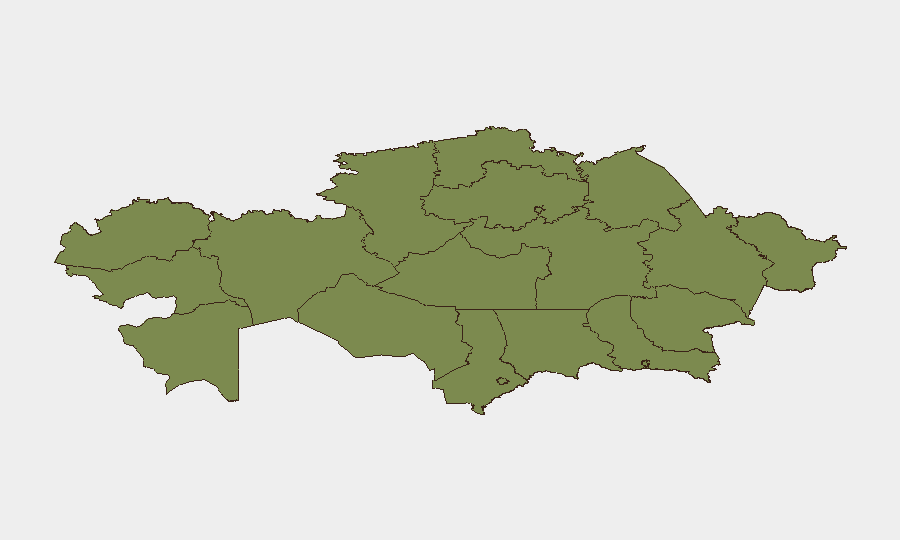
West Kazakhstan Region (composite risk 31.2) and Astana (21.2) account for the majority of tracked risk, though absolute incident frequency remains low. West Kazakhstan's elevated profile reflects historical border dynamics, regional cross-border activity, and critical infrastructure concentration; Astana's ranking reflects political concentration and sensitive government/diplomatic presence. All remaining regions score at or near baseline (1.2–11.2), with Ulytau Region the only secondary concern (11.2), likely reflecting remote geography and limited visibility. The disparity between top-tier and lower-ranked regions is substantial, indicating risk is not uniformly distributed.
How GeoBit Would Assist
Security and risk teams with personnel or assets in Kazakhstan should employ Intel Sweep and global event feeds for continuous monitoring of emerging incidents and cross-border activity, particularly in West Kazakhstan Region. AOI Monitoring & Early Warning with persistent alerting on Astana and West Kazakhstan would enable rapid notification of civil unrest, security incidents, or policy shifts affecting operations. OSINT fusion (social media, news, Telegram/X monitoring, multi-language search) and sentiment & temporal analysis provide early warning of political or social friction before it escalates to open instability. Routing & Network Analysis supports contingency journey planning for staff in high-risk regions.
7-Day Outlook
No imminent acute security threats are forecast for the near term; conditions are expected to remain stable absent external shocks or diplomatic escalation. Ongoing diplomatic activity and routine governance should continue without security incident. Organizations should maintain baseline monitoring posture and standard duty-of-care protocols, with heightened vigilance in West Kazakhstan Region and Astana where composite risk remains elevated relative to other regions.
Highest-Risk Areas — Ranked
| # | State / Region | Risk |
|---|---|---|
| 1 | West Kazakhstan Region | 31.2 |
| 2 | Astana | 21.2 |
| 3 | Ulytau Region | 11.2 |
| 4 | Turkistan Region | 1.2 |
| 5 | Almaty Region | 1.2 |
| 6 | East Kazakhstan Region | 1.2 |
| 7 | Abay Region | 1.2 |
| 8 | Jetisu Region | 1.2 |
| 9 | Atyrau Region | 1.2 |
| 10 | Mangystau Region | 1.2 |
| 11 | Aqtöbe region | 1.2 |
| 12 | Pavlodar Region | 1.2 |
Sources
Previous Daily Briefs
A new Kazakhstan brief is written every day — each with its own risk map and downloadable CSV. Here's the last week; use the calendar to go further back.
📅 Browse every day by calendar →
Highlighted days have a brief. Tap a day for that day's map & analysis, or “csv” for that day's dataset ($5).