Situation Summary
Lesotho faces no acute security incidents as of 23 June 2026. The country remains stable in the short term, with no credible multi-source reports of conflict, civil unrest, terrorism, major crime, or infrastructure disruption in the last 24–48 hours. Underlying structural risks—including youth unemployment, governance capacity in certain districts, and implementation challenges around major infrastructure projects—persist but do not currently manifest as active security events.
Key Developments
No discrete security incidents meeting intelligence thresholds were identified in Lesotho during the 24–48 hour window preceding this brief.
Open-source monitoring and multi-source corroboration found no reports of:
- Armed conflict, violence, or armed group activity
- Civil unrest, protests, or demonstrations
- Terrorism or extremist activity
- Major crime events or organized violence
- Political instability or institutional collapse
- Infrastructure disruption or sabotage
Chronic baseline concerns (youth unemployment, Foot and Mouth Disease in livestock sectors, governance capacity gaps) remain subjects of ongoing national and international attention but are not characterized as new acute incidents within the reporting window.
Highest-Risk Areas
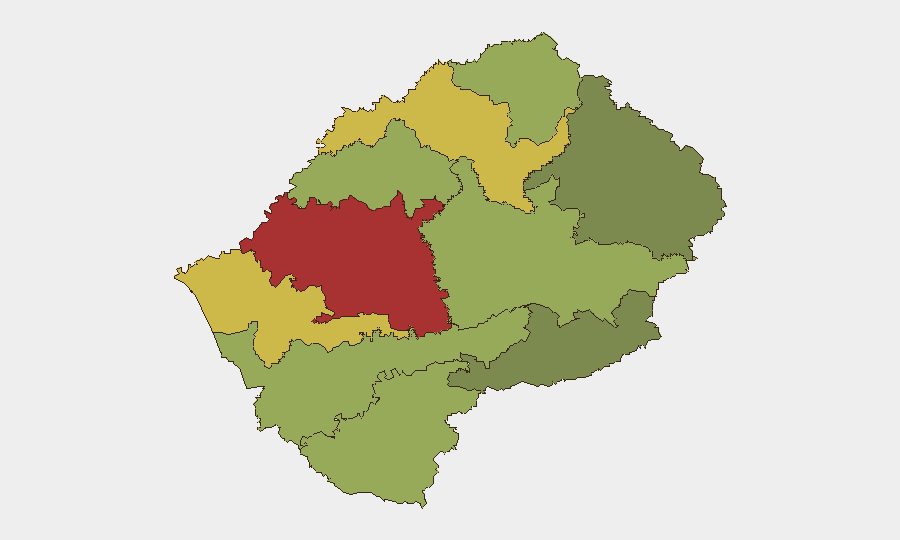
Maseru District (risk score 78) dominates the sub-national profile, reflecting its concentration of capital infrastructure, population density, and administrative activity. Mafeteng District (65) and Leribe District (62) follow as secondary hotspots. Risk scores in these three districts are driven by cumulative exposure to urban crime, potential civil unrest vectors tied to economic grievance, and governance/service-delivery pressures rather than by current active conflict or organized violence.
Southern and eastern districts (Qacha's Nek, Mokhotlong, Quthing) show materially lower risk scores, suggesting lower population density, fewer critical infrastructure nodes, and historically lower incidence of acute security events. Corporate and humanitarian assets concentrated in Maseru merit proportionately closer monitoring.
How GeoBit Would Assist
Security teams with personnel or assets in Lesotho should deploy AOI Monitoring & Early Warning on Maseru District and secondary hotspots to surface emerging protest activity, strike action, or civil disorder in near-real time. Intel Sweep and multi-language OSINT (X/Twitter, Telegram, local news) provide continuous baseline intelligence on political, economic, and security messaging that could signal deterioration. Risk & Threat Assessment and Network & Actor Analysis help identify nascent organized crime or labor-movement activity before it escalates. Routine monitoring reduces duty-of-care exposure for field teams.
7-Day Outlook
No imminent acute security deterioration is forecast for the next seven days. Lesotho's political and security environment is expected to remain broadly stable, with risk concentrated in chronic governance and economic indicators rather than in active conflict or organized violence vectors. Monitoring should remain routine but continuous, with particular attention to Maseru District activity and any signals related to implementation or disputes around major development projects (e.g., Kobong Hydropower in Mokhotlong).
Highest-Risk Areas — Ranked
| # | State / Region | Risk |
|---|---|---|
| 1 | Maseru District | 78 |
| 2 | Mafeteng District | 65 |
| 3 | Leribe District | 62 |
| 4 | Berea District | 58 |
| 5 | Mohale's Hoek District | 52 |
| 6 | Butha-Buthe District | 48 |
| 7 | Thaba-Tseka District | 45 |
| 8 | Quthing District | 42 |
| 9 | Mokhotlong District | 38 |
| 10 | Qacha's Nek District | 28 |
Sources
Previous Daily Briefs
A new Lesotho brief is written every day — each with its own risk map and downloadable CSV. Here's the last week; use the calendar to go further back.
📅 Browse every day by calendar →
Highlighted days have a brief. Tap a day for that day's map & analysis, or “csv” for that day's dataset ($5).