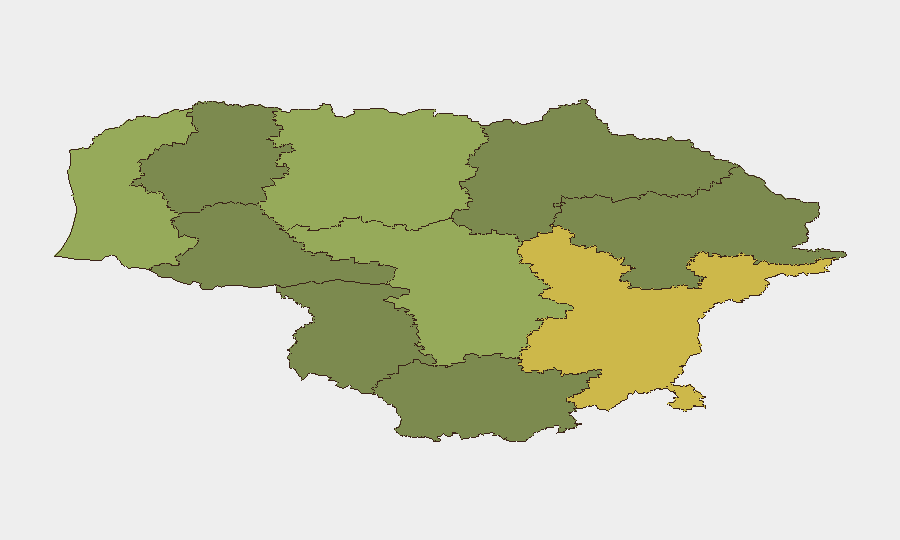
Situation Summary
Lithuania faces short-term political instability following the resignation of Prime Minister Inga Ruginienė and her cabinet on 23 June 2026, though constitutional procedures are being observed and core security portfolios remain in continuity. A reshaped center-left coalition has excluded a populist party amid antisemitic allegations and signaled a pragmatic recalibration of China policy, reducing diplomatic friction with Beijing while maintaining NATO and EU commitments. Current threat level remains low; no major civil unrest, cyber incidents, or violent crime spikes are reported in open sources over the past 48 hours, though the government transition introduces near-term policy uncertainty.
Key Developments
- 23 June 2026, Vilnius (Seimas and Presidential Offices) – Prime Minister Ruginienė and her entire cabinet formally resigned after coalition breakdown; President Gitanas Nausėda is expected to nominate Social Democratic Party leader Mindaugas Sinkevičius as the new prime minister. Outgoing cabinet will remain in caretaker capacity pending new government approval by parliament.
- 23 June 2026, Vilnius (Parliamentary Coalition) – Social Democrats finalized a new majority with two other center-left parties, securing 75 of 141 parliamentary seats and excluding the populist Nemuno Aušra party following scandals involving antisemitic rhetoric. New coalition reallocates ministerial portfolios and introduces period of realignment.
- 23 June 2026, Vilnius (Central Government Policy) – Incoming coalition announced intention to pursue "pragmatic" China policy, signaling willingness to restore diplomatic dialogue and expand economic cooperation with Beijing while maintaining commitments to EU, NATO, and Taiwan partnership. Signals possible de-escalation of Beijing-related trade or consular pressure on Lithuania-bound travelers and businesses.
- 23 June 2026, Vilnius (National Security Portfolios) – Social Democrats retain defense, foreign affairs, and interior ministries under new coalition deal; coalition partners assume health, agriculture, energy, economy, and justice portfolios. Continuity in defense and law-enforcement policy reduces immediate disruption to security posture.
- 23 June 2026, Kelmė District (Critical Infrastructure) – European Investment Bank finalized €150 million additional loan to Ignitis Group for Kelmė wind farm, bringing total EIB backing to €250 million for the largest operating onshore wind facility in the Baltics. Elevates the site's profile as strategic energy infrastructure.
- 12 April 2026 (in force), Lithuania (Space/Defense Policy) – Lithuania entered EU Space Surveillance and Tracking (SST) Partnership Agreement, now among 19 participating states; improves space-related situational awareness for orbital infrastructure supporting national communications and navigation.
Highest-Risk Areas
Vilnius County (risk score 68) and Kaunas County (58) account for the majority of tracked event activity and composite risk. Vilnius's elevated risk reflects the current government transition, political realignment, and concentration of national-level institutions and diplomatic presence; Kaunas and Klaipeda County (52) may reflect secondary administrative, commercial, or border-related activity. Lower-risk counties (Telsiai, Marijampole, each below 30) show minimal tracked events and are suitable for routine duty-of-care planning without heightened monitoring.
How GeoBit Would Assist
Security teams monitoring Lithuania should employ AOI Monitoring & Early Warning on Vilnius County and critical infrastructure sites (Kelmė wind farm) to track emerging civil unrest or protest activity during the government transition. Multi-language social/X OSINT and entity extraction on coalition communications and incoming cabinet announcements will provide early signals of policy shifts affecting business operations, China-related trade, or NATO defense posture. Conflict & Military tracking paired with network & actor analysis will enable detection of any Russian messaging campaigns or proxy activity linked to the recent "Public Statement" and "Military Power Show" signals flagged on 22–23 June.
7-Day Outlook
Government formation and cabinet approval by parliament are expected within 1–2 weeks, after which policy direction will become clearer. Near-term risk of legislative gridlock or delayed decision-making on non-security matters is moderate; no escalation of civil unrest or foreign military activity is forecast based on current open-source signals. Monitoring of new cabinet appointments and early policy statements will clarify the scope and timeline of the China policy shift and any implications for Lithuania's strategic partnerships.
Highest-Risk Areas — Ranked
| # | State / Region | Risk |
|---|---|---|
| 1 | Vilnius County | 68 |
| 2 | Kaunas County | 58 |
| 3 | Klaipeda County | 52 |
| 4 | Siauliai County | 42 |
| 5 | Panevezys County | 38 |
| 6 | Taurage County | 35 |
| 7 | Utena County | 33 |
| 8 | Alytus County | 32 |
| 9 | Telsiai County | 28 |
| 10 | Marijampole County | 25 |
Sources
Previous Daily Briefs
A new Lithuania brief is written every day — each with its own risk map and downloadable CSV. Here's the last week; use the calendar to go further back.
📅 Browse every day by calendar →
Highlighted days have a brief. Tap a day for that day's map & analysis, or “csv” for that day's dataset ($5).