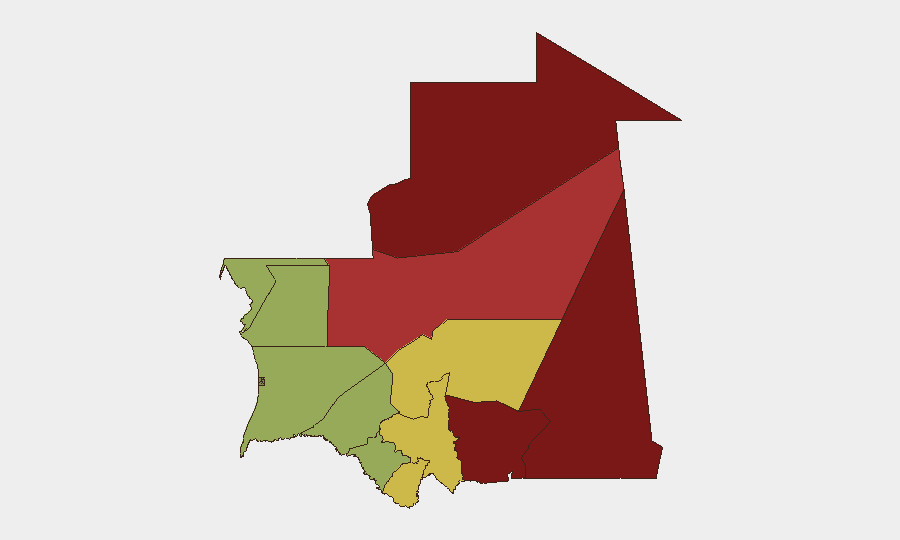
Situation Summary
Mauritania remains classified as a low-threat environment (composite score 2.7, rank #113 globally) with no major security incidents reported in the last 24–48 hours. The country's risk profile is heavily concentrated in its eastern and northern border regions, where persistent jihadist activity, smuggling networks, and porous boundaries with Mali and Algeria create localized volatility. The broader operating environment is stable, though structural vulnerabilities in remote regions demand targeted vigilance from organizations with personnel or assets in-country.
Key Developments
- 2026-06-26 · Physical Assault involving Police and Asylum Seeker – A police altercation with an asylum seeker was recorded; no location specified in indexed reports. Severity and circumstances remain unclear from available open-source data.
- 2026-06-25 · Rejection Event – A rejection incident was flagged in GeoBit's event tracking; specific location and context not yet clarified in cross-confirmed reporting.
- No armed clashes, terrorist attacks, or civil unrest incidents confirmed in the last 48 hours – Open-source monitoring across news feeds and social media shows no escalation or major new security events beyond routine low-level activity.
*Note: Both June 25–26 events lack sufficient corroborating detail in available web and social-media sources to assess impact or operational relevance. Duty-of-care teams should monitor for follow-up reporting.*
Highest-Risk Areas
Tiris Zemmour (risk 95), Hodh Ech Chargui (85), and Hodh El Gharbi (80) dominate the threat landscape, reflecting the Sahel's chronic jihadist presence, cross-border militia activity, and weak state control. These eastern and southeastern zones border Mali and Algeria, making them conduits for weapons trafficking, militant recruitment, and refugee flows. Adrar (78) and Tagant (68) extend risk northward into mineral-rich but sparsely governed territory. Together, these five regions account for the majority of Mauritania's conflict-related risk; the capital Nouakchott and western coastal zones remain significantly lower-risk, though petty crime and labor disputes warrant standard duty-of-care practices.
How GeoBit Would Assist
Organizations should deploy AOI Monitoring & Early Warning on high-risk regions (Tiris Zemmour, Hodh provinces, Adrar) to flag emerging incidents in near-real-time via X/Twitter, Telegram, and local-language sources. OSINT Fusion & Corroboration and Multi-Language Search capabilities enable detection of cross-border militia movements, jihadist communications, and smuggling-network activity before they escalate to major incidents. For teams with mobile or remote assets, Routing & Network Analysis identifies safer transit corridors and contingency pathways in high-risk zones. Network & Actor Analysis provides visibility into armed-group structure and intent, informing site-security and travel-risk decisions.
7-Day Outlook
No acute crisis indicators are present; the security environment is expected to remain stable over the next week. However, the Sahel's structural instability—persistent jihadist recruitment, cross-border weapons flows, and state-capacity gaps—means localized incidents (ambushes, kidnappings, clashes) remain possible in remote eastern regions without warning. Organizations should maintain baseline AOI monitoring and escalation protocols; no urgent travel restrictions or asset relocations are warranted at this time, but standard precautions in Tiris Zemmour and eastern Hodh provinces remain essential.
Highest-Risk Areas — Ranked
| # | State / Region | Risk |
|---|---|---|
| 1 | Tiris Zemmour | 95 |
| 2 | Hodh Ech Chargui | 85 |
| 3 | Hodh El Gharbi | 80 |
| 4 | Adrar | 78 |
| 5 | Tagant | 68 |
| 6 | Guidimaka | 65 |
| 7 | Assaba | 62 |
| 8 | Gorgol | 58 |
| 9 | Trarza | 55 |
| 10 | Inchiri | 52 |
| 11 | Brakna | 48 |
| 12 | Dakhlet Nouadhibou | 45 |
Sources
Previous Daily Briefs
A new Mauritania brief is written every day — each with its own risk map and downloadable CSV. Here's the last week; use the calendar to go further back.
📅 Browse every day by calendar →
Highlighted days have a brief. Tap a day for that day's map & analysis, or “csv” for that day's dataset ($5).