Situation Summary
Mexico remains the fifth-highest-threat country globally (composite score 100), driven primarily by ongoing criminal insurgency across 1,576 tracked events. The security environment is characterized by persistent cartel violence, territorial competition, and state fragmentation, with recent tactical gains by Mexican security forces (notably the killing of CJNG leader El Mencho on 2026-06-02) triggering cascading disruptions to civilian infrastructure and cross-border travel. While some localized stabilization is underway—particularly in Jalisco following the initial post-Mencho violence spike—underlying criminal organizational strength and territorial control remain intact across 12 highest-risk states, suggesting volatility will persist.
Key Developments
- Jalisco (Guadalajara & Puerto Vallarta) – 2026-06-02 to present: El Mencho's death by Mexican security forces triggered multi-day cartel violence including vehicle burnings, roadblocks, and airport capacity reductions. Hundreds of U.S. travelers were stranded; airline operations are being progressively restored but shelter-in-place advisories and elevated State Department warnings remain in effect.
- U.S.–Mexico diplomatic friction – 2026-06-02 to 06-03: Ambassador arrest/detention and disapproval signals indicate rising bilateral tension, with potential implications for cross-border security coordination and U.S. government travel restrictions for personnel.
- Guerrero state (Acapulco, Zihuatanejo, Taxco, Ixtapa) – ongoing: Armed groups operate independently of state authority; U.S. government employees are prohibited from traveling anywhere in the state due to chronic roadblocks, kidnapping risk, and organized-crime violence.
- Tamaulipas border corridor (Reynosa–Nuevo Laredo) – ongoing: Severe organized-crime activity including gun battles, kidnappings for ransom targeting motorists and bus passengers, and armed criminal patrols with limited law-enforcement response.
- Zacatecas & Guanajuato – ongoing: Widespread extortion, violent crime, and gang-linked disputes (including fuel-theft operations in Guanajuato) sustain elevated risk for overland travel and collateral exposure to armed confrontations.
- Islamic-linked investigation signal – 2026-06-01: Unconfirmed investigative activity flagged; warrants monitoring for any convergence with cartel or transnational criminal networks.
Highest-Risk Areas
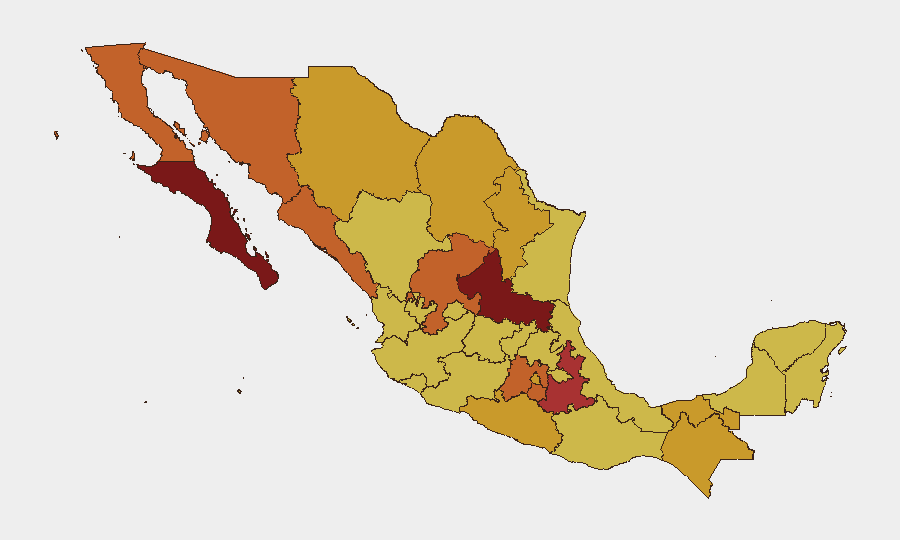
San Luis Potosí (risk 100), Baja California Sur (80.4), and Puebla (79.1) top the sub-national ranking, reflecting entrenched cartel territorial control, weak state capacity, and high rates of kidnapping and extortion. The northern border region—Baja California, Sonora, Coahuila, and Tamaulipas—sustains elevated risk due to cartel trafficking operations, armed patrols, and kidnapping pipelines targeting cross-border commerce and travelers. Central states including State of Mexico, Morelos, and Zacatecas face compounded risk from proximity to Mexico City's criminal networks and fragmented gang competition. Guerrero's ranking (11th) understates its operational threat level given the explicit prohibition on U.S. government travel and persistent armed-group control of key corridors.
How GeoBit Would Assist
Security teams monitoring Mexico should employ AOI Monitoring & Early Warning to track persistent threats in high-risk states, with real-time alerting on cartel leadership changes, roadblock activity, and armed-group movements. Network & Actor Analysis and Entity Extraction via OSINT (X/Twitter, Telegram, radio SIGINT) would reveal criminal-organization structure shifts following Mencho's death and detect emerging power-consolidation or fragmentation signals. Routing & Network Analysis capabilities enable alternative journey planning and real-time corridor assessment for personnel and asset movements, while Conflict & Military force-structure tracking provides early warning of state security operations that may trigger secondary cartel violence spikes.
7-Day Outlook
Jalisco will likely stabilize further as Mexican security operations conclude and commercial traffic resumes, though residual cartel retaliation or succession violence remains possible. Northern border states and Guerrero will sustain their current high-threat posture with no anticipated reduction in kidnapping, extortion, or roadblock activity. Elevated bilateral tension signals and the unconfirmed Islamic-linked investigation warrant close monitoring for any cross-border or transnational implications.
Highest-Risk Areas — Ranked
| # | State / Region | Risk |
|---|---|---|
| 1 | San Luis Potosí | 100 |
| 2 | Baja California Sur | 80.4 |
| 3 | Puebla | 79.1 |
| 4 | Baja California | 75.8 |
| 5 | State of Mexico | 74.3 |
| 6 | Zacatecas | 73.8 |
| 7 | Sinaloa | 73.5 |
| 8 | Morelos | 73.5 |
| 9 | Sonora | 73 |
| 10 | Tabasco | 72.7 |
| 11 | Guerrero | 72.3 |
| 12 | Coahuila | 72.2 |
Previous Daily Briefs
A new Mexico brief is written every day — each with its own risk map and downloadable CSV. Here's the last week; use the calendar to go further back.
📅 Browse every day by calendar →
Highlighted days have a brief. Tap a day for that day's map & analysis, or “csv” for that day's dataset ($5).