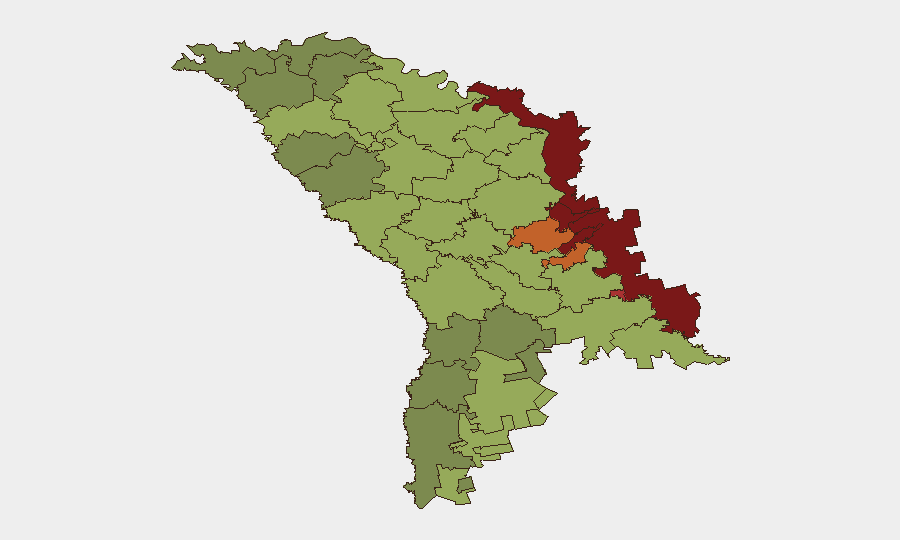
Situation Summary
Moldova remains a low-frequency, persistent-risk environment (global rank #104, composite score 6). The security landscape is dominated by the unresolved status of breakaway Transnistria and Russian military presence on the left bank of the Dniester, compounded by energy vulnerabilities and ongoing intelligence service reform. No major incidents were detected in the last 24–48 hours; current developments are limited to governance measures and preparedness actions rather than operational threats or civil unrest.
Key Developments
- Chișinău, 14 Jun 2026 — President Maia Sandu announced completion of a "deep reform" of Moldova's Security and Intelligence Service (SIS) with European Union support, signaling continued institutional modernization and realignment toward Western security frameworks.
- Moldova (National), 14 Jun 2026 — The government approved an increase in natural gas security stockpiles for the 2026–2027 heating season, reflecting persistent energy resilience concerns ahead of winter and historical Russian supply pressure.
- Kyiv–Chișinău, 8 Jun 2026 — Ukrainian officials reported Moldova is pursuing consultation with Ukraine on interceptor drone capability and legislative frameworks, indicating defensive military modernization planning in response to regional threats.
Assessment note: No security incidents, border clashes, protest activity, or significant crime events were detected in the past 48 hours. Provided signals reflect governance and preparedness activity, not acute operational developments.
Highest-Risk Areas
The left-bank administrative units (risk 85) and Dubăsari (82) and Bender (79) remain the dominant risk drivers, all located in or adjacent to the Transnistria breakaway zone and characterized by Russian military presence, unclear governance, and weapons storage. The secondary risk belt—Criuleni (75), Rezina (58), and Taraclia (55)—reflects proximity to the Dniester corridor and past conflict zones. Gagauzia (54), an autonomous region with Russian sympathies, and the capital Chișinău (49) carry moderate risk. These rankings reflect structural factors (unresolved territorial status, foreign military presence, energy dependency) rather than imminent escalation.
How GeoBit Would Assist
Corporate security teams should employ Area-of-Interest Monitoring & Early Warning to track Transnistria-adjacent districts (Dubăsari, Bender, Criuleni) for cross-border military movement or supply activity; OSINT fusion & corroboration (X/Telegram, local news, radio SIGINT) to detect early signs of protests, supply disruptions, or regime instability; and Border & Disputed-Territory Search combined with Satellite & Imagery Analysis to maintain persistent visibility on Russian military posture and infrastructure along the left bank. Network & Actor Analysis supports monitoring of pro-Russian and pro-Western political movements that could drive internal destabilization.
7-Day Outlook
No acute escalation is forecast for the next week. The near-term trajectory remains stable but fragile: energy preparedness measures and SIS reform reflect Chișinău's focus on institutional resilience and Western integration, while Russian military posture in Transnistria shows no reported mobilization. Monitoring should remain elevated during the heating season (October–March) when energy coercion historically increases, and ahead of Moldova's next electoral cycle.
Highest-Risk Areas — Ranked
| # | State / Region | Risk |
|---|---|---|
| 1 | Administrative-Territorial Units of the Left Bank of the Dniester | 85 |
| 2 | Dubăsari | 82 |
| 3 | Bender | 79 |
| 4 | Criuleni | 75 |
| 5 | Rezina | 58 |
| 6 | Taraclia | 55 |
| 7 | Gagauzia | 54 |
| 8 | Căușeni | 53 |
| 9 | Soroca | 52 |
| 10 | Ștefan Vodă | 51 |
| 11 | Orhei | 50 |
| 12 | Chișinău | 49 |
Sources
Previous Daily Briefs
A new Moldova brief is written every day — each with its own risk map and downloadable CSV. Here's the last week; use the calendar to go further back.
📅 Browse every day by calendar →
Highlighted days have a brief. Tap a day for that day's map & analysis, or “csv” for that day's dataset ($5).