Situation Summary
Moldova remains exposed to cross-border airspace violations linked to the ongoing Russia–Ukraine conflict, with five confirmed drone incursions or crashes recorded during 14–20 October 2026. The national threat ranking remains low globally (rank 136), but sub-national risk concentrations—particularly in Transnistria-adjacent zones and northern border districts—reflect persistent vulnerability to spillover effects. No direct attacks on Moldovan territory or civilian infrastructure have occurred, but the frequency and geographic spread of unauthorized airspace crossings indicate sustained operational activity in the region.
Key Developments
- Overnight 15–16 October, nationwide: Four Russian drones crossed Moldovan airspace during a broader attack on Ukraine, entering between 23:02 and 03:46, and one additional crossing occurred at 05:59–06:09. All objects returned toward Ukraine; no impact recorded.
- 16 October, Dondușeni District (Codrenii Noi–Scăieni area): An unmanned aircraft crashed and exploded in an unpopulated field; local police and state authorities conducted site examination and debris recovery.
- 16 October, four northern/eastern locations: Unauthorized UAV overflights were detected over Tudora (Ștefan Vodă District), the Otaci–Hădărăuți route (Ocnița District), the Căplani–Olănești and Purcari–Dnestrovsk routes (location unspecified), with no reported impacts.
- 16 October, ~16:22, Sobari (Soroca District): A suspected unauthorized aircraft transited Moldovan airspace; no collision or ground damage reported.
Highest-Risk Areas
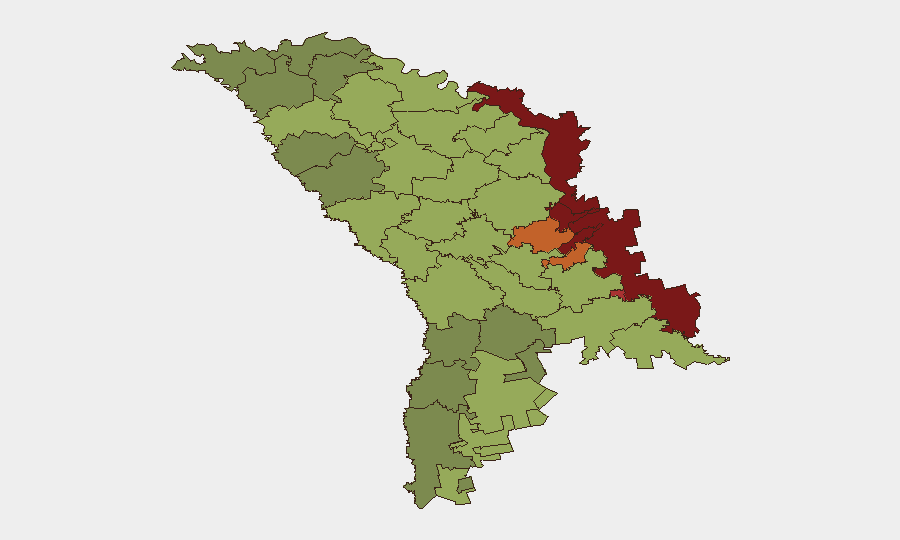
The Left Bank of the Dniester and adjacent districts (Dubăsari, Bender, Criuleni) account for the three highest composite risk scores (85, 82, 79 respectively), reflecting Transnistria's unresolved status, Russian military presence, and proximity to active Ukraine operations. Northern border regions—Rezina, Soroca, and Ocnița—score 52–58 and face direct exposure to cross-border drone traffic and spillover effects from the conflict zone. Chișinău (rank 12, score 49) and central zones remain lower-risk but retain residual vulnerability. The pattern indicates that risk correlates directly with proximity to Transnistria or the Ukraine border, where Russian military activity generates recurring airspace violations.
How GeoBit Would Assist
Corporate security teams with personnel or assets in Moldova should employ AOI Monitoring & Early Warning to establish persistent watch over high-risk districts (Left Bank, Dubăsari, northern borders) with automated alerting for airspace incursions or explosions. Conflict & Military capabilities—including battle mapping and force-structure monitoring—enable tracking of Russian drone operations and their likely corridors through Moldovan airspace. GIS & Spatial Analysis and Satellite & Imagery Analysis support real-time assessment of incident locations, blast radius estimation, and route-planning alternatives to avoid active violation zones.
7-Day Outlook
Drone incursions are likely to persist as long as Russia maintains large-scale air operations against Ukraine; the 14–20 October cluster suggests a weekly frequency of 4–6 crossings, predominantly in northern and eastern airspace. No escalation to kinetic strikes on Moldovan territory is currently indicated, but the growing geographic dispersal of violations warrants heightened vigilance in Soroca, Ocnița, and Dondușeni districts through the immediate week ahead.
Highest-Risk Areas — Ranked
| # | State / Region | Risk |
|---|---|---|
| 1 | Administrative-Territorial Units of the Left Bank of the Dniester | 85 |
| 2 | Dubăsari | 82 |
| 3 | Bender | 79 |
| 4 | Criuleni | 75 |
| 5 | Rezina | 58 |
| 6 | Taraclia | 55 |
| 7 | Gagauzia | 54 |
| 8 | Căușeni | 53 |
| 9 | Soroca | 52 |
| 10 | Ștefan Vodă | 51 |
| 11 | Orhei | 50 |
| 12 | Chișinău | 49 |
Sources
Previous Weekly Briefs
A new Moldova brief is written every Monday, covering the week — each with its own risk map and downloadable CSV. Use the calendar to go further back.
- October 13, 2026
- October 6, 2026
- September 29, 2026
- September 22, 2026
- September 15, 2026
- September 8, 2026
- September 2, 2026
📅 Browse past briefs by calendar →
Highlighted days have a brief. Tap a day for that day's map & analysis, or “csv” for that day's dataset ($5).
Atlas — our AI intelligence desk — emails them this snapshot personally. Nothing else, no list.