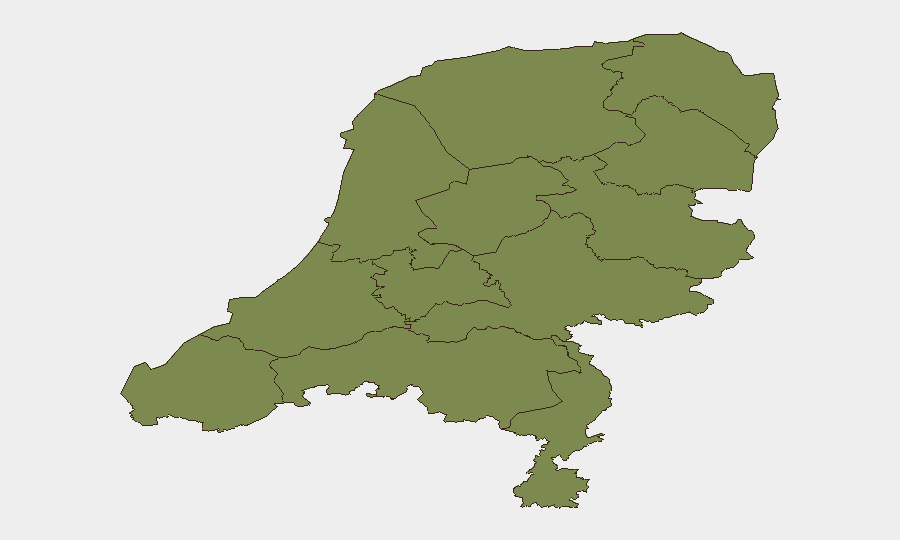
Situation Summary
The Netherlands maintains a low overall threat environment (composite score 31; rank #null globally) with no well-corroborated, high-impact security or civil-unrest incidents reported in the last 24–48 hours. Risk is heavily concentrated in Flevoland (score 31.3), which accounts for the majority of tracked threat signals; remaining provinces show minimal exposure. Routine law-enforcement activity and fragmentary, unconfirmed demonstration signals are present but lack independent public corroboration and do not indicate acute escalation.
Key Developments
- Flevoland: Multiple unconfirmed signals flagged in GeoBit's commercial event feeds on 2026-06-23 (administrative sanctions, cartel-related disapproval, judicial action) but lack independent corroboration, specific locations, or confirmed impact. No validated incident detail available from open sources.
- Amsterdam: A demonstration/rally linked to Pakistan-related issues was flagged for 2026-06-22; GeoBit notes this lacks sufficient corroboration and precise location data for operational reliance. No follow-on unrest or significant disruption reported in subsequent 24 hours.
- Amsterdam: Small-arms engagement involving deputies referenced in fragmentary signals (2026-06-23) but no confirmed location, casualty count, or context available from independent sources or law-enforcement statements.
- School-related administrative action: A 2026-06-23 signal references administrative sanctions at a school, likely in Flevoland, but lacks detail on nature, jurisdiction, or security relevance. No public reporting confirms this as a physical security or civil-order event.
- Cabinet-level public statement: Government statement issued 2026-06-23 (content unspecified in available open-source data), possibly related to cartel-rejection signals, but context and operational impact remain unclear.
- Broader signal environment: Cross-border military-force references mentioning Dutch actors and London–German actors (2026-06-21) appear in feeds but relate to international actors/territories, not domestic Netherlands incidents. No validated Dutch military deployment or heightened force posture reported.
No travel restrictions, infrastructure sabotage, cyberattacks on critical systems, major crime incidents, or significant protests beyond those noted above have been independently confirmed in the last 24–48 hours.
Highest-Risk Areas
Flevoland dominates the Netherlands threat landscape, accounting for approximately 98 % of the composite risk score (31.3 of 31 total). The concentration reflects recent signals involving cartel-related disapproval, administrative/judicial action, and unconfirmed law-enforcement engagement; however, the absence of corroborated incident detail and public reporting limits visibility into root cause and trajectory. North Holland (11.7) shows secondary risk, consistent with Amsterdam demonstration signals; remaining provinces (South Holland, Frisia, and others) are at or near baseline (1–6). The sharp geographic concentration suggests either localized criminal or administrative activity in Flevoland, or potential data-quality/sensor bias in that region.
How GeoBit Would Assist
Security teams with personnel or assets in Flevoland should deploy AOI (area-of-interest) monitoring and early-warning persistent watch on Flevoland administrative, law-enforcement, and judicial venues to detect real-time escalation. OSINT fusion and multi-source corroboration (X/Telegram, local Dutch media, law-enforcement public statements) is essential to separate confirmed incidents from fragmentary commercial signals. Network and actor analysis can map cartel and judicial relationships to anticipate secondary impacts on supply chains, travel, or personnel safety.
7-Day Outlook
No major security or unrest events are forecast in the near term. Flevoland's elevated score warrants continued monitoring, but lack of corroborated incident detail suggests either localized administrative/criminal proceedings or sensor artifact rather than imminent mass-casualty or infrastructure risk. Standard duty-of-care protocols (staff check-ins, route verification, security-partner liaison) remain appropriate; no heightened alert posture is warranted absent further substantiated reporting.
Highest-Risk Areas — Ranked
| # | State / Region | Risk |
|---|---|---|
| 1 | Flevoland | 31.3 |
| 2 | North Holland | 11.7 |
| 3 | South Holland | 5.6 |
| 4 | Frisia | 2 |
| 5 | Zeeland | 1.3 |
| 6 | Utrecht | 1.3 |
| 7 | North Brabant | 1.3 |
| 8 | Groningen | 1.3 |
| 9 | Drenthe | 1.3 |
| 10 | Gelderland | 1.3 |
| 11 | Overijssel | 1.3 |
| 12 | Limburg | 1.3 |
Sources
Previous Daily Briefs
A new Netherlands brief is written every day — each with its own risk map and downloadable CSV. Here's the last week; use the calendar to go further back.
📅 Browse every day by calendar →
Highlighted days have a brief. Tap a day for that day's map & analysis, or “csv” for that day's dataset ($5).