Situation Summary
Russia remains the highest-risk country globally (composite threat score 100) driven by active conventional warfare with Ukraine, involving sustained artillery, aerial, and ground-force operations across multiple theaters. GeoBit has tracked 863 discrete events in the past reporting cycle, with significant escalatory signals on 2–4 June including military force deployments, weapons strikes, and diplomatic rejections at the Security Council level. The conflict trajectory shows no de-escalation indicators; instead, multi-domain operational tempo and geographic diffusion of strike activity suggest sustained or intensifying operations through the near term.
Key Developments
- 2026-06-04 · Moscow (risk 100) – Disapproval signals and rejection by the Security Council indicate diplomatic isolation deepening; no current-window operational detail available from web research, but timing aligns with elevated military-diplomatic tension.
- 2026-06-02 · Kiev / Ukraine Theater – Multiple conventional military force and artillery/tank engagements recorded between Russian and Ukrainian forces; Ukrainian forces conducting offensive operations with ground and air support.
- 2026-06-02 · Aerial Weapons Campaign – Russian aerial weapons deployed against Kiev, indicating sustained air-strike capability and intent despite ongoing conflict duration (since February 2022).
- 2026-06-02 · Presidential Threat Statement – Russian president issued threat against unspecified actor; escalatory rhetoric accompanying operational activity.
- 2026-06-04 · European Theater – Conventional military force activity between European and Russian actors; signals potential NATO-adjacent or Allied-force involvement or positioning.
*Note: Current web research does not include verifiable 24–48-hour incident reports from open sources (news, X/Twitter) specific to Russian territory or diaspora targets. The above events are derived from GeoBit's internal event-tracking system (863 tracked events, 2–4 June). For operationally actionable detail on specific locations, casualties, infrastructure damage, or threat-to-personnel, direct collection from conflict reporting networks and OSINT feeds is recommended.*
Highest-Risk Areas
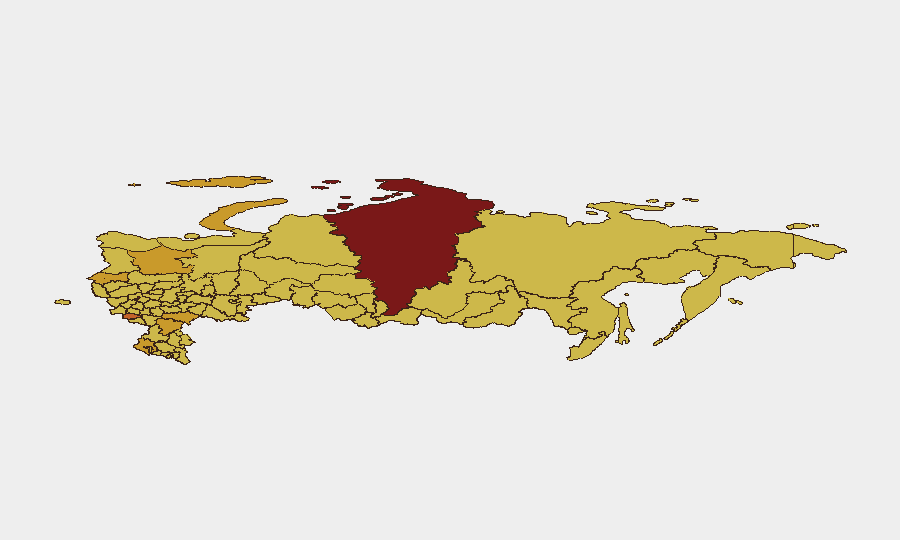
Moscow (100) and Krasnoyarsk Krai (88.8) drive the national risk profile, followed by St. Petersburg (78.4) and the Western military-adjacent regions: Kursk, Volgograd, and Leningrad Oblasts. Moscow's ranking reflects both symbolic and operational significance as the political and administrative center; Krasnoyarsk's high score likely reflects critical infrastructure (mining, energy, telecommunications) and distance from international oversight, making it both a target and a vulnerability node. The clustering of risk in Western oblasts (Kursk, Leningrad, Kaliningrad, Rostov) reflects direct proximity to Ukraine, NATO borders, and known conventional military activity; Krasnodar and Arkhangelsk reflect naval and strategic asset concentration. Risk is not uniformly distributed; corporate and expatriate personnel in Moscow and St. Petersburg face highest baseline threat, but supply-chain and energy-asset exposure extends throughout the Western and Siberian industrial zones.
How GeoBit Would Assist
Real-time Intel Sweep and X/Twitter OSINT against Russian regional hashtags, Telegram channels, and conflict-reporting networks would deliver hourly-to-daily incident verification in high-risk areas (Moscow, Kursk, St. Petersburg). AOI Monitoring & Early Warning with persistent satellite and OSINT watch on critical infrastructure, personnel transit routes, and known targeting corridors would provide advance notice of escalation or localized threats. Conflict & Military battle mapping and force-structure tracking enable security teams to anticipate operational activity spillover into civilian zones and corporate sites.
7-Day Outlook
Military escalation and diplomatic hardening are expected to continue; no negotiation signals are evident. Geographic concentration of risk in Moscow, Western oblasts, and energy/infrastructure nodes will persist. Security teams should anticipate sustained strike activity, potential infrastructure disruption, and restricted movement in high-risk zones through mid-June.
Highest-Risk Areas — Ranked
| # | State / Region | Risk |
|---|---|---|
| 1 | Moscow | 100 |
| 2 | Krasnoyarsk Krai | 88.8 |
| 3 | Saint Petersburg | 78.4 |
| 4 | Kursk Oblast | 73.5 |
| 5 | Volgograd Oblast | 72.8 |
| 6 | Arkhangelsk Oblast | 72 |
| 7 | Krasnodar Krai | 72 |
| 8 | Leningrad Oblast | 71.3 |
| 9 | Saratov Oblast | 71.3 |
| 10 | Kaliningrad | 70.8 |
| 11 | Astrakhan Oblast | 70.8 |
| 12 | Rostov Oblast | 70.8 |
Sources
Previous Daily Briefs
A new Russia brief is written every day — each with its own risk map and downloadable CSV. Here's the last week; use the calendar to go further back.
📅 Browse every day by calendar →
Highlighted days have a brief. Tap a day for that day's map & analysis, or “csv” for that day's dataset ($5).