Situation Summary
Rwanda maintains a relatively stable security environment with a composite threat score of 6 (rank #97 globally). Open-source reporting over the last 24–48 hours shows no confirmed domestic security incidents, civil unrest, or acute crime events within Rwanda's borders. The country's internal security posture remains characterized by tight state control and low reported disorder, though independent verification of incidents is constrained by limited independent media space. Risk concentration is heavily localized to Kigali City, which accounts for the majority of national threat activity.
Key Developments
- 2026-06-16 · Kigali City (location inferred): A public statement attributed to "Company vs Africa" was posted; content and specific security implications require further corroboration and are not yet independently verified as a security or stability threat.
- Recent · Health/Regional: Marburg virus disease remains under observation in Rwanda's health-security environment; however, Rwanda is currently classified as *Ebola-free* and Marburg cases, if present, have not been reported as a new outbreak in the last 24–48 hours. This is primarily a regional health-monitoring matter, not an acute incident.
- No acute crime, protest, infrastructure, or conflict events confirmed in Rwanda proper in the last 24–48 hours based on available open sources.
Note on Regional Context (not current Rwanda incidents): International media and NGO reporting in recent weeks have focused on Rwanda's alleged involvement in supporting M23 military operations in eastern Democratic Republic of Congo; these are regional security dynamics, not domestic Rwanda incidents, and predate the current 24–48-hour window.
Highest-Risk Areas
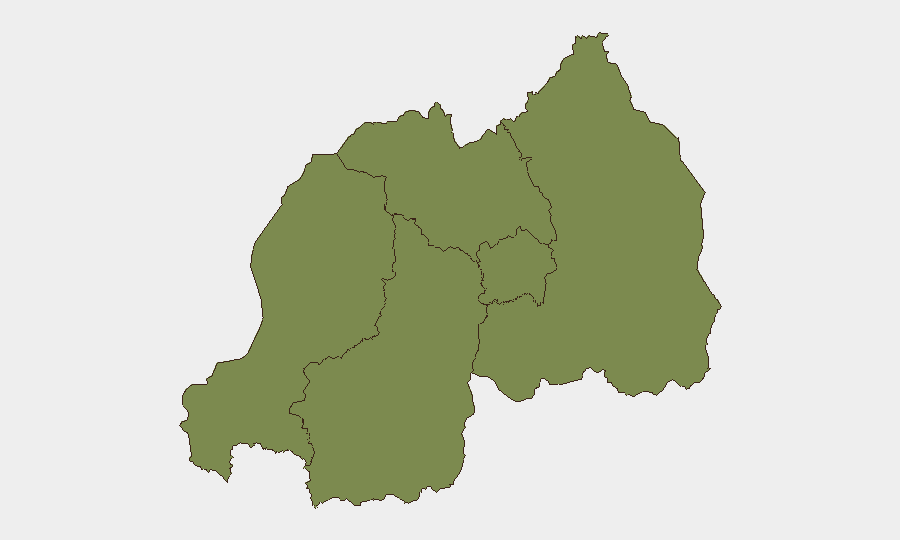
Kigali City dominates Rwanda's threat profile with a composite risk score of 32.5—more than 13 times higher than any other region. The four remaining provinces (Western, Northern, Southern, Eastern) all register at 2.4, indicating near-parity and markedly lower risk. This concentration reflects Kigali's role as the capital and largest urban center, where political, economic, and administrative activity creates greater exposure to protest, crime, and inter-personal violence. The stark differential suggests that corporate security teams with assets or personnel outside Kigali face substantially lower operational risk, though basic duty-of-care protocols remain advisable.
How GeoBit Would Assist
A security or risk team monitoring Rwanda would deploy AOI (Area-of-Interest) Monitoring & Early Warning on Kigali City to detect emerging civil unrest, protest activity, or security incidents in real time; Intel Sweep and multi-language OSINT fusion to corroborate rumors and official statements; and Risk & Threat Assessment combined with Conflict & Actor Network Analysis to track any escalation in regional dynamics (M23, DRC border) that could affect Rwanda's stability or pose indirect risk to corporate operations. Routing & Network Analysis would support contingency planning for personnel and supply chains should conditions shift.
7-Day Outlook
No acute security catalyst is visible on the horizon for the next 7 days. Rwanda's political calendar and regional diplomatic engagement (DRC-Rwanda border tensions, SADC mediation efforts) will likely continue at current tempo without sudden escalation. Security teams should maintain baseline monitoring for health developments (Marburg), routine crime reporting in Kigali, and any shift in Rwanda's posture toward eastern DRC, but no significant near-term trajectory change is anticipated.
Highest-Risk Areas — Ranked
| # | State / Region | Risk |
|---|---|---|
| 1 | Kigali City | 32.5 |
| 2 | Western Province | 2.4 |
| 3 | Northern Province | 2.4 |
| 4 | Southern Province | 2.4 |
| 5 | Eastern Province | 2.4 |
Sources
Previous Daily Briefs
A new Rwanda brief is written every day — each with its own risk map and downloadable CSV. Here's the last week; use the calendar to go further back.
📅 Browse every day by calendar →
Highlighted days have a brief. Tap a day for that day's map & analysis, or “csv” for that day's dataset ($5).