Situation Summary
Slovakia remains a low-threat environment globally (rank #88, composite score 13) with no major security incidents verified in the last 24–48 hours. A persistent, nationwide trend of ATM-blast robberies—15 cases recorded in Q1 2026, 29 in 2025—continues to drive police operational response and corporate security upgrades in the banking sector. The sub-national risk profile is heavily skewed toward Banská Bystrica region (composite score 31.8), which accounts for the majority of tracked national threat signals; all other regions score significantly lower (1.8 each), indicating concentrated rather than diffuse risk geography.
Key Developments
- No discrete, timestamped security incidents verified within the last 24–48 hours. Available reporting remains operationally contextual (police task-force activity, banking sector hardening) rather than event-specific.
- ATM-blast trend (nationwide, ongoing through 2026). Attacks in municipalities including Dolné Saliby, Dudince, Oslany, and Lehota pod Vtáčnikom continue; police have established a dedicated working group and banks are deploying enhanced physical security. Precise incident dates within the current 48-hour window could not be independently corroborated from available sources.
Highest-Risk Areas
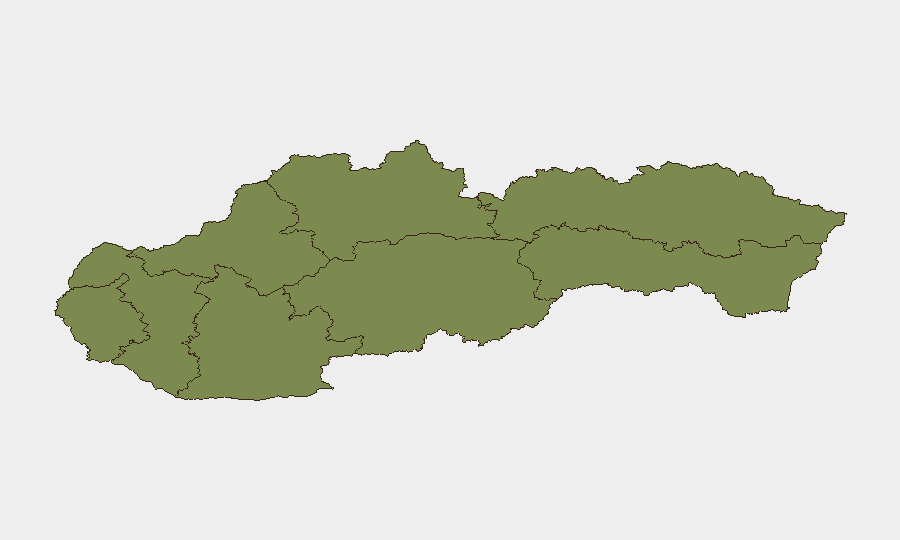
Banská Bystrica region is a clear outlier, with a composite risk score of 31.8—more than 17 times higher than any other Slovak region—and accounts for the overwhelming majority of GeoBit's 39 tracked events nationwide. The remaining seven regions (Košice, Žilina, Bratislava, Trnava, Trenčín, Nitra, Prešov) all register identical scores of 1.8, suggesting either distributed, lower-level baseline risks or a concentration of reporting bias toward central Slovakia. Banská Bystrica's elevated profile should guide asset-protection and personnel-safety planning for organizations with operations or personnel in that region; for Bratislava and other major urban centers, risk appears commensurate with routine corporate-security baselines in a stable EU member state.
How GeoBit Would Assist
Corporate security teams can deploy AOI (Area-of-Interest) Monitoring & Early Warning to track Banská Bystrica and other high-footprint locations for emerging crime, civil unrest, or infrastructure disruptions with real-time alerting. Intel Sweep and multi-language OSINT fusion can correlate ATM-gang activity, police operations, and banking-sector responses across local news, law enforcement communications, and sector forums to detect escalation or shift in attack patterns. Risk & Threat Assessment capability can model exposure for specific sites (branches, facilities, personnel routes) and recommend layered mitigations aligned with the documented ATM-robbery trend and regional risk variance.
7-Day Outlook
No major shifts in Slovakia's security posture are anticipated in the near term. The ATM-robbery phenomenon is likely to persist as a routine criminal enterprise rather than escalate into organized violence or wider civil instability; banking sector countermeasures and police enforcement should maintain suppression of large-scale incidents. Duty-of-care teams should continue standard Europe-baseline security hygiene and refresh ATM/cash-handling protocols in line with banking-sector advisories, particularly in Banská Bystrica region.
Highest-Risk Areas — Ranked
| # | State / Region | Risk |
|---|---|---|
| 1 | Region of Banská Bystrica | 31.8 |
| 2 | Region of Košice | 1.8 |
| 3 | Region of Žilina | 1.8 |
| 4 | Region of Bratislava | 1.8 |
| 5 | Region of Trnava | 1.8 |
| 6 | Region of Trenčín | 1.8 |
| 7 | Region of Nitra | 1.8 |
| 8 | Region of Prešov | 1.8 |
Previous Daily Briefs
A new Slovakia brief is written every day — each with its own risk map and downloadable CSV. Here's the last week; use the calendar to go further back.
📅 Browse every day by calendar →
Highlighted days have a brief. Tap a day for that day's map & analysis, or “csv” for that day's dataset ($5).