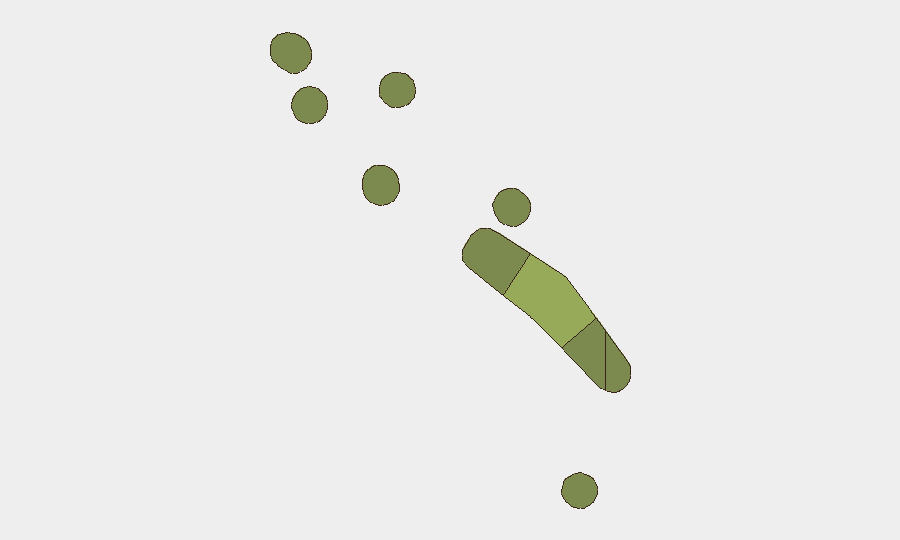
Situation Summary
Tuvalu remains a low-threat environment with no credible security incidents, civil unrest, or infrastructure disruptions reported in the last 24–48 hours. The nation's composite threat score of 4 and absence of tracked events reflect a broadly stable security posture. Risk concentration is geographic, with Funafuti (the capital) accounting for the majority of the country's monitored exposure.
Key Developments
No discrete security incidents, civil unrest, crime events, political instability, or travel-risk developments have been publicly reported for Tuvalu in the 24–48 hours prior to 2026-06-24. Web-based news sources, social media monitoring, and real-time threat dashboards show no new threat activity. This absence of reportable events is itself the operative finding for the current reporting window.
Highest-Risk Areas
Funafuti dominates risk concentration, with a sub-national score of 45—substantially above all other islands. Vaitupu (28) and Nui (25) follow at considerable distance. The disparity reflects Funafuti's role as the capital, administrative center, and primary port of entry; it thus hosts the largest foreign resident population, most significant economic activity, and highest density of government and financial infrastructure. Remaining islands (Niutao, Nanumanga, Nanumea, Nukulaelae) present minimal elevated risk. For most corporate operations, duty-of-care and asset-protection priorities should remain concentrated in Funafuti; remote island operations face lower threat profiles but proportionally greater supply-chain and medical-evacuation constraints.
How GeoBit Would Assist
For ongoing Tuvalu monitoring, security teams would employ AOI Monitoring & Early Warning on Funafuti and other asset locations to detect emerging civil unrest, infrastructure disruption, or maritime/aviation incidents with alert capability. Intel Sweep and multi-language OSINT fusion would track government communications, financial-sector announcements, and regional diplomatic signals for political or economic shifts affecting stability. Maritime & Aviation tracking, combined with Routing & Network Analysis, would support contingency planning and alternative journey options for personnel in or transiting the country.
7-Day Outlook
No near-term acute security deterioration is anticipated. Tuvalu's structural vulnerabilities remain climate and maritime-related rather than conflict or governance-driven; no political transitions, electoral periods, or international tensions are flagged for the coming week. Risk posture is expected to remain stable and low, with day-to-day variation confined to routine maritime weather and administrative activity.
*GeoBit Daily Security Brief | Tuvalu | 2026-06-24*
*Threat Ranking: #175 globally | Composite Score: 4 | Events Tracked: 0*
Highest-Risk Areas — Ranked
| # | State / Region | Risk |
|---|---|---|
| 1 | Funafuti | 45 |
| 2 | Vaitupu | 28 |
| 3 | Nui | 25 |
| 4 | Nukufetau | 22 |
| 5 | Niutao | 20 |
| 6 | Nanumanga | 18 |
| 7 | Nanumea | 15 |
| 8 | Nukulaelae | 12 |
Sources
Previous Daily Briefs
A new Tuvalu brief is written every day — each with its own risk map and downloadable CSV. Here's the last week; use the calendar to go further back.
📅 Browse every day by calendar →
Highlighted days have a brief. Tap a day for that day's map & analysis, or “csv” for that day's dataset ($5).