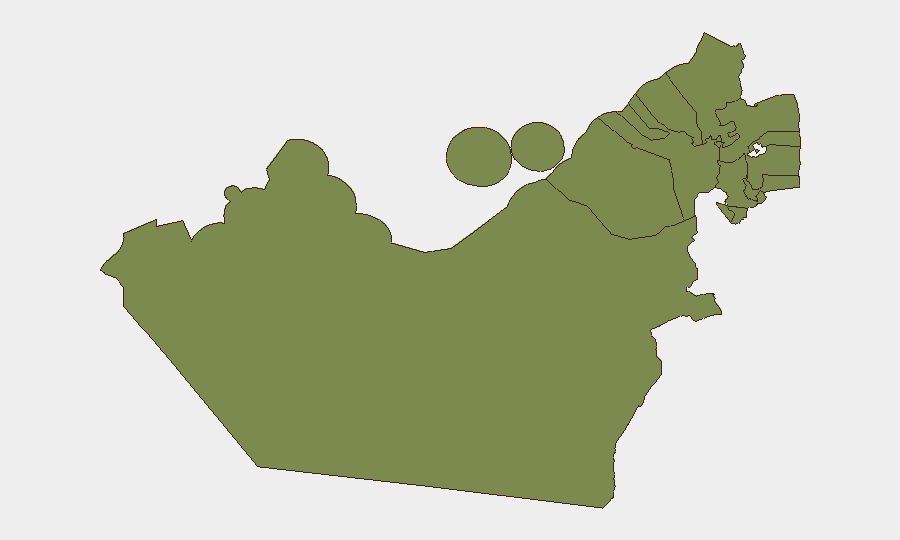
Situation Summary
The UAE faces an elevated security environment driven by regional Iranian-linked drone and missile activity, with six hostile drones intercepted over 48 hours and aerial-threat alerts issued and then stood down by authorities. The U.S. travel advisory maintains Level 3: Reconsider Travel status due to armed-conflict and terrorism threats, with non-emergency U.S. government staff ordered to depart. Dubai dominates the sub-national risk profile (31.5 composite score), while the wider emirates remain significantly lower-risk but subject to spillover effects from regional escalation.
Key Developments
- Nationwide – six drones intercepted in 48 hours (2026-06-02 to 2026-06-04): UAE air-defence systems engaged multiple hostile drones linked to Iranian missile and drone operations targeting civilian sites across the Emirates and neighboring states, reflecting direct asymmetric-attack capability.
- Nationwide – aerial-threat alert issued and cancelled (2026-06-02 to 2026-06-04): Ministry of Interior mobile alerts warned of possible aerial attacks; authorities subsequently stated the threat had ended and the situation was safe, indicating fluid tactical assessment and potential for rapid escalation/de-escalation cycles.
- UAE airspace – FAA NOTAM issued for Middle Eastern operations (2026-06-04): The U.S. Federal Aviation Administration advised U.S. carriers and operators to exercise caution in UAE and wider Middle Eastern airspace due to drone and missile activity linked to U.S.–Iran confrontation, affecting commercial-aviation routing and operational planning.
- Abu Dhabi – continued counter-terror-finance focus (2026-06-02): Foreign Minister chaired the 23rd meeting of the Higher Committee overseeing the National Strategy on Anti-Money Laundering, Countering the Financing of Terrorism and Countering Proliferation Financing, signaling sustained internal security emphasis on financial-crime and terror-finance vulnerabilities.
- Dubai – occupational-safety memorandum with UK institution (2026-06-02): Dubai Municipality signed cooperation agreement with Institution of Occupational Safety and Health to enhance workplace health, safety and wellbeing systems, pointing to tightening compliance standards and inspection regimes at commercial worksites and public venues.
- Nationwide – U.S. travel advisory maintains Level 3 (ongoing): U.S. government maintains non-emergency-staff departure orders and cites Iranian statements about targeting U.S.-affiliated locations in the UAE, indicating sustained official assessment of direct targeting risk to Western interests.
- Nationwide – Ebola preparedness messaging (2026-06-02): Ministry of Health and Prevention confirmed no Ebola cases in the UAE while emphasizing high-level preparedness, relevant for multimodal transport-hub monitoring and traveler-screening protocols.
Highest-Risk Areas
Dubai accounts for approximately 73% of the UAE's tracked composite risk score (31.5 of 42.5 total), driven by its status as the primary international business, financial, transport, and tourism hub. Abu Dhabi Emirate ranks second at 8.6, reflecting capital-region infrastructure and diplomatic importance. The remaining five emirates cluster below 2.0 each and carry primarily secondary or spillover risk. Risk concentration in Dubai reflects both higher asset density and likelihood of attack targeting—and consequent detection and reporting—relative to less-urbanized emirates.
How GeoBit Would Assist
Security teams would employ AOI Monitoring & Early Warning on Dubai and Abu Dhabi airports, port facilities, and major commercial clusters to detect incipient drone or missile activity with real-time alerting. Conflict & Military capability—including battle mapping and weapons-capability tracking—would support assessment of Iranian drone/missile range, payload, and likely target sets. Routing & Network Analysis would enable alternative-route and journey planning around high-risk airspace and identified threat corridors, supporting safe movement of personnel and assets.
7-Day Outlook
Regional escalation cycles are expected to remain volatile and short-notice, with further drone interdictions possible and travel advisories likely to remain at Level 3. Commercial aviation and ground transport should anticipate continued routing delays and security-screening intensity. No major de-escalation signals are evident; sustained vigilance and contingency-activation protocols remain warranted.
Highest-Risk Areas — Ranked
| # | State / Region | Risk |
|---|---|---|
| 1 | Dubai | 31.5 |
| 2 | Abu Dhabi Emirate | 8.6 |
| 3 | Sharjah Emirate | 2.9 |
| 4 | Ajman Emirate | 1.5 |
| 5 | Ras al-Khaimah | 1.5 |
| 6 | Fujairah Emirate | 1.5 |
| 7 | Umm al-Quwain | 1.5 |
Previous Daily Briefs
A new United Arab Emirates brief is written every day — each with its own risk map and downloadable CSV. Here's the last week; use the calendar to go further back.
📅 Browse every day by calendar →
Highlighted days have a brief. Tap a day for that day's map & analysis, or “csv” for that day's dataset ($5).