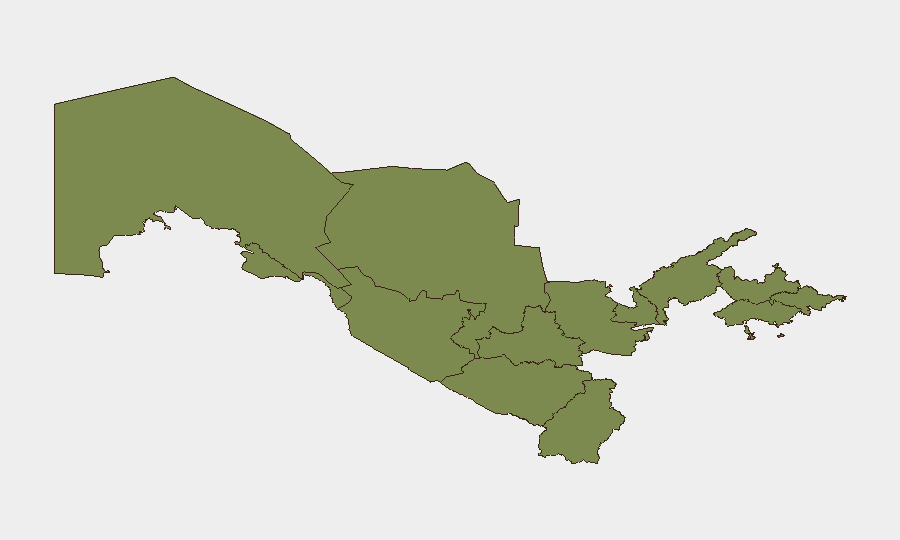
Situation Summary
Uzbekistan remains a low-threat environment globally (composite score 6), but sub-national risk is heavily concentrated in Navoiy Region and Tashkent, where ongoing government investigations, inter-agency disputes, and a violent protest incident on 9 June indicate domestic political strain. Four tracked events in the past 72 hours—spanning government, parliamentary, and bilateral tensions with Turkmenistan—suggest elevated internal friction rather than widespread civil unrest. Open-source verification of recent developments remains limited; genuine on-the-ground security incidents in the last 24–48 hours have not been independently corroborated in available feeds.
Key Developments
- 9 June, Tashkent / Navoiy Region: Government investigation announced (category: GOVERNMENT); details and scope remain unclear from available reporting. Status: Investigate.
- 9 June, Tashkent: Finance Ministry vs. Parliament dispute entered investigative phase, signaling internal executive-legislative tension. Status: Investigate.
- 9 June, location unspecified: Violent protest or riot involving a military/security captain reported; scale and cause not yet detailed. Status: Violent Protest/Riot.
- 9 June, Uzbekistan-Turkmenistan border/diplomatic channel: Bilateral investigation initiated; context suggests border or resource dispute. Status: Investigate.
- 8 June (×2): Public statements exchanged between Uzbekistan and Russia on unspecified matters; no escalation indicators present.
- Limited corroboration: Web research in the last 24 hours did not independently verify 6–10 recent domestic security developments; the most recent independently sourced item was a routine security screening of Uzbekistan's national football team in New York (6 June, non-threat context).
Highest-Risk Areas
Navoiy Region (score 31.3) and Tashkent (score 25.3) dominate the risk profile, together accounting for the vast majority of tracked threat signals. Navoiy's elevated score likely reflects industrial infrastructure sensitivity, border proximity, or resource-related tensions; Tashkent's reflects political activity, government density, and investigative action. All remaining regions score uniformly at 1.3, indicating either lower actual risk or lower reporting/monitoring density. Corporate teams with operations in Navoiy (notably energy, mining, or logistics sectors) and Tashkent (government-facing functions) should maintain heightened situational awareness.
How GeoBit Would Assist
Security teams should deploy AOI (Area of Interest) Monitoring & Early Warning on Navoiy Region and Tashkent to flag protest activity, law-enforcement movements, or infrastructure incidents in real time. OSINT fusion (X/Twitter, Telegram, local news, and sentiment analysis) would provide daily corroboration of government actions and inter-agency disputes, filling current reporting gaps. Risk & Threat Assessment modules can ingest the four tracked events and cross-reference them against entity networks (Finance Ministry, Parliament, security services) to predict escalation vectors and duty-of-care exposures.
7-Day Outlook
The investigation phase across government, finance-parliament relations, and Uzbekistan-Turkmenistan bilateral channels suggests internal friction is being managed through procedural channels rather than street-level escalation. If investigations conclude without public disputes or sanctions, risk should stabilize. Conversely, if investigative findings trigger political blame or resource disputes, Tashkent and Navoiy could see elevated rhetoric and minor protest activity through mid-June. Continued monitoring of parliamentary and ministry statements is warranted.
Highest-Risk Areas — Ranked
| # | State / Region | Risk |
|---|---|---|
| 1 | Navoiy Region | 31.3 |
| 2 | Tashkent | 25.3 |
| 3 | Qashqadaryo Region | 1.3 |
| 4 | Surxondaryo Region | 1.3 |
| 5 | Fergana Region | 1.3 |
| 6 | Republic of Karakalpakstan | 1.3 |
| 7 | Xorazm Region | 1.3 |
| 8 | Bukhara Region | 1.3 |
| 9 | Jizzakh Region | 1.3 |
| 10 | Tashkent Region | 1.3 |
| 11 | Namangan Region | 1.3 |
| 12 | Sirdaryo Region | 1.3 |
Sources
Previous Daily Briefs
A new Uzbekistan brief is written every day — each with its own risk map and downloadable CSV. Here's the last week; use the calendar to go further back.
📅 Browse every day by calendar →
Highlighted days have a brief. Tap a day for that day's map & analysis, or “csv” for that day's dataset ($5).