Situation Summary
Venezuela is experiencing acute political and security instability following a large-scale U.S. military operation that captured President Nicolás Maduro within the last 48 hours. Interim President Delcy Rodríguez has assumed leadership, and Venezuelan authorities have instituted elevated internal-security measures, including reinforced checkpoints, patrols, and infrastructure monitoring nationwide. The immediate threat environment is characterized by political uncertainty, heightened military presence, and localized civil unrest in central Caracas, though no sustained large-scale clashes have been confirmed by multiple sources to date. The trajectory remains volatile and contingent on political developments, the stance of the armed forces, and international pressure.
Key Developments
- Caracas (Distrito Capital), early June 2026 (within 48h): U.S. Delta Force raid on a fortified compound resulted in the capture of Nicolás Maduro; Venezuelan authorities reported at least 24 security officers killed during the operation.
- Caracas, early June 2026 (within 48h): Delcy Rodríguez sworn in as interim president; state media documented extensive National Guard and police deployments around government buildings and key infrastructure sites.
- Northern Venezuela (multiple locations), early June 2026 (within 48h): Airstrikes on air-defense and military infrastructure reported; localized damage and military lockdowns around certain bases with disruption to adjacent civilian areas.
- Caracas (Miraflores district and central plazas), early June 2026 (within 48h): Sporadic pro- and anti-government protests and assemblies documented under heavy security presence; authorities recorded dispersing crowds and restricting street access in multiple central neighborhoods.
- Venezuela nationwide, early June 2026 (within 48h): Venezuelan government reinforced patrols, checkpoints, and surveillance around airports, ports, and oil facilities in response to the intervention.
- Caracas & major cities, early June 2026 (within 48h): U.S. State Department Venezuela travel advisory remains at "Reconsider travel (Level 3)," with "Do Not Travel" designations for border regions and rural southern areas, reflecting ongoing crime, kidnapping, and terrorism risk.
Highest-Risk Areas
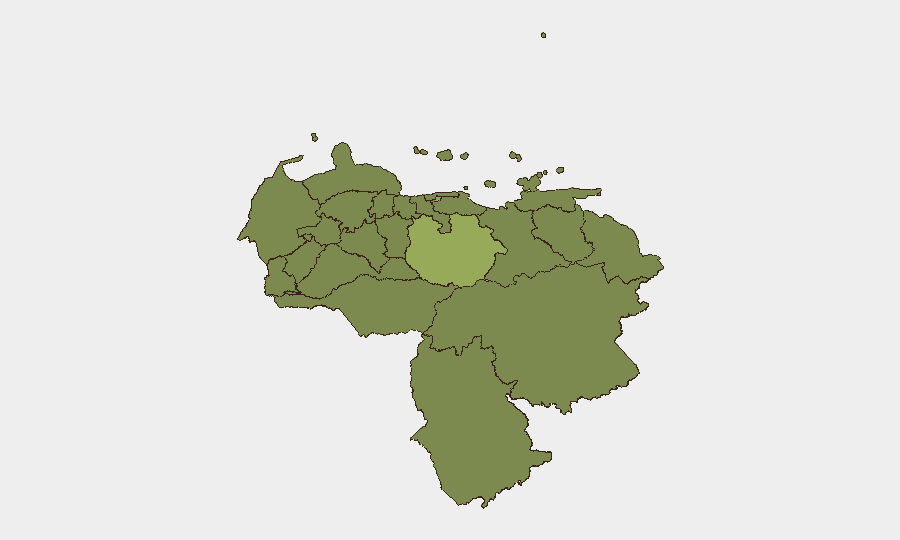
Guarico State (risk 55.4) and the Federal District/Caracas (risk 42.7) dominate the threat landscape, driven by the confluence of political instability, military presence, and historical criminal activity. Carabobo State (32.9) and Zulia State (28.6) represent secondary concentration zones, likely reflecting ongoing organized-crime networks and border-proximate vulnerabilities. The northern cluster—including Carabobo, Zulia, and Anzoategui—aligns with military infrastructure affected by airstrikes and with traditional drug-trafficking corridors; Guarico's elevated score reflects proximity to Caracas and rural banditry patterns. Border regions (Táchira, Apure, Amazonas) remain designated "Do Not Travel" zones due to Colombian militant activity and trafficking networks.
How GeoBit Would Assist
Security teams should deploy AOI (Area-of-Interest) Monitoring & Early Warning on Caracas (Miraflores, Distrito Capital), key ports, and oil facilities to detect checkpoint movements, protest assembly, and infrastructure disruption in real time. Network & Actor Analysis paired with OSINT fusion (X/Telegram, YouTube, radio SIGINT) will track emerging political factions, military command-structure shifts, and armed-group positioning to forecast secondary instability. Routing & Network Analysis enables alternative-route planning around checkpoints and reinforced zones for personnel and supply movements, while Conflict & Military mapping tracks military deployments and airbase status to assess strike risk and no-go zones.
7-Day Outlook
The next 72–168 hours will be critical for determining whether Rodríguez's interim government stabilizes or whether military factions or opposition forces challenge state authority. Secondary protest activity and sporadic clashes in Caracas are probable; cross-border activity from Colombia and organized-crime responses to power-vacuum dynamics should be monitored. Risk of further U.S. military action remains contingent on Venezuelan compliance; corporate assets in ports, oil zones, and central Caracas face heightened disruption risk.
Highest-Risk Areas — Ranked
| # | State / Region | Risk |
|---|---|---|
| 1 | Guarico State | 55.4 |
| 2 | Federal District | 42.7 |
| 3 | Carabobo State | 32.9 |
| 4 | Zulia State | 28.6 |
| 5 | Sucre State | 27.4 |
| 6 | Miranda State | 27.3 |
| 7 | Amazonas State | 27.3 |
| 8 | Anzoategui State | 26 |
| 9 | Tachira State | 26 |
| 10 | Monagas State | 25.9 |
| 11 | Bolivar State | 25.7 |
| 12 | Apure State | 25.6 |
Previous Daily Briefs
A new Venezuela brief is written every day — each with its own risk map and downloadable CSV. Here's the last week; use the calendar to go further back.
📅 Browse every day by calendar →
Highlighted days have a brief. Tap a day for that day's map & analysis, or “csv” for that day's dataset ($5).