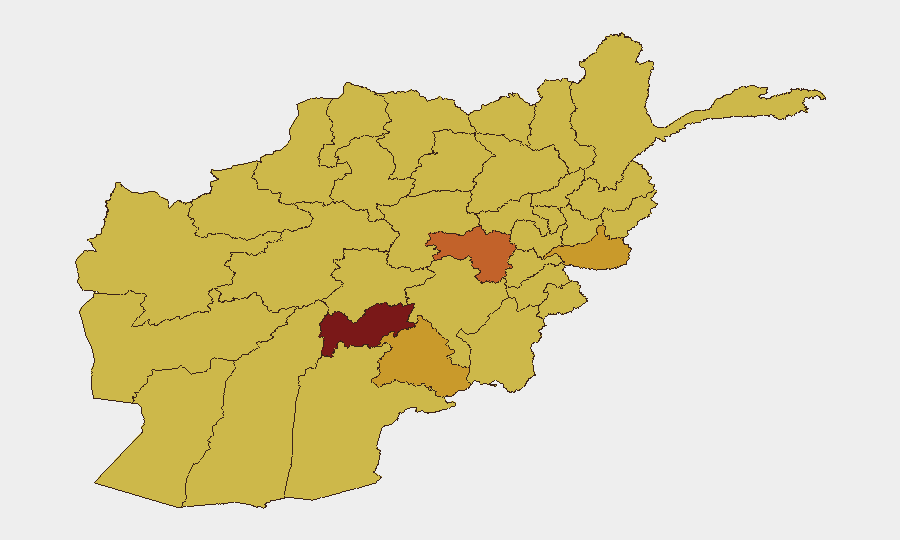
Situation Summary
Afghanistan remains a tier-1 global security concern (composite threat ranking #3), driven by persistent insurgency, terrorism, and transnational militant activity under Taliban rule. The country faces compounding pressures: cross-border Pakistan–Afghanistan tensions, forced Afghan returns from Iran creating humanitarian and social instability, and ongoing presence of ISIS-K, al-Qaeda, TTP, and other non-state armed groups. While Taliban territorial control is firm and consolidated, the repressive internal-security environment, arbitrary detention practices, and restricted freedom of movement create elevated duty-of-care risk for international personnel and assets, particularly in eastern and southern provinces.
Key Developments
- Nangarhar Province (eastern) – ISIS-K commander killed and buried in Achin district in recent targeted operation; indicates sustained counter-ISIS activity by Taliban forces and continued militant presence in traditional ISIS stronghold.
- Iran–Afghanistan border (national) – Over 700,000 Afghans forcibly deported by Iran in a single month; Kabul demanding coordination on returns. Creates acute humanitarian pressure, migration surges, and elevated crime/unrest risk in border reception areas.
- Afghanistan–Pakistan border (frontier provinces: Khost, Kunar, Paktia, Kandahar) – Unresolved TTP presence and Pakistani airstrikes in Afghan territory reported as "active conflict"; cross-border tension sustains elevated travel and security risk with potential for further escalation.
- Kabul (national capital) – UN Security Council divisions over Taliban engagement, human rights, and aid access reducing predictability of international response and aid delivery. 22 million Afghans require humanitarian assistance; restrictions hampering relief operations.
- Nationwide – ISIS-K, al-Qaeda, ETIM, TTP, and Baloch militants remain operationally active; sustained baseline terrorism threat to urban centers and infrastructure justifies continued high travel advisories.
- Afghan airspace (nationwide) – 96,000+ transit flights annually (≈270/day) despite weak international oversight and limited technical capacity; classified high-risk by many states for diversion or emergency-landing scenarios.
- Kabul and major urban centers – Taliban criminal procedures reinforcing discrimination, enabling violence against women/children, and restricting expression; arbitrary detention risks elevated for journalists, activists, and foreigners.
Highest-Risk Areas
Uruzgan Province (risk 100) remains the single highest-risk location, followed by a cluster of six provinces in the 70–75 range: Maidan Wardak (74.7), Nangarhar (72.2), Zabul (71.5), and Balkh (70.7). Kabul itself scores 70.6, indicating that the capital carries material risk despite Taliban consolidation. The concentration of high-risk provinces in the eastern corridor (Nangarhar, Zabul, Paktika) and southern belt (Uruzgan, Kandahar, Helmand) reflects persistent ISIS-K and Taliban-splinter activity, as well as proximity to Pakistan border tensions. Maidan Wardak's elevated rank reflects Taliban-internal instability and banditry. The inclusion of Kabul in the top tier underscores risks from targeted militant attacks, arbitrary state detention, and humanitarian collapse.
How GeoBit Would Assist
Security and risk teams should deploy AOI Monitoring & Early Warning on highest-risk provinces (Uruzgan, Nangarhar, Maidan Wardak) to track incident tempo and militant activity in near-real time. Network & Actor Analysis combined with multi-language OSINT (Telegram, local media, X) provides visibility into Taliban enforcement actions, ISIS-K cells, and cross-border militant movements affecting personnel safety. Routing & Network Analysis tools enable identification of safer travel corridors and alternative journeys; combined with conflict and border-crossing search, teams can adjust duty-of-care protocols and evacuation planning as conditions shift.
7-Day Outlook
Incident tempo is likely to remain elevated given active cross-border Pakistan–Afghanistan tensions, ongoing ISIS-K operations in the east, and Taliban consolidation of internal security (including arbitrary detention). The scale of Iranian deportations may spike localized unrest and irregular border-crossing activity in the next 5–7 days. No major de-escalation is anticipated; monitor for further Pakistani airstrikes and Taliban counter-ISIS operations as leading indicators of trajectory shift.
Highest-Risk Areas — Ranked
| # | State / Region | Risk |
|---|---|---|
| 1 | Uruzgan Province | 100 |
| 2 | Maidan Wardak Province | 74.7 |
| 3 | Nangarhar Province | 72.2 |
| 4 | Zabul Province | 71.5 |
| 5 | Balkh Province | 70.7 |
| 6 | Kabul Province | 70.6 |
| 7 | Helmand Province | 70.2 |
| 8 | Kandahar Province | 70 |
| 9 | Ghazni Province | 70 |
| 10 | Paktika Province | 70 |
| 11 | Farah Province | 70 |
| 12 | Nimruz Province | 70 |
Previous Daily Briefs
A new Afghanistan brief is written every day — each with its own risk map and downloadable CSV. Here's the last week; use the calendar to go further back.
📅 Browse every day by calendar →
Highlighted days have a brief. Tap a day for that day's map & analysis, or “csv” for that day's dataset ($5).