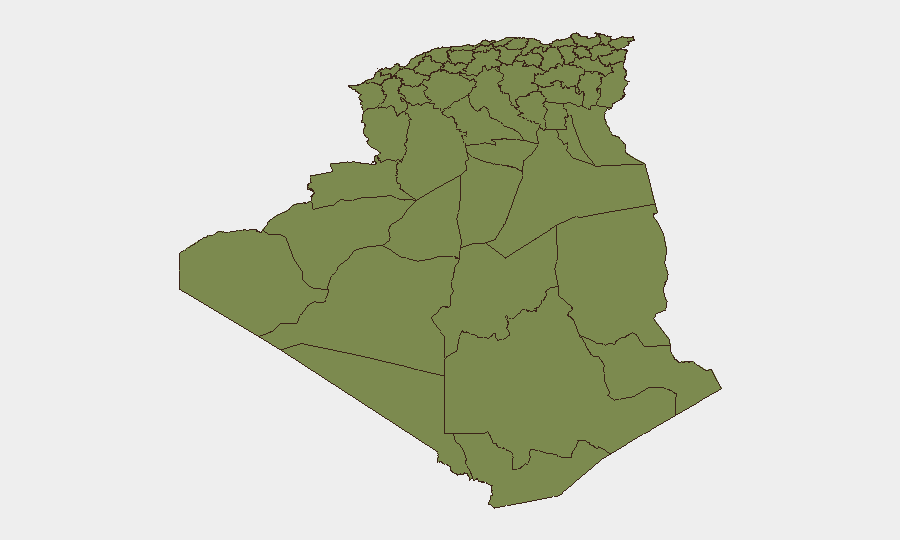
Situation Summary
Algeria maintains a composite threat score of 15 globally (rank #84), reflecting a low-to-moderate baseline security profile with concentrated geographic risk. No major security incidents, civil unrest, or attacks were documented in the last 24–48 hours across open-source news or social channels as of 30 June 2026. The security environment remains stable in most urban centers and northern regions, though terrorism-linked activity and logistical vulnerabilities persist in the southern Saharan zone, particularly around In Salah.
Key Developments
- No discrete security incidents reported in the last 24–48 hours. Open-source monitoring (news, social media, local reporting) shows no credible, time-stamped attacks, protests, or civil unrest events within this window as of 04:00 UTC, 30 June 2026.
- Baseline counterterrorism and border-security posture remains active. Algeria's armed forces continue routine anti-smuggling and counter-insurgency operations in Saharan regions, a pattern consistent with previous months but not reflected in a specific recent incident.
- Gender-based violence and shelter capacity remain systemic concerns (ongoing since prior reporting periods) in northern regions including Tipaza, Mostaghanem, and Annaba, though this reflects structural challenges rather than an acute incident.
- Arms and narcotics smuggling across southern borders continues as a background threat; no new smuggling interdiction or trafficking event was documented in the last 48 hours.
Highest-Risk Areas
In Salah dominates the risk ranking (31.8), driven by its proximity to ungoverned Saharan space, terrorist group activity in the broader Sahel, and logistical vulnerabilities. Algiers (20.6) reflects urban concentration of diplomatic and commercial targets, as well as historical protest activity, though current incidents are not evident. The remaining tracked regions (Bechar, Beni Abbes, Adrar, Bordj Badji Mokhtar, and others) carry baseline risk (1.8 each), indicating low current threat levels relative to the southern frontier zones. Risk in the north is primarily structural (economic strain, governance gaps) rather than active instability.
How GeoBit Would Assist
Security and duty-of-care teams operating in Algeria should employ AOI Monitoring & Early Warning (persistent watch on In Salah, Algiers, and southern border zones with alerting on activity spikes), Intel Sweep and multi-language OSINT (continuous monitoring of Arabic-language social media, Telegram, and local news for early signals of unrest or incidents), and Risk & Threat Assessment tools to track changes in the terrorism and smuggling landscape. Routing & Network Analysis can identify safe transit corridors and alternative movement paths in high-risk southern regions. Satellite and imagery analysis can support supply-chain and facility security in remote operational areas.
7-Day Outlook
No significant escalation is anticipated in the near term. Security conditions are expected to remain stable in northern urban zones (Algiers, coastal cities) with continued baseline counterterrorism pressure in the south. Teams should maintain standard vigilance posture and periodic reassessment of personnel movement in In Salah and border-adjacent areas, where seasonal cross-border activity and smuggling networks create persistent but not acute risk.
Highest-Risk Areas — Ranked
| # | State / Region | Risk |
|---|---|---|
| 1 | In Salah | 31.8 |
| 2 | Algiers | 20.6 |
| 3 | Bechar | 1.8 |
| 4 | Beni Abbes | 1.8 |
| 5 | Adrar | 1.8 |
| 6 | Bordj Badji Mokhtar | 1.8 |
| 7 | El Bayadh | 1.8 |
| 8 | Ghardaia | 1.8 |
| 9 | Saïda | 1.8 |
| 10 | Boumerdes | 1.8 |
| 11 | Tizi Ouzou | 1.8 |
| 12 | Chlef | 1.8 |
Sources
Previous Daily Briefs
A new Algeria brief is written every day — each with its own risk map and downloadable CSV. Here's the last week; use the calendar to go further back.
📅 Browse every day by calendar →
Highlighted days have a brief. Tap a day for that day's map & analysis, or “csv” for that day's dataset ($5).