Situation Summary
Azerbaijan maintains a low-to-moderate composite threat profile globally (rank #164, score 3), with 26 tracked events concentrated in a small number of high-risk urban and border zones. The most significant recent development is institutional: establishment of a National Cybersecurity Agency (14 June) to defend critical infrastructure and state digital services against reported Russian- and Iran-linked cyber threats. Current diplomatic engagement with Armenia (working-level security meeting, 14 June) represents an ongoing stabilization effort, though the broader regional security architecture—particularly border stability and cyber resilience—remains the primary risk vector for corporate operations.
Key Developments
- Baku — 2026-06-14: Azerbaijan's president signed a decree establishing a National Cybersecurity Agency, centralizing defense of critical information infrastructure, state digital services, data centers, and media space. This institutional move reflects heightened perceived cyber threat from state and non-state actors in the Russia–Iran sphere.
- Dilijan/Baku — 2026-06-14: Working-level security dialogue between Azerbaijan (Hikmat Hajiyev) and Armenia (Security Council Secretary Armen Grigoryan) held. Continuation of post-conflict stabilization talks signals ongoing diplomatic engagement, though implementation and durability remain contingent on border management and confidence-building.
- Recent event signals (12–15 June): OSINT feeds identify a cluster of public statements, demand/threat signals, and arrest/detention activity, concentrated around state actors and media organizations. Specifics remain unverified from second-source reporting; no major security incidents or mass-casualty events confirmed in independent coverage over the last 48 hours.
Highest-Risk Areas
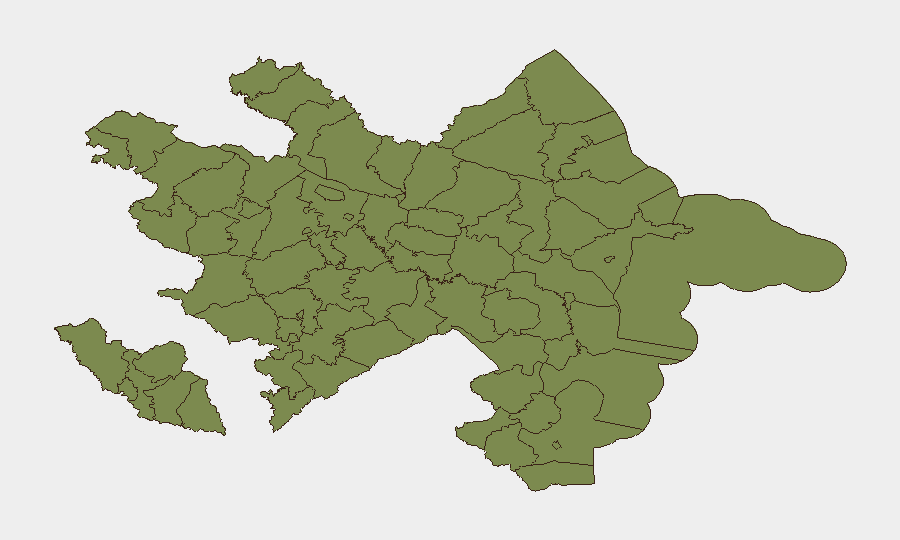
Baku City dominates the risk landscape (score 31.4), driven by concentration of state institutions, media, diplomatic presence, and historical political volatility. Ujar District (27.1) shows elevated risk—likely reflecting proximity to the Armenia border and post-conflict transition dynamics. All other tracked regions score 1.4, indicating either very low recent event density or limited exposure outside Baku and the Azerbaijan–Armenia borderland. For corporate duty-of-care purposes, Baku remains the primary operational risk area; border districts warrant situational awareness but do not currently present acute threat to civilian or commercial activity.
How GeoBit Would Assist
Security teams should deploy Intel Sweep and X/Twitter OSINT to monitor emerging statements and demands directed at state leadership and media, which recent signals suggest may escalate. AOI Monitoring & Early Warning on Baku's government, financial, and telecom sectors—paired with Cyber intelligence feeds—would provide real-time visibility into state-sponsored attack campaigns and institutional responses post-agency creation. Conflict & Regime-Stability search and Network & Actor Analysis can map the broader Armenia–Azerbaijan reconciliation trajectory and identify second-order risks (economic sanctions, diaspora activism, cyber retaliation) affecting operations.
7-Day Outlook
No major escalation is anticipated in the near term. Diplomatic engagement with Armenia and institutional cyber-defense buildout suggest Azerbaijan's security establishment is in managed-response mode rather than crisis. However, cyber incidents, political arrests, or border friction could spike within days; monitoring intensity should remain elevated on state media, security statements, and border-zone reporting.
Highest-Risk Areas — Ranked
| # | State / Region | Risk |
|---|---|---|
| 1 | Baku City | 31.4 |
| 2 | Ujar District | 27.1 |
| 3 | Sadarak District | 1.4 |
| 4 | Qazakh District | 1.4 |
| 5 | Sharur District | 1.4 |
| 6 | Yevlakh District | 1.4 |
| 7 | Kangarli District | 1.4 |
| 8 | Nakhchivan Autonomous Republic | 1.4 |
| 9 | Aghstafa District | 1.4 |
| 10 | Tovuz District | 1.4 |
| 11 | Qakh District | 1.4 |
| 12 | Shaki | 1.4 |
Sources
Previous Daily Briefs
A new Azerbaijan brief is written every day — each with its own risk map and downloadable CSV. Here's the last week; use the calendar to go further back.
📅 Browse every day by calendar →
Highlighted days have a brief. Tap a day for that day's map & analysis, or “csv” for that day's dataset ($5).